Chinese chipmaker CanSemi shares to open for public subscription, set to become ChiNext’s first wafer foundry if listed
If listed, company set to become first wafer foundry on ChiNext: analysts
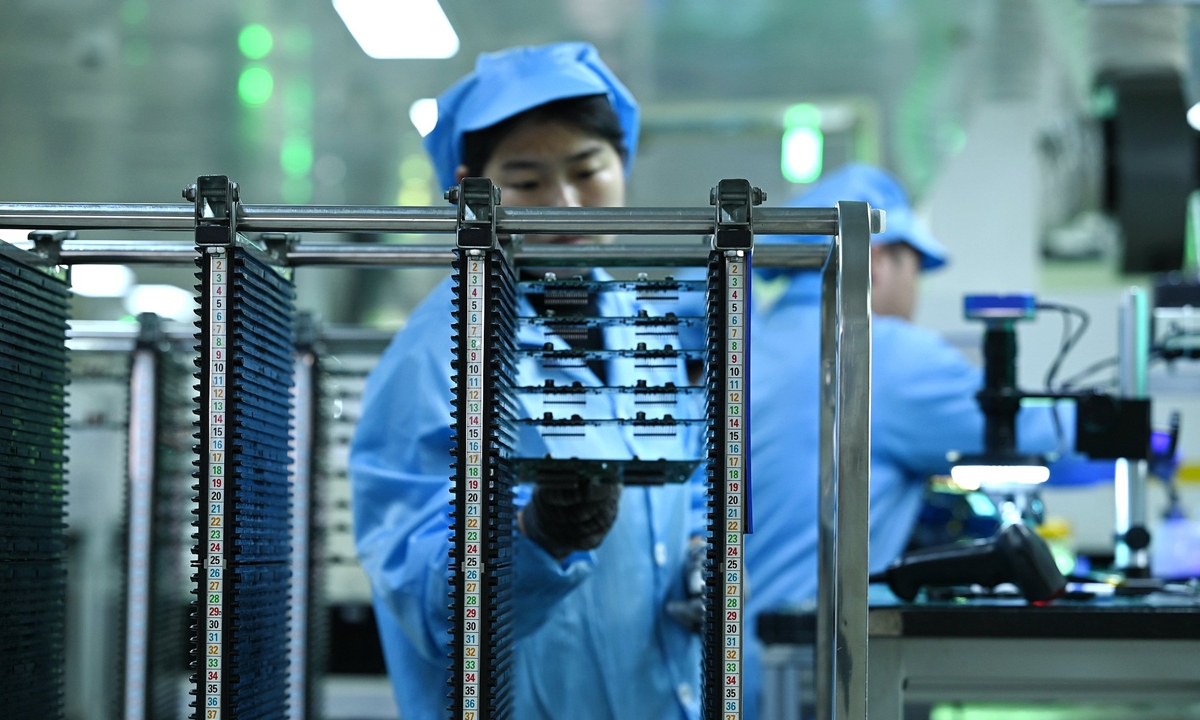
A technician conducts chip quality inspections in a factory in Yiwu, East China's Zhejiang Province, in March 2026. Photo: VCG
Chinese chipmaker CanSemi Technology, one of the Chinese manufacturers of 12-inch wafers to have achieved mass production, will begin its IPO subscription on Thursday as the company moves toward a listing on Shenzhen's ChiNext board. A Chinese analyst said that if the listing is completed, the company will become the first wafer manufacturer to be listed on the ChiNext board.
According to the offering announcement released on Tuesday, CanSemi has set the issue price at 12.01 yuan ($1.79) per share. The initial offering comprises 513 million shares, accounting for about 17.81 percent of the company's total share capital after the offering, before any exercise of the overallotment option.
The company, founded in 2017 in Guangzhou, South China's Guangdong Province, was reportedly the first 12-inch wafer manufacturer in the province to achieve mass production, and also the only firm in the Chinese mainland capable of large-scale production of 12-inch silicon-photonics wafers as of the end of April 2026, according to Frost & Sullivan data cited by the IPO prospectus.
The company plans to raise a total of 7.5 billion yuan through the IPO, with the proceeds earmarked for capacity expansion and technology R&D. This includes funds for a 12-inch analog-mixed signal specialty process production line project, which has a designed monthly capacity of 40,000 wafers and is aimed mainly at industrial- and automotive-grade applications, as well as a specialty-process technology-platform R&D project, according to the company's IPO prospectus. The total planned investment in the 12-inch production line project is 16.25 billion yuan, of which 3.5 billion yuan is to come from the IPO proceeds.
The company's IPO prospectus shows that it is still ramping up production capacity.
CanSemi currently operates two 12-inch wafer fabs, with a combined planned capacity of 80,000 wafers a month. By the end of 2025 the capacity had reached 63,300 wafers a month.
The Chinese company has also begun construction of another 12-inch production line project with a designed capacity of 40,000 wafers a month. Once the project is completed, CanSemi's total capacity will reach 120,000 wafers a month.
Wang Peng, an associate research fellow at the Beijing Academy of Social Sciences, told the Global Times on Wednesday that CanSemi's further advance in optoelectronic integration and automotive-grade chip development would underpin manufacturing in high-speed communications, artificial intelligence and automotive electronics, and strengthen self-reliance across the Chinese industry chain.
On the top line, CanSemi's revenue was 1.04 billion yuan in 2023, 1.68 billion yuan in 2024 and 2.58 billion yuan in 2025, translating to a compound annual growth rate of 57.3 percent. However, the Chinese chipmaker also recorded widening losses, with net losses of 1.92 billion yuan, 2.25 billion yuan and 2.35 billion yuan over the same period. CanSemi said in the prospectus that it could turn a profit as early as 2029.
CanSemi is seeking a listing as an unprofitable firm under the third set of ChiNext, which drop the profit test, and was reportedly among the first such cases to clear the listing committee after this year's board reform.
CanSemi's IPO adds to a string of Chinese chipmakers that have gone public this year — among them star DRAM maker Changxin Technology (CXMT) and AI-chip firm Enflame on the STAR Market, and analog-chip designer Zhanxin on ChiNext — with CanSemi set to become the growth board's first wafer foundry if the listing goes through.
Ma Jihua, a veteran tech industry analyst, told the Global Times on Wednesday that the wave of semiconductor listings shows Chinese capital is shifting from asset-light business with quick returns toward capital-intensive, long-cycle businesses. "Chinese investors are now clearly more willing to back semiconductor firms that are capital-intensive, unlikely to turn a profit soon, but have long-term growth potential," Ma said.
Xiang Ligang, a veteran telecommunications expert, told the Global Times on Wednesday that as global demand for chips has surged this year amid the AI boom, the series of listings will give these Chinese companies the capital they need to expand chip production capacity and advance their R&D efforts.
Analysts pointed out that wafer manufacturing is a capital-intensive business that requires heavy investment and involves long development cycles. Large capital expenditures at the early stage are therefore the industry norm, meaning that some semiconductor companies may operate at a loss for extended periods and face funding constraints.
"The successive listings of Chinese semiconductor manufacturers also underscored how capital market reforms are increasingly aligning with the financing needs of industrial development," Wang said, noting that the listings also provide a financing avenue for other domestic advanced manufacturers that are capital-intensive and still unprofitable.
RELATED ARTICLES