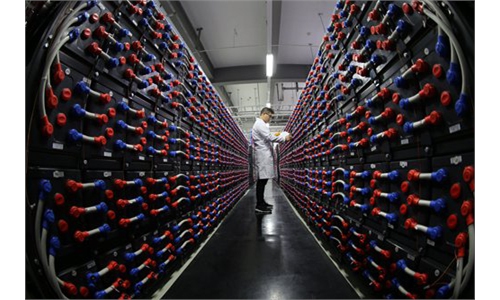
Data centers are pictured in Frankfurt, Germany, Wednesday, August 26, 2026. Photo: VCG
Chinese technology giant Alibaba on Wednesday unveiled plans to expand its data center network across Europe, the Middle East and Asia, stepping up its global artificial intelligence (AI) push, as Chinese cloud providers seek to win overseas customers and challenge established international rivals.
Alibaba Cloud announced at its annual Apsara Conference in Hangzhou, East China's Zhejiang Province, that it will establish its first cloud regions in Turkey, Finland and the Netherlands over the next 12 months, while expanding its data center footprint in Malaysia, Germany, the United Arab Emirates, and France.
The expansion forms part of Alibaba's broader AI infrastructure strategy. In a separate announcement on Tuesday, the company set a target of more than 20 gigawatts of global data center capacity by 2032. Bloomberg cited a Citigroup estimate that the target could support about $160 billion in external cloud revenue by fiscal 2033.
The expansion puts Alibaba in more direct competition with established cloud providers such as Amazon Web Services (AWS), which already operates data centers across Europe and the Middle East, as Chinese companies seek a larger share of the global AI computing services market.
Chen Jing, vice president and research fellow at the Society for the Study of Technological and Strategic Trends, told the Global Times on Wednesday that Chinese cloud providers are moving beyond primarily serving Chinese businesses overseas to competing for local enterprise customers and AI infrastructure contracts.
The shift is being driven by growing demand for AI training and inference, tighter data-sovereignty requirements and the need to secure computing and power resources, Chen said. Local infrastructure can also reduce latency and help companies meet data-storage requirements, he added.
Other Chinese technology companies are also stepping up investment and partnerships to tap growing demand for cloud computing and AI services, particularly in the Middle East and Southeast Asia.
Earlier this month, ByteDance's enterprise cloud arm, BytePlus, announced a partnership with Saudi telecom operator Mobily to establish its first public cloud region in the Middle East and Africa, using Mobily's existing data center infrastructure to provide localized cloud and AI services in Saudi Arabia, according to the Saudi Press Agency.
Tencent Cloud is also expanding its presence in Saudi Arabia, having signed a memorandum of understanding with local technology firm Nourah Information Technology Company on September 1 to explore cooperation in cloud computing, AI and data analytics.
Huawei Cloud is also expanding its international AI offerings. On September 18, the company unveiled its new AI Cluster Service (AICS), with overseas commercial availability scheduled for November 30. Its enterprise AI agent platform, AgentArts, is set to follow on December 30, according to Huawei.
Chen said overseas demand varies by region, with Europe focused on compliance and sovereign AI, the Middle East on large-scale AI projects, and Southeast Asia on cost-effective cloud services. These differing needs create opportunities for Chinese cloud providers to leverage their strengths in engineering delivery, cost control, full-stack integration and industry-specific solutions.
Chinese AI models are also seeing growing use on international AI platforms, providing another potential avenue for cloud providers to expand their overseas services. Chinese models recorded nearly 61.2 trillion tokens in usage on AI platform OpenRouter during the week of September 7-13, according to platform data cited by media reports.
Chen said overseas data centers could support the international adoption of Chinese open-source AI models, development tools and software services by bringing computing resources closer to customers.
RELATED ARTICLES