ARTS / CULTURE & LEISURE
GT interview with Wang Shun: 32-year-old swimmer closes fifth Asian Games with no regrets
No endpoint on swimming
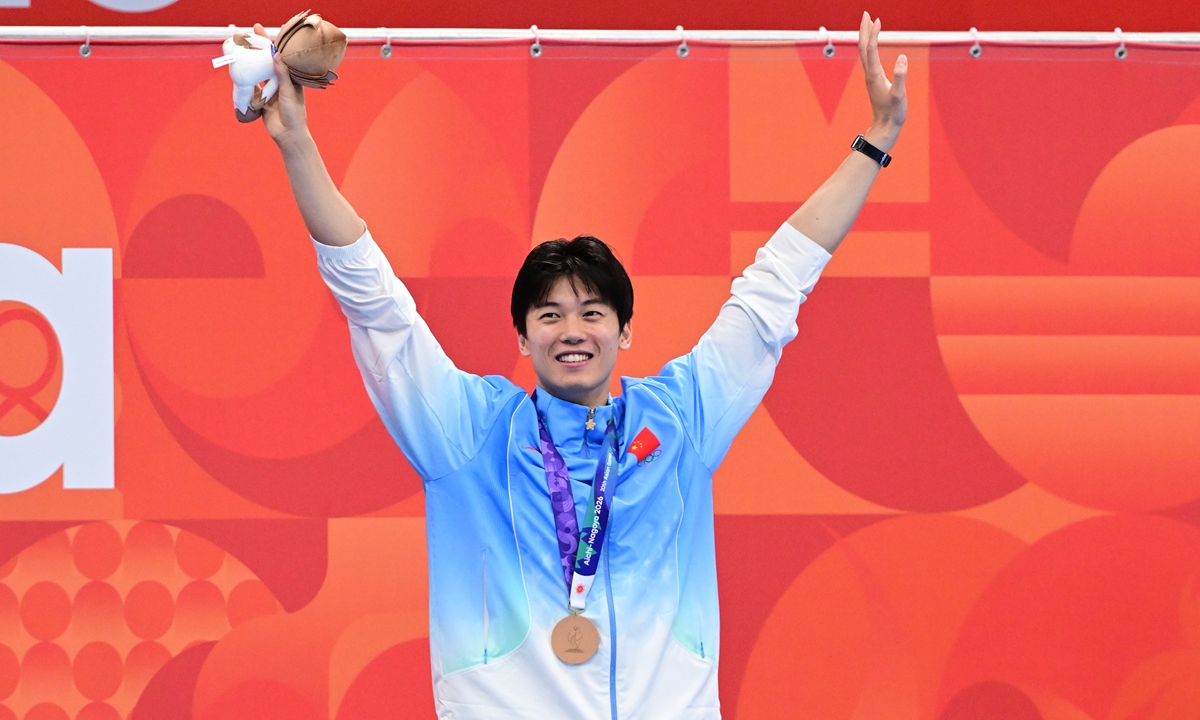
Wang Shun waves to spectators during the medal ceremony at the 20th Asian Games Aichi-Nagoya 2026 on September 22, 2026.
At 32, Wang Shun knows that the next breakthrough in his swimming career may not come from doing more of what he has already been doing for years, but from finding the remaining 5 percent that he has yet to explore.
"This is my fifth Asian Games journey, and it has come to a satisfying conclusion," Wang told the Global Times in an interview after finishing the swimming competition. "From my first one at 16 to now at 32, I have gone through 16 years of Asian Games."
Wang won bronze in the men's 200-meter individual medley with a time of 1:57.14 and another bronze in the 400m individual medley with 4:14.59. He also earned a gold medal as part of China's men's 4x200m freestyle relay squad after swimming in the heats.
The 200m individual medley result was a step down from his two previous Asian Games, where Wang won gold. At the Hangzhou Asian Games in 2023, he set an Asian record of 1:54.62. Yet Wang said he had no regrets about the outcome.
Before the 2026 Asian Games, he had hoped to bring his 200m individual medley time below the 1:56 mark.
"You cannot always predict the result. Even if you give 100 percent, you may go backward, or there may be all kinds of reasons why things don't turn out as you planned," Wang told the Global Times.
"What matters most is whether I gave my all and whether I treated it seriously. When I asked myself this after the competition, I realized I had no regrets."
The remaining 5 percent
That attitude does not mean that Wang has stopped looking for improvement. Now at an age when recovery takes longer and injuries can require more attention, he said the next breakthrough will have to come from somewhere different.
"Recovery has become slower now, but my experience has gradually increased," he said.
Wang estimates that more than 95 percent of the training methods and physical capabilities he has worked on over the years have already been developed to a high level.
"I may have to look for that remaining 5 percent and try to make breakthroughs there," he said.
"If I keep pushing on the previous 95 percent of training methods, the returns will become smaller. So I want to find things that can bring greater returns - training methods, approaches or aspects of the body that I have not yet explored."
It is an approach that also connects with Wang's academic work. He is pursuing a doctorate at Ningbo University, where his research examines the biomechanics of elite 200m individual medley swimmers using a marker-less motion-recognition and analysis system.
For Wang, studying the event is not simply an academic exercise. "The higher the level, the more my understanding and insights into training increase," he said.
He hopes to turn those experiences into knowledge that other swimmers can use when they encounter problems or plateaus.
"They can get some reference points, methods and ideas from it, which may help them break through," Wang said. "That is something about my current doctoral research that makes me very proud."
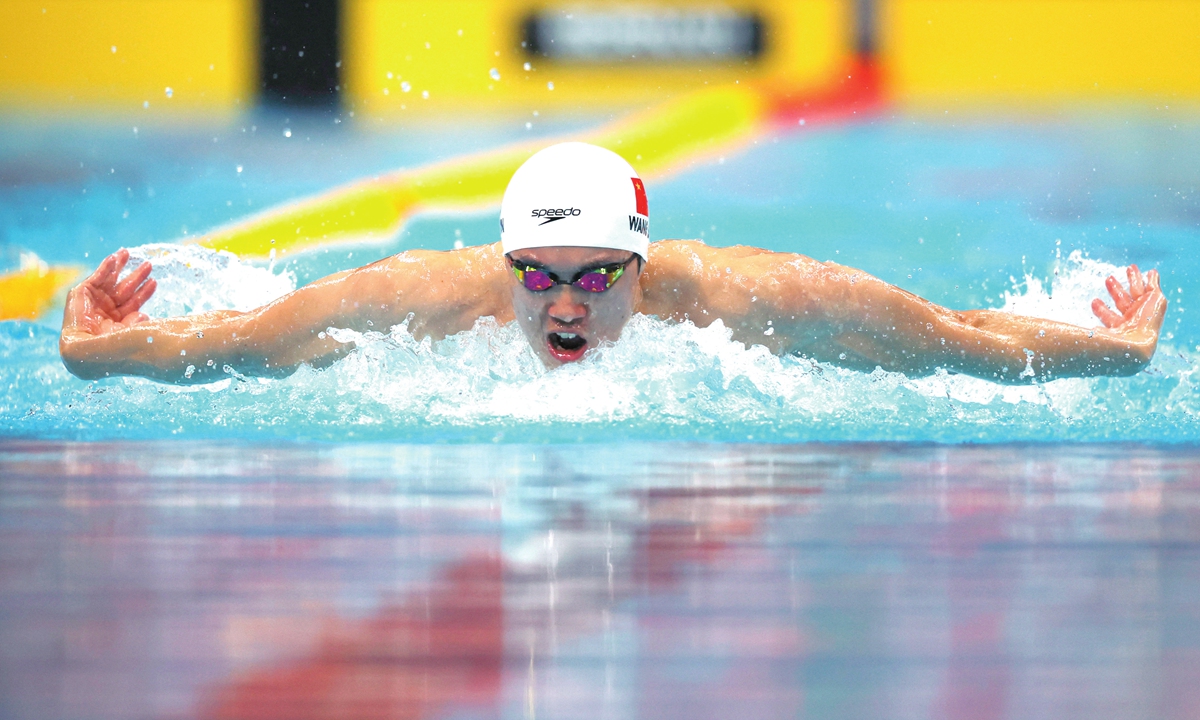
Wang Shun competes in the men's 200-meter individual medley heats at the 20th Asian Games Aichi-Nagoya 2026 in Tokyo, Japan, on September 20, 2026. Photos: IC Photo
Becoming 'elder brother'
Wang's five Asian Games have also marked a change in his role within the Chinese team. When he made his Asian Games debut in Guangzhou in 2010, he was a teenager being guided by older athletes.
"Back then, I was probably led by athletes older than me. I was somewhat confused and didn't understand the competition or my opponents as clearly as I do now," he said. "Now, I am more often taking young athletes with me to the Asian Games. That feels different."
Wang has also watched several generations of Japanese swimmers come and go during his career. Seeing former rivals such as Kosuke Hagino, who presented Wang a medal at an awarding ceremony, move into different stages of life has given Wang a sense of perspective.
For the Chinese veteran, competition and friendship can coexist.
"In sports, everyone gives their best and shows their ability," he said. "I think that is a way of respecting your opponents. Through sports, we can also communicate with each other and appreciate each other."
Learning to switch off
Wang has also become increasingly conscious of the psychological demands of a long sporting career. Years of repetitive and closed training, he said, require athletes to learn when to step away.
"No matter the time or place, athletes need to know how to relax and maintain balance. You cannot keep your nerves tense all the time," he said.
His own way of dealing with difficult periods is relatively simple: take a break, change his surroundings and do something he enjoys.
"You can go for a walk, change your environment, watch a movie or do something you like," he said. "That way, you can make yourself physically and mentally happier while remaining focused on training."
The same applies to social media, which Wang said young athletes cannot completely escape.
"The only thing you can really do is improve your ability to shield yourself," he said. "Athletes cannot control what people say on social media, but they can decide how much attention to give it."
Wang's fifth Asian Games may be over, but he is not ready to put a definitive endpoint on his swimming career.
Asked about the 2028 Los Angeles Olympics, he declined to set a specific target. "I still don't want to set limits. I'll just take it step by step," he said.
Wang added that even when he eventually leaves competitive swimming, he does not expect to leave the sport itself.
"I have been doing this for so many years and I still enjoy swimming," he said. "Whenever I leave the pool in the future, I think I will still do something related to it. I don't think I will leave swimming."
RELATED ARTICLES