China's deep‑sea drilling capacity hits 5,000‑meter level, becoming the world’s third to retrieve deep-ocean hard‑rock samples
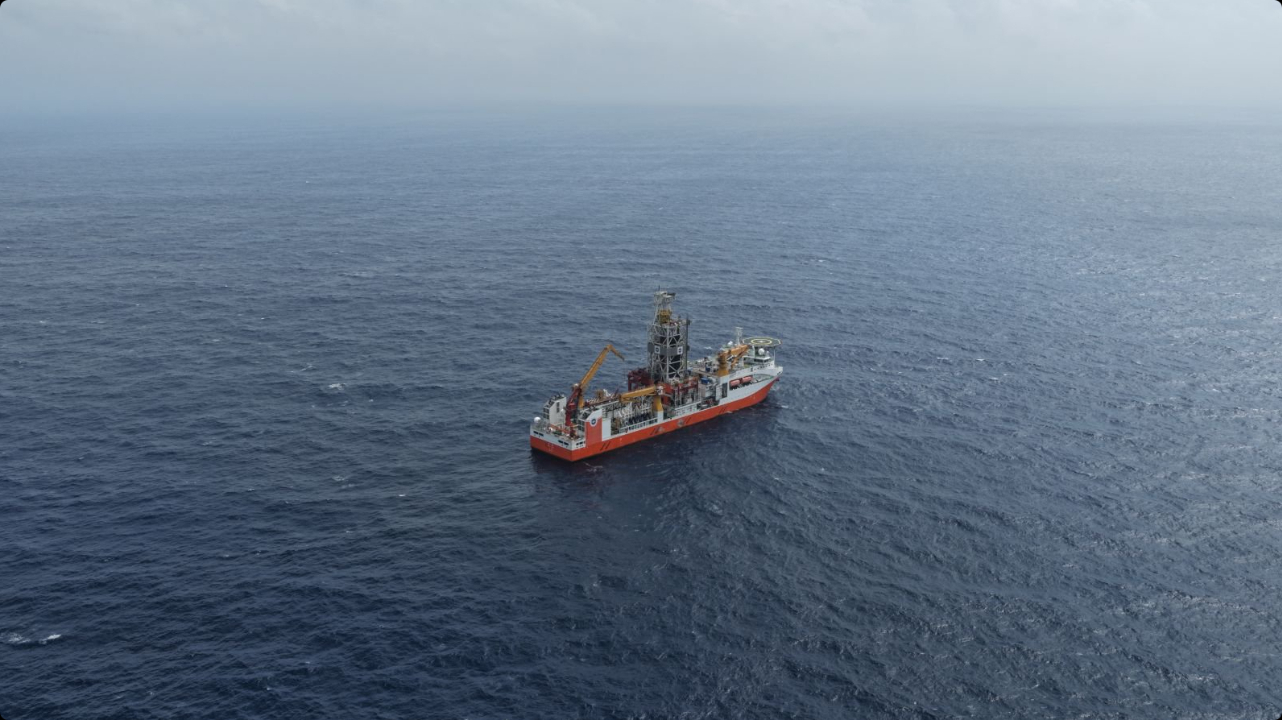
The Mengxiang (Dream) ocean drilling vessel Photo: Courtesy of China Geological Survey under the Ministry of Natural Resources
China's Mengxiang (Dream) ocean drilling vessel has set a national record in deep-sea drilling, elevating its capability to the 5,000-meter level, after obtaining basalt samples from the South China Sea basin, the Ministry of Natural Resources said on Monday.
China has now become the third country, after the US and Japan, to retrieve hard-rock samples from a deep-sea ocean basin using a drilling vessel. The vessel has recently returned to Guangzhou, South China’s Guangdong Province after completing a 30 day trial scientific drilling mission in the South China Sea.
During the voyage, the vessel achieved a maximum total depth of 4,929.17 meters and a maximum penetration of 864.77 meters, setting a new national record for China’s independently‑conducted drilling.
Using self‑developed rotary coring tools, the team recovered a 4.27‑meter‑long basalt core sample. This puts China, alongside US and Japan, as only the third nation worldwide to retrieve hard‑rock samples from deep‑ocean basins via a drilling vessel.
Meanwhile, a coring system matching International Ocean Discovery Program (IODP) standards has been established. Core‑recovery rates exceeded 100 percent in several operational runs, with coring efficiency, sample quality and operational stability meeting IODP’s advanced benchmarks.
The team also developed an innovative risk‑prevention and emergency‑response system for challenging ultra‑deep‑water well drilling.
For the first time, ship‑borne remotely operated vehicles (ROVs) performed long‑duration, high‑intensity coordinated operations. Two ROVs logged over 358 cumulative working hours at 4,000‑meter depth, with a single continuous mission lasting up to 103 hours - their performance has reached international advanced levels.
It also marks China’s full mastery of ultra‑deep‑water ocean scientific drilling workflows.
Also, for the first time, processing and analysis of core samples were completed following IODP standards, covering collection, documentation, description, sectioning, scanning, sampling, testing and archiving.
Large volumes of valuable rock cores and data were obtained from the cruise. These findings provide critical evidence for solving core scientific questions about seafloor spreading and may reshape scientific understanding of how the South China Sea formed and evolved. The discovery also carries great significance for studying the South China Sea’s paleo‑environmental evolution as well as ultra‑deep‑water energy exploration and development.
Global Times
RELATED ARTICLES