China’s deep‑sea drilling capacity hits 5,000‑meter level, obtaining basalt samples from the South China Sea basin
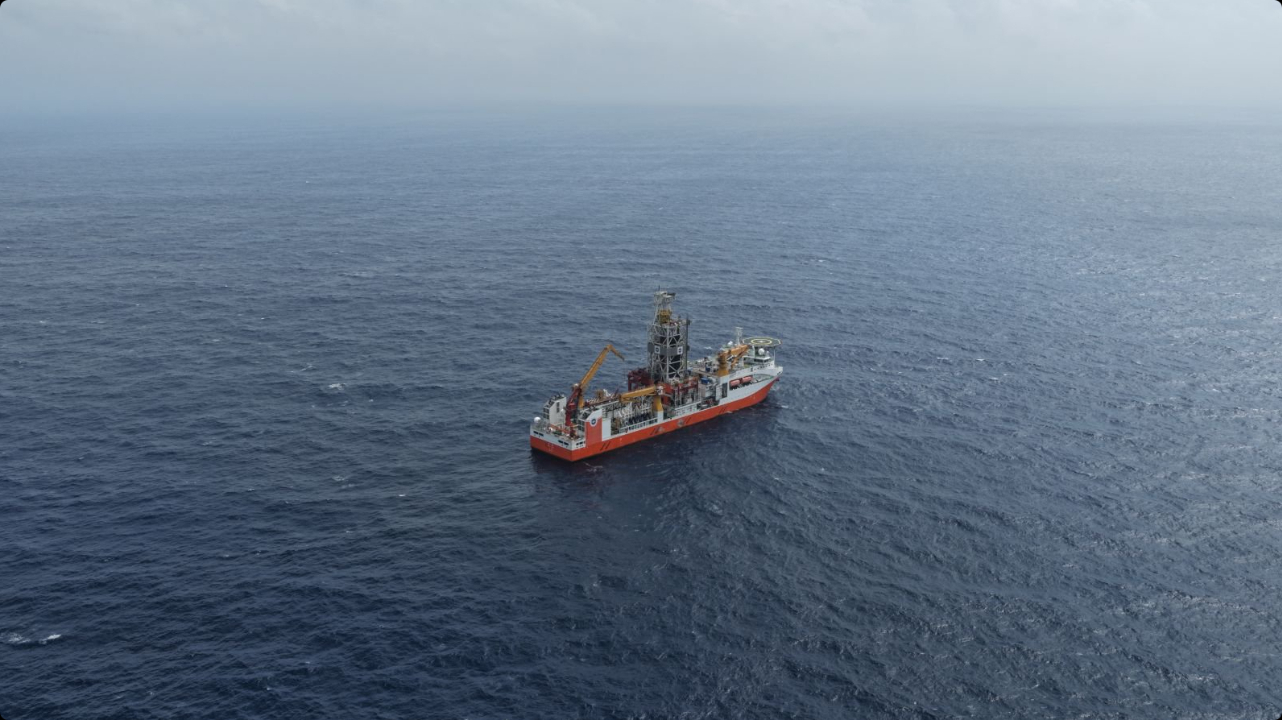
The Mengxiang (Dream) ocean drilling vessel Photo: Courtesy of China Geological Survey under the Ministry of Natural Resources
China's ocean drilling vessel Mengxiang, meaning "dream," has set a national record in deep-sea drilling, elevating its capability to the 5,000-meter level, after obtaining basalt samples from the South China Sea basin, the Ministry of Natural Resources (MNR) said on Monday, making the country the third in the world to retrieve hard-rock samples from a deep-sea ocean basin using a drilling vessel.According to the ministry, the vessel has recently returned to Guangzhou, capital of South China's Guangdong Province, after completing a 30-day trial scientific drilling mission in the South China Sea. During the voyage, the vessel achieved a maximum total depth of 4,929.17 meters and a maximum penetration of 864.77 meters, setting a new national record for China's independently‑conducted drilling.
A 4.27-meter basalt sample was extracted during the voyage via a self-developed drill, which made China the third country after the US and Japan to obtain hard rock samples from a deep ocean basin using drilling vessels.
"It is a great pride to successfully obtain hard-rock samples from a deep-sea ocean basin in the South China Sea," Sun Zhen, a researcher at the Guangzhou Marine Geological Survey (GMGS) in South China, told media.
Basalt found on the global ocean floor typically occurs in deep-water and ultra-deep-water zones at depths ranging from 1,000 to 7,000 meters. As the term "hard rock" implies, basalt is exceptionally tough; even drill bits capable of slicing through iron like butter find this material extremely challenging to tackle. Furthermore, the rock's inherent brittleness adds significant difficulty to drilling and core sampling operations, Sun said.
The research team conducted a long-term and high-intensity operation of shipborne remotely operated vehicles (ROVs), deploying two ROVs to operate for over 358 hours in total at a depth of 4,000 meters, with a single continuous operation lasting up to 103 hours, reaching internationally advanced levels, the scientist said.
Following the standards of the International Ocean Discovery Program for the first time, researchers also completed on-site multi-parameter processing and analysis of the samples, including cataloging, cutting, scanning, testing and storage, thereby mastering full-process operational capabilities for ultra-deep water ocean scientific drilling, Sun added.
The samples and data obtained during the voyage provide crucial empirical evidence for addressing core scientific issues such as the expansion of the South China Sea. They are also of great significance for studying the evolution of the ancient marine environment in the sea and for the exploration and development of ultra-deep water energy resources, researchers noted.
Building a strong maritime country
This trial drilling in the South China Sea serves merely as a prelude to the Mengxiang vessel's quest to unlock the secrets of the deep sea. This national strategic equipment will continue to explore the ocean depths, laying a solid foundation for building a strong maritime nation and developing deep-earth resources, while injecting substantial Chinese strength into the global endeavor of large-scale ocean science, experts said.
Mengxiang, China's first domestically-built ocean drilling vessel, was officially commissioned in 2024. With a drilling depth of 11,000 meters, the vessel features four drilling modes and three coring methods, and houses the world's largest and most comprehensive shipboard laboratory.
Its overall performance surpasses that of Japanese drilling-equipped research vessel Chikyu and the retired US vessel JOIDES Resolution, firmly establishing it as a global leader among ocean drilling ships and a key asset in China's drive to become a maritime and scientific-technological powerhouse, according to an article on the State-owned Assets Supervision and Administration Commission of the State Council (SASAC) website in February.
The Mengxiang is not merely a scientific research vessel, but a core piece of equipment underpinning China's efforts to build itself into a strong maritime and scientific and technological power, Cao Heping, a professor from Peking University, told the Global Times on Monday. "It also provides foundational technologies for China's broader national economic system and represents a landmark achievement reflecting the country's comprehensive industrial capabilities."
Mengxiang drives a marine heavy industry supply chain worth hundreds of billions of yuan and has spawned a series of entirely new industrial chains spanning sectors such as specialized marine-grade steel, deep-sea drill bits, precision instruments, and large-scale deep-sea equipment. Looking ahead, these capabilities can also be leveraged to export integrated equipment clusters - ranging from foundational components to high-end systems - to Belt and Road partner countries, Cao said.
Represented by Monday's breakthrough, China's marine economy has maintained rapid growth in recent years, shifting from a scale- and speed-driven model to one driven by quality and efficiency, and from resource dependence to innovation-driven development.
According to data released by the MNR, the size of China's marine economy reached 11.02 trillion yuan ($1.64 trillion) in 2025, growing by 5.5 percent on a yearly basis and contributing 7.9 percent to the growth of GDP last year. Meanwhile, traditional marine industries have maintained steady and relatively rapid growth, while emerging marine industries are continuously being cultivated and expanded. For instance, the value-added output of the marine engineering equipment manufacturing sector surged by 10.2 percent year-on-year last year.
Cao said the blueprint for the marine economy during the 15th Five-Year Plan period (2026-30), specifically developing marine energy resources and cultivating key industries such as deep-sea and offshore aquaculture, marine equipment manufacturing, and marine biomedicines means greater development opportunities for the country's maritime economy.
RELATED ARTICLES