ARTS / CULTURE & LEISURE
From chasing difficulty to finding stability:Gymnastics star Zhang Boheng finds a steadier path
Gymnastics star Zhang Boheng finds a steadier path
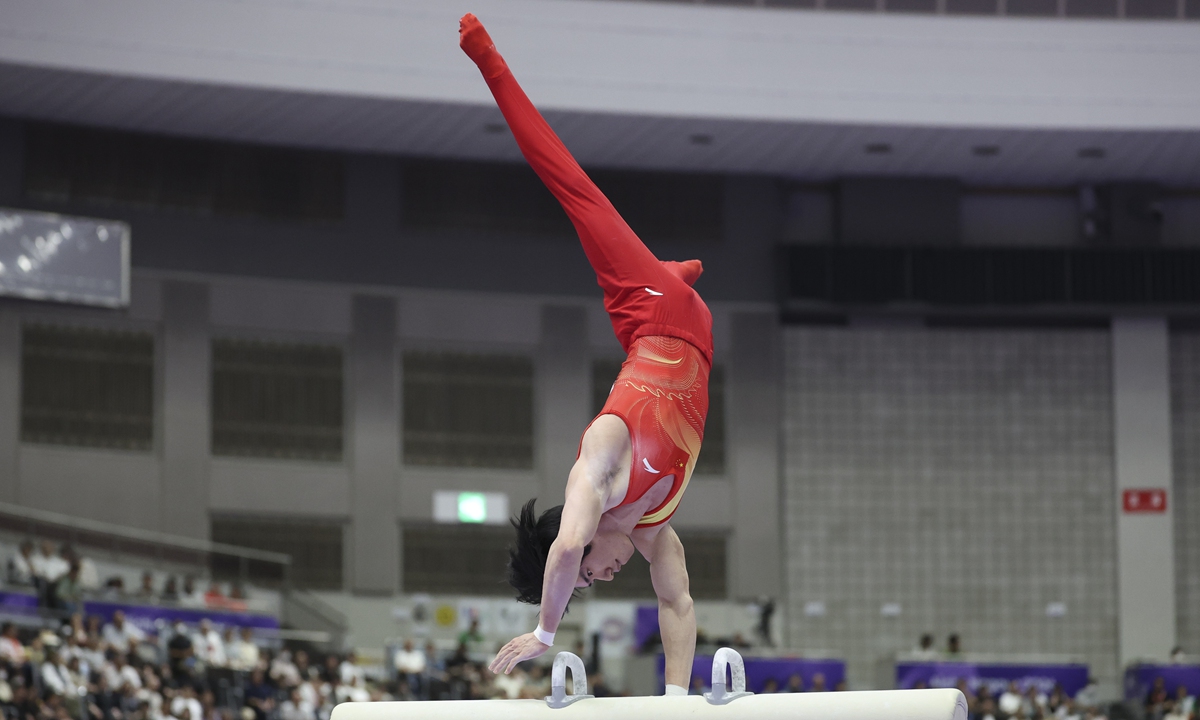
Zhang Boheng of China competes on the Pommel Horse during the Artistic Gymnastics Men's Team Final on day four of the 20th Asian Games Aichi-Nagoya at Nagoya City General Gymnasium Rainbow Hall on September 23, 2026 in Nagoya, Aichi, Japan. Photo: VCG
Two years after a narrow Olympic defeat to Japan left him with an Olympic silver medal and plenty to reflect on, China's gymnastics star Zhang Boheng found himself facing the same rival on another major stage.
This time, the result was different.
On September 23, at the Aichi-Nagoya Asian Games, Zhang helped China win the men's gymnastics team title, beating Japan 255.095 to 253.826 for a third consecutive Asian Games gold in the event.
The 26-year-old captain also successfully defended his individual all-around title two days earlier, finishing ahead of Japan's two Olympic champions Shinnosuke Oka and Daiki Hashimoto.
Yet Zhang did not describe the victory simply as redemption.
Asked by the Global Times what the team gold meant to him, he gave a succinct answer: "The belief in holding on." "The team competition is not about one person. This gold medal is the result of the efforts of the entire Chinese gymnastics team," Zhang told the Global Times.
That perspective reflects a change in the way Zhang approaches gymnastics.
The Paris Olympics had left China with a narrow defeat, but the team did not simply move on from it. Zhang said the Chinese team conducted a systematic review after the Games, examining problems in technique, tactics and competition mentality before beginning the next Olympic cycle.
"When I look at myself in the past, I have changed a lot," Zhang said. "Take the previous Asian Games in Hangzhou. At that time, I was focused on breaking through, trying to pursue the highest difficulty and the highest score."
"Now I pay more attention to stability. I have realized that in an all-around competition, it is not simply about how high the score is on each apparatus. The key is to maintain a stable state and complete all six events."
That change was visible in Nagoya.
Zhang won the men's individual all-around title with 85.065 points, successfully defending the Asian Games title he won in Hangzhou. He finished ahead of Japan's Paris Olympic champion Shinnosuke Oka and Tokyo Olympic champion Daiki Hashimoto.
The result was particularly significant because both Japanese gymnasts were competing on home soil, while Zhang was dealing with an injury. The competition also demonstrated another aspect of his evolving approach. Rather than treating every routine as an opportunity to maximize difficulty, Zhang increasingly considers the situation as a whole and adjusts his decisions accordingly.
"Thinking accounts for 70 or 80 percent of my competition," he said. "Now when I make a decision, I no longer completely follow my body's instinctive reaction. I first clarify the goal, evaluate all the factors, and then take action."
For Zhang, that ability to think through a competition is also connected to his changing understanding of the rivalry between China and Japan.
The two countries have been among the leading forces in men's artistic gymnastics for years, and their rivalry has been particularly prominent during Zhang's career.
Zhang won the world all-around title in 2021 in Kitakyushu, Japan, while he later finished second behind Oka in the individual all-around at the Paris Olympics.
Rather than seeing the rivalry only through the results, Zhang said that he believes the competition itself can benefit the sport.
"I think this is healthy competition," he said. "It can push world gymnastics forward and take the sport to a whole new level. Fierce competition will also make more people pay attention to gymnastics and see more exciting contests."
Zhang said Japan has strengths in technical areas, while China has spent the current Olympic cycle working on its own weaknesses. "From the performance in this team competition, we can see that we have made significant progress," he said. "I believe that in the two years remaining before the Los Angeles Olympics, we will make even greater progress and be more composed on the Olympic stage."
The Los Angeles Olympics are now the next major target, but Zhang's vision of the future is not defined only by another medal.
Asked what he hopes the Zhang of two years from now will be like, the answer was simple. "I hope that two years from now, that Zhang will be more stable, will not lose his courage, and will always keep his love for gymnastics," Zhang said.
RELATED ARTICLES