Exclusive: China to respond with strong policy toolbox if EU presses ahead with European equivalent of Section 301: observer
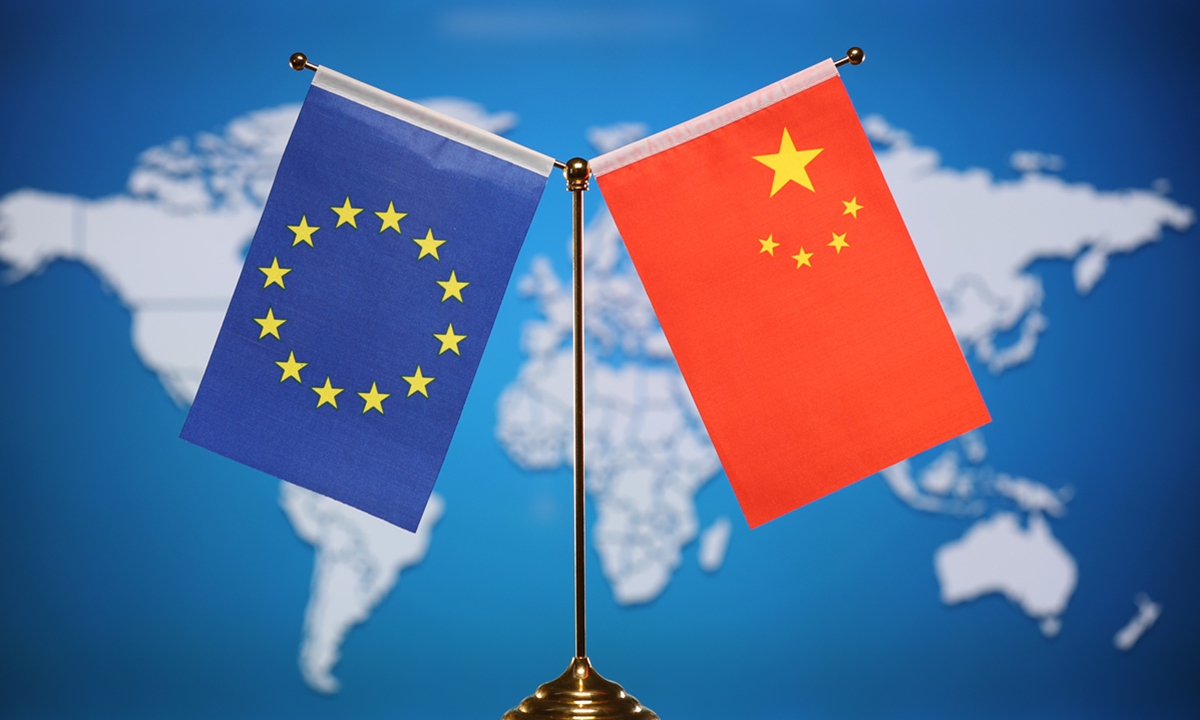
China EU Photo:VCG
China on Tuesday vowed to respond resolutely to safeguard the legitimate rights and interests of Chinese industries if the EU insists on introducing discriminatory restrictions against Chinese companies or products, after media reports that some EU member states are drafting a joint document calling on the European Commission to accelerate the development of a European version of the US "Section 301" tool and take tougher measures against China.
China and the EU are currently maintaining dialogue under their trade and investment consultation mechanism and exploring ways to address each other's concerns. If the EU engages in dialogue and consultations with China while at the same time stepping up pressure against China, it will seriously undermine mutual trust, disrupt the overall consultation process and affect broader China EU economic and trade cooperation, a spokesperson of China's Ministry of Commerce (MOFCOM) said on Tuesday.
A Chinese observer told the Global Times on Tuesday that if the EU presses ahead with protectionist measures targeting China, China will respond with a strong policy toolbox. Potential countermeasures could include anti-discrimination investigations, industrial and supply chain security investigations, investigations into the impact of foreign subsidies and so on, the observer said.
Germany and France are reportedly finalizing a joint paper which will call on the European Commission (EC) to fast-track development of an instrument that gives Brussels new powers to shut China out of the EU market, EU China analyst Noah Barkin wrote, citing European officials.
The European officials expect the paper to receive a green light from France’s Emmanuel Macron and Germany’s Friedrich Merz in the coming days and then be sent to European Commission President Ursula von der Leyen, according to Barkin. One official claimed the technicalities of how to construct the instrument, which could mirror US Section 301 tariff authorities, would be left to the EC.
In response to the reported move, the spokesperson for the MOFCOM said on Tuesday that the tool mentioned in the reports is a typical protectionist and unilateral measure. The move will not help solve problems, but will instead backfire on the EU itself and disrupt China EU trade as well as the stability of global industrial and supply chains. The EU itself has also been a victim of such tools. One should not impose on others what one does not desire for oneself, the spokesperson said.
As an important member of the WTO, the EU has consistently portrayed itself as a defender of multilateralism. If it fails to lead by example and instead takes the lead in violating WTO rules, it will seriously undermine the rules based multilateral trading system, the MOFCOM spokesperson said.
Potential shift
This reported move by Germany and France signals a shift toward “more concerted and aggressive” EU trade protectionism against China, as the bloc’s two largest economies seek to align their positions, with new trade tools expected to focus largely on China despite not being explicitly China specific, a Chinese expert said, calling out the EU for its double standard.
“The EU itself has been a target of US Section 301 probes and related unilateral trade measures, and has repeatedly criticized unilateralism and protectionism. Yet it is now considering similar tools to exert pressure on other trading partners. Such a policy shift warrants concern,” Shi Xiaoli, director of the WTO Law Research Center at the China University of Political Science and Law, told the Global Times on Tuesday.
If these tools are in practice primarily directed at specific countries or products from particular sources, questions could also arise over their consistency with the principle of nondiscrimination and WTO rules, Shi said, while highlighting China’s ability to safeguard its legitimate rights and interests through various means.
"China has sufficient tools to respond if the EU continues to expand unilateral trade restrictions. The EU should carefully consider the costs of further escalating trade frictions," Shi warned.
The reported move does not come in isolation. Over the past month, the EU has sent increasingly tough signals on trade with China and market access. On September 16, von der Leyen cited the China EU trade imbalance and what she called a "second China shock" in her state of the Union address, claiming the bloc would use all tools at its disposal to "rebalance" its relationship with China.
Earlier in September, the European Commission also proposed a new Public Procurement Act introducing "European preference" criteria. The provisions could exclude or restrict third-country companies, with media reports suggesting that it was "a move that clearly targets Chinese companies."
"China and the EU have developed deeply integrated industrial and supply chains over the years. These ties are not simply a matter of one side depending on the other, but the result of long-term market choices and the international division of labor," Zhou Mi, a senior research fellow at the Chinese Academy of International Trade and Economic Cooperation, told the Global Times on Tuesday.
Against this backdrop, erecting new trade barriers would not simply bring relevant industries and production capacity back to Europe, said Zhou.
Commenting on the latest reported moves by France and Germany, Zhou said that the two countries, despite being the EU's two largest economies, cannot speak for Europe as a whole. "The interests and priorities of European countries and businesses are far from identical. Many companies across Europe, including French and German companies themselves, want closer ties with China and greater access to opportunities in the Chinese market," said Zhou.
Call for dialogue
Despite growing trade frictions, China has maintained economic and trade communication with both the EU and its member states in recent weeks. On September 17, Chinese Commerce Minister Wang Wentao held a video call with European Commissioner for Trade and Economic Security Maros Šefčovič at the latter's request to discuss China EU economic and trade issues.
On September 21, Wang said during a meeting with Hildegard Müller, president of the German Association of the Automotive Industry, that China is not the source of the economic and trade challenges facing the EU, but a partner in addressing them. China does not want to see the EU turn to protectionism, restrict or close its market, which could ultimately lead to markets shutting each other out globally, Wang said.
Müller said China is not only an important sales market for the German auto industry, but also a key partner in production and innovation, adding that strengthening its own competitiveness is the way for the German auto industry to overcome its current challenges.
On Monday, Wang held a video call with German Federal Minister for Economic Affairs and Energy Katherina Reiche, with the two sides exchanging views on China Germany and China EU economic and trade relations.
"What China-EU economic and trade relations need now is to manage differences rather than create new ones," said Zhou, noting that if the two sides maintain dialogue while the bloc continues to introduce new unilateral restrictive measures, it will not only reduce the room for talks to produce concrete results, but also increase uncertainty for businesses over the future policy environment.
