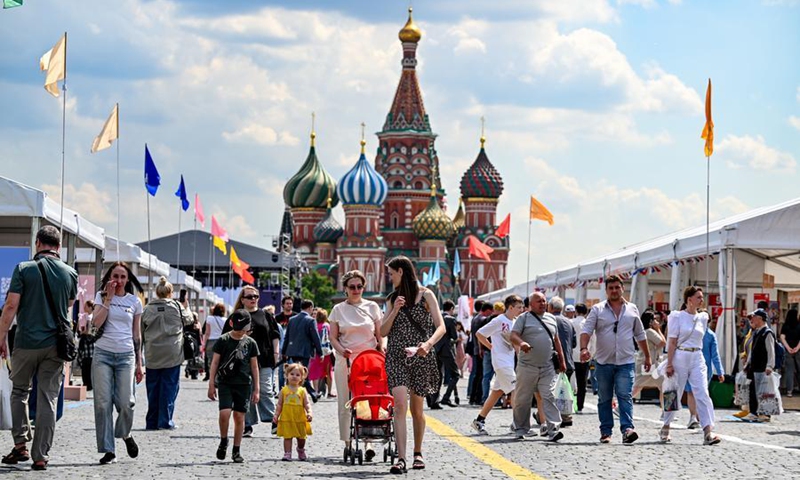
People visit the 12th Red Square Book Festival in Moscow, Russia, on June 4, 2026. (Xinhua/Feng Kaihua)
During China's week-long National Day holiday this year, Chinese tourists are frequently seen on the streets of Moscow. "Russia is a unique country and a must-visit," said Wang Xinzuo, who visited several Russian cities and described his trip as smooth and enjoyable.
In the first half of 2026, Chinese tourists accounted for over 50 percent of all inbound tourist trips to Russia.
"We are witnessing a substantial rise in travel volumes. In 2025, the number of mutual tourist visits exceeded 3 million. According to our data, 154,200 Chinese tourists visited Russia in the first quarter alone this year, marking a 44 percent increase year on year," Chinese Ambassador to Russia Zhang Hanhui said before the holiday.
Russia is preparing for further growth. In early September, Russian Deputy Prime Minister Dmitry Chernyshenko said the country aims to accommodate more than 5.5 million Chinese tourists by 2030.
Behind the figures lies an industry adapting to a new generation of Chinese travelers.
MOSCOW: FROM GROUP TO INDEPENDENT TRAVEL
Moscow remains the main gateway for Chinese tourists. According to the Border Service of the Russian Federation, 240,000 Chinese tourists visited Moscow in the first half of 2026, up 7 percent year on year.
But the profile of visitors is changing. Guided group tours are becoming less dominant as younger and more independent Chinese travelers arrive.
More than 80 percent of travelers from China come to Moscow independently, including for business, according to Bulat Nurmukhanov, deputy chairman of the Moscow Tourism Committee.
In response, a China Friendly certification program is expanding in Moscow, covering services such as Chinese-language information, adapted menus and trained staff.
The Cosmos Hotel Group told Xinhua that two of its four- and five-star hotels in Moscow have received the certification, with more properties planned to join the program.
Moscow has also strengthened its promotion in China through Chinese-language tourism services, social media and cooperation with Chinese travel platforms, while highlighting its cultural heritage and modern attractions.
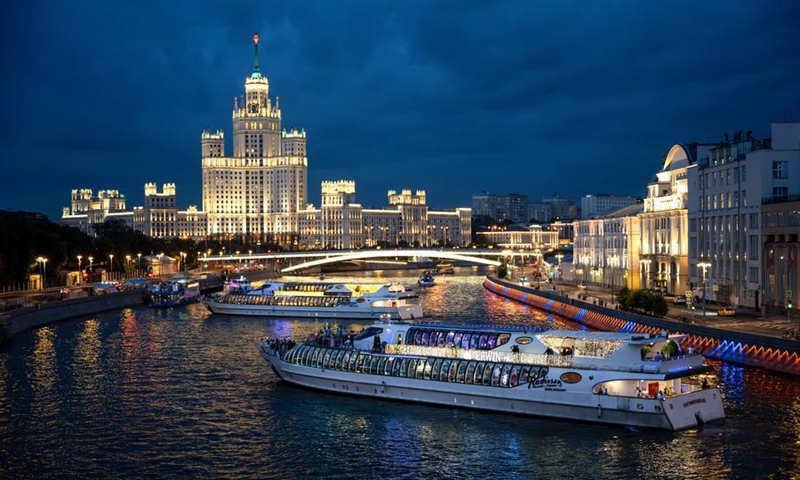
Tourist boats travel on the Moskva River in Moscow, Russia, July 11, 2026. (Xinhua/Feng Kaihua)
REGIONS SEEK NEW OPPORTUNITIES
Beyond Moscow, Russian regions are increasingly competing for Chinese tourists.
In St. Petersburg, the number of Chinese tourists has risen by nearly 60 percent since 2021, according to Nana Gvichiya, deputy chair of the city's Tourism Development Committee. Chinese visitors are showing a growing interest not only in historical sites but also in local cuisine and creative spaces.
In the Altai region, the number of Chinese tourists increased 1.5 times in 2025 from the previous year, exceeding 6,000 for the first time, said Alexander Baryshnikov, head of the regional Department for Tourism and Resort Development.
Although the region receives fewer Chinese visitors than Moscow and St. Petersburg partly because of a lack of direct flights, local businesses are improving services and developing China-friendly tourism products. Several hotels and resorts have received China Friendly certification, while tour operators have developed specialized routes and promoted them through international exhibitions and Chinese social media.
In Russia's Far East, the Amur region has recorded a 60 percent increase in Chinese tourists since the introduction of the visa-free policy between China and Russia in 2025, Governor Vasily Orlov said. The region plans more than 200 joint events with China in 2026.
A planned cross-border cable car linking Blagoveshchensk and Heihe is also expected to boost tourism. Once completed, the journey between the two countries will take just over two minutes, with an annual capacity of 2.5 million passengers.
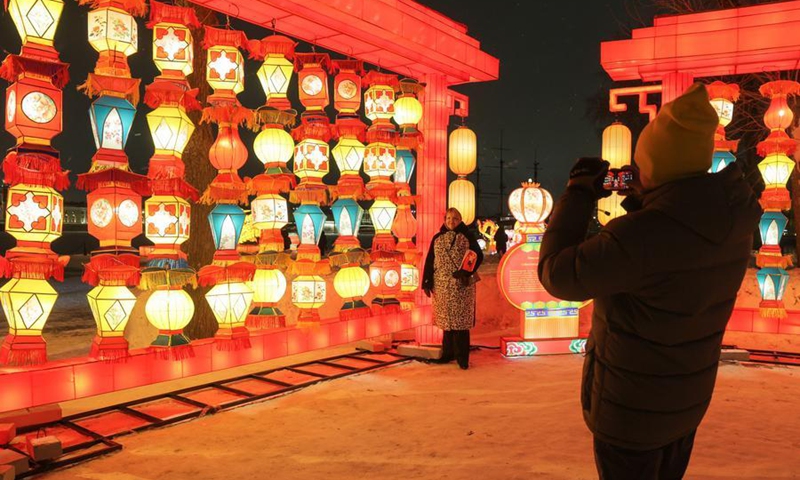
A tourist takes photos of lanterns in St. Petersburg, Russia, Feb. 15, 2026. (Photo by Irina Motina/Xinhua)
ADAPTING SERVICES
The rapid growth has also exposed gaps in Russia's tourism infrastructure. Experts and tourists cite language barriers, difficulties with digital payments and a shortage of qualified staff, particularly outside major tourist destinations.
"Special attention should be paid to the training of professional guides for Chinese groups in Russia," said Anastasia Pavlova, an expert on cultural and tourism cooperation at the Russian State University for the Humanities.
Ilya Umansky, president of the Russian Union of Tourism Industry, stressed the need for closer cooperation between the two sides in the tourism sector.
"Today we find ourselves in a unique state of revival of our mutual tourist exchanges," Umansky said. "I am confident that we have a great future."
