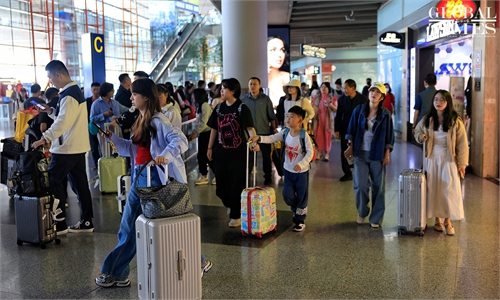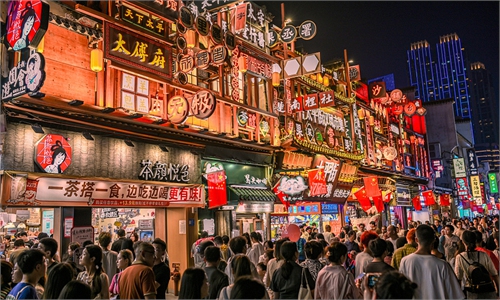
Shanghai railway sees return-travel peak on final day of National Day holiday Photo: Lu Ting/Global Times
"When Chinese people go on holidays, the whole world knows about it." During the 2026 National Day holidays from October 1 to 7, Chinese tourists were seen at famous landmarks around the globe - from the Colosseum in Rome and Yellowstone National Park in the US to the snow-capped mountains of Switzerland and the beaches of the Aegean Sea, sparking lively discussion online.
Official data backs this up.
China recorded 15.462 million inbound and outbound trips by Chinese and foreign travelers during this year's seven-day National Day holidays, averaging 2.209 million per day, up 6.7 percent year-on-year, according to data released on Thursday by the National Immigration Administration (NIA).
The daily peak for inbound and outbound traffic was recorded on October 4, at 2.397 million trips. Outbound trips by Chinese mainland residents reached 4.444 million, up 9.3 percent year-on-year.
Inbound trips by foreign nationals totaled 682,000, including 505,000 under visa-free policies, up 5.4 percent and 9.2 percent, respectively, the NIA said.
Regional data also showed strong growth in inbound and outbound travel, with Shanghai serving as a typical example.
From October 1 to 7, Shanghai border inspection authorities conducted inspections of 809,000 inbound and outbound travelers, a year-on-year rise of 3.4 percent. Among them, Pudong and Hongqiao international airports handled 763,000 inbound and outbound travelers, while Shanghai's cruise port recorded 46,000, local news portal jfdaily.com reported on Thursday.
As of 4 pm on Wednesday, Haikou border inspection authorities in South China's Hainan had processed 409 aircraft and vessels and 54,000 inbound and outbound trips, up 12.1 percent and 13.4 percent year-on-year, respectively, according to people.com.cn on Thursday.
Sanya Phoenix International Airport in Hainan, for instance, handled 22,000 inbound and outbound passengers, a year-on-year surge of 28.7 percent. According to the report, the main source countries for inbound visitors included Russia, Kazakhstan, Indonesia, Malaysia, Singapore and Belarus, while Singapore, Thailand and Australia ranked as the top three outbound destinations for Chinese travelers.
Zhao Shuaichen, a young man from Harbin in Northeast China's Heilongjiang Province, told the Global Times on Thursday that he spent the holiday traveling through Germany, France, Switzerland and the Czech Republic, spending more than 30,000 yuan ($4,474).
It was his fifth trip abroad since 2013. Asked why he chose to travel overseas, he said that he wanted to take in the sights with his friends and experience a different side of Europe, meaning its history and culture.
China's civil aviation sector is estimated to have operated more than 14,000 international flights during the holidays, with the average daily flight volume recovering to 94.9 percent of the 2019 level, data from the information platform Flight Master showed on Thursday.
Flights to Southeast and East Asia accounted for 71.9 percent of the total, with South Korea, Thailand and Malaysia ranking as the three most popular destination countries.
Qunar, another online travel platform, said that during the holidays, hotel bookings for Ireland, Greece, Portugal, Nepal and Finland more than doubled year-on-year, while searches for Armenia, Bosnia and Herzegovina, Bangladesh and Kenya surged by more than 70 percent.
The steady rise in inbound and outbound travel showed that residents' travel demand is shifting toward higher-quality experiences. As leisure vacations and in-depth exploration become more popular, demand is growing for quality and personalized experiences that maximize both value and the overall experience within a limited holiday window, Jiang Yiyi, a professor at the School of Leisure Sports and Tourism at Beijing Sport University, told the Global Times on Thursday.
People are willing to spend more on travel and cultural experiences, a sign of growing consumer confidence and willingness to spend, Jiang added.
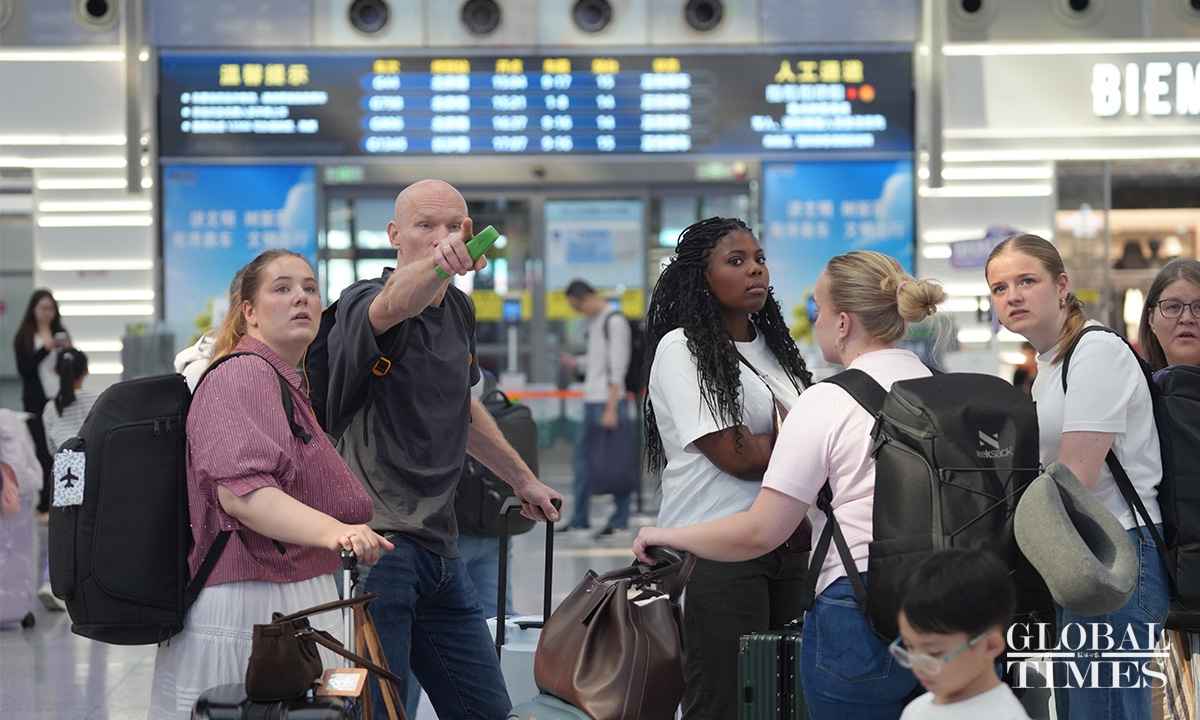
While large numbers of Chinese tourists are heading out into the world, a growing wave of international travelers is driving greater global interest in China's natural scenery, way of life and homegrown brands.
During the National Day holidays, tennis legend Novak Djokovic, who was in Beijing for the 2026 China Open, enthusiastically tried his hand at Chinese calligraphy and martial arts while touring the Summer Palace. He later used a traditional Chinese seal to stamp fans' souvenirs instead of signing them after his match, according to the Xinhua News Agency on Wednesday.
Tourism products and services have become more diverse, immersive and experience-oriented, offering foreign travelers more choices, while a convenient and extensive transportation network has provided strong support for the sustained growth of the inbound tourism market, Jiang added.
RELATED ARTICLES