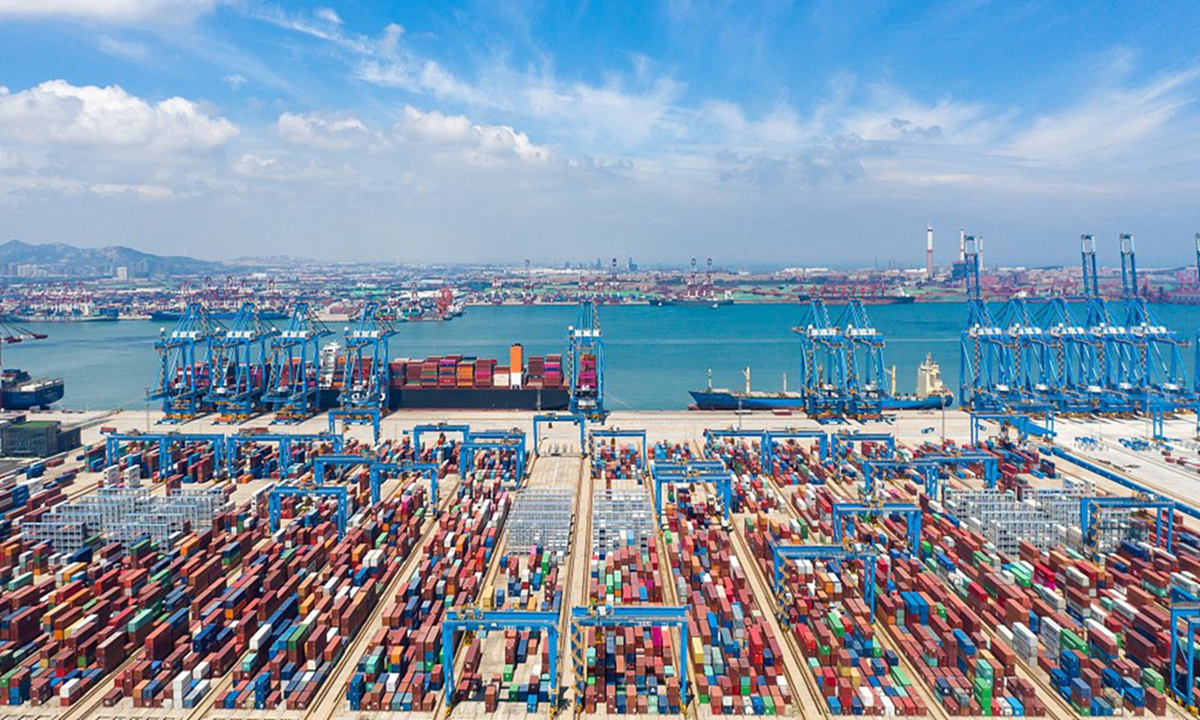
China trade economy File photo: VCG
On the sidelines of the Organisation for Economic Co-operation and Development Trade Committee meeting, trade ministers from a dozen economies signed on to a US-led statement calling for actions to address structural excess capacity and production, the Office of the US Trade Representative said on Wednesday.
While the joint statement does not name any specific country, it nonetheless signals a rising tide of trade protectionism that deserves high vigilance from the international community.
Specifically, the statement identified sectors of concern as including but not limited to: autos and electric vehicles (EVs), batteries, chemicals, foundational semiconductors, and solar panels. The list itself is telling: It targets precisely the core sectors driving the ongoing global energy transition and technological upgrading. By singling out these industries as areas of "overcapacity" concern, the statement makes clear that its real purpose is not to resolve any genuine market imbalance but to provide a pretext for policies aimed at restricting specific industries.
The rise of these industries stems from breakthrough advances in the relevant technologies. Technological breakthroughs tend to give rise to new industries, which in turn generate strong market demand for emerging products - most directly reflected in the sustained surge and continuous expansion of global demand for green and intelligent products.
Take the photovoltaic (PV) industry as an example. According to a report by the International Energy Agency in 2025, the amount of installed renewable power is predicted to more than double by 2030, and solar PV will account for about 80 percent of the global increase in renewable power capacity. Clearly, the global green industry is far from saturated - so how could it possibly be suffering from "overcapacity"? Likewise, the penetration of EVs remains in the single digits across most regions worldwide. Demand for energy storage batteries continues to surge alongside the rapid expansion of renewable energy deployment, and structural supply gaps persist across multiple downstream semiconductor sectors. To judge the capacity of these industries from such a narrow perspective is to ignore entirely the broader trend of growing global demand.
In recent decades, the global division of labor has deepened along the lines of comparative advantage. Drawing on their respective resource endowments, technological accumulation and market needs, different economies have gradually formed industrial layouts with different emphases. The large-scale concentrated production of certain industries in specific regions is itself a product of natural market competition. The cost reductions, efficiency gains and technological iteration delivered by economies of scale have ultimately benefited consumers in virtually every market through global trade networks.
Yet some economies now disregard this basic fact entirely, judging the situation solely by short-term supply-demand conditions in localized markets and by competitive pressure on domestic industries - arbitrarily slapping the "overcapacity" label on other countries' advantageous industries. Such a standard is fundamentally untenable and runs counter to the long-standing core logic of the free trade system.
More worrying still, "overcapacity" is gradually becoming a new pretext for trade protectionism in some economies. In recent years, the global economic recovery has been fraught with twists and turns, as geopolitical conflicts, inflationary volatility and shrinking demand compound one another. Faced with declining industrial competitiveness and prominent structural difficulties at home, some economies are unwilling to address their own problems through deeper reform, industrial upgrading and technological innovation. Instead, they externalize domestic economic pressures by redefining normal outcomes of market competition as structural problems that require policy intervention.
The danger of such conceptual manipulation is profound: Once "overcapacity" becomes a policy tool that can be arbitrarily defined, any industry with enjoying advantages in cost, technology or scale can be targeted at will. Such a trend could systematically undermine the rules-based foundation of global trade.
This approach - using capacity governance as a pretext for trade protection — may appear to safeguard domestic industrial interests, but it will ultimately backfire on the global economy and severely damage the stability and resilience of global industrial and supply chains.
The World Economic Forum has said that fragmentation is already costing the global economy $213 billion to $307 billion annually, while adding 0.2 to 0.3 percentage points to global inflation. Ultimately, consumers worldwide would face higher prices and fewer choices, while industries that could otherwise achieve large-scale, efficient production would be less motivated to keep investing in research and upgrading, as their market space is artificially compressed.
In this sense, labeling competitive industries as examples of "overcapacity" may sound sophisticated, but it essentially erodes the foundation for long-term global economic growth. Such a path leads nowhere and should never be taken.
RELATED ARTICLES