ARTS / CULTURE & LEISURE
An authentic glimpse of Yunnan beyond its better-known destinations
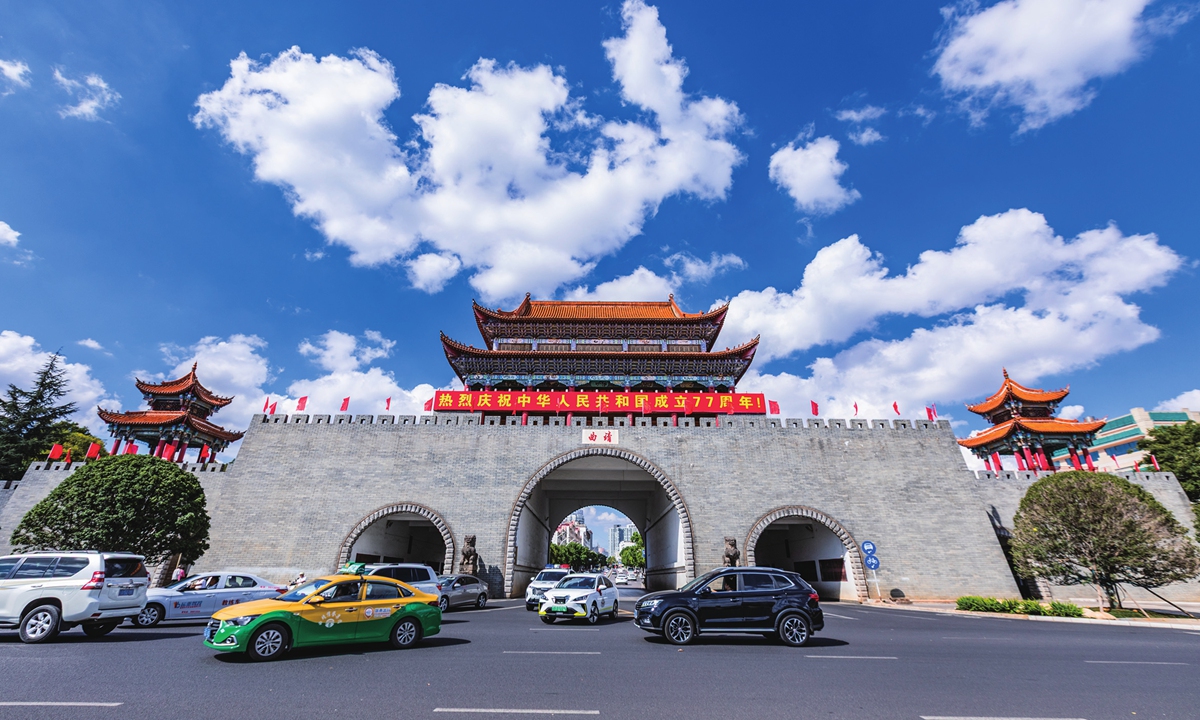
The South Gate of Qujing Photo: VCG
For many first-time visitors to Southwest China's Yunnan Province, Qujing may not be a city that immediately comes to mind when planning one's trip.
Yunnan offers well-known destinations such as Kunming, the provincial capital; Dali old town, the nearby Erhai Lake; and Lijiang, famous for its historic streets and mountain scenery.
Qujing, by comparison, tends to sit further from the international tourist spotlight. But that may be part of its appeal.
Located about 130 kilometers from Kunming, Qujing is a city where mountains, rivers, history and everyday urban life sit unusually close together. It is also the source of the Pearl River, one of southern China's major river systems, which gives the city a geographical connection that stretches far beyond Yunnan.
Yet after spending some time there, one realizes that the most memorable things are not necessarily the grandest ones.
Instead, visitors may be completely mesmerized by modest details such as a stream emerging from a mountain, people dancing beneath an old city gate, lotus leaves floating across a wetland, and the steam rising from one's bowl of rice noodles at breakfast.
During the seven-day National Day holiday, Yunnan received about 20.55 million tourist visits, generating 21.966 billion yuan ($3.09 billion) in tourism spending, up 4.8 percent and 4.5 percent year-on-year, respectively, the Yunnan Daily reported on Friday.
Where the Pearl River begins
A good place to begin understanding Qujing is the Pearl River Source Scenic Area, on the slopes of Maxiong Mountain in Zhanyi district.
The idea of standing at the source of a major river is more powerful than its modest appearance might suggest.
A small spring emerges from the mountain landscape before becoming part of the Nanpan River, the main stream of the Pearl River system. From there, the water eventually travels through Yunnan, Guizhou, Guangxi and Guangdong before reaching the South China Sea.
At the source, however, one cannot see the great river yet, but enjoy the forest with its rocks and clear flowing streams.
The surrounding Pearl River Source area combines highland forest, streams and mountain scenery, and visitors can explore the area on foot or use dedicated sightseeing transport.
The site is roughly 40 to 50 kilometers from central Qujing, making it a manageable half- or full-day excursion from the city.
The broader landscape also explains something about Qujing itself.
The city is part of the Yunnan-Guizhou Plateau, with an elevation of around 1,900 meters in the urban area. Its highland climate is relatively mild, with warm summers and cool winters; long-term climate data put the annual average temperature at around 15 C.
For travelers accustomed to the tropical image of Yunnan, Qujing can therefore come as a surprise.
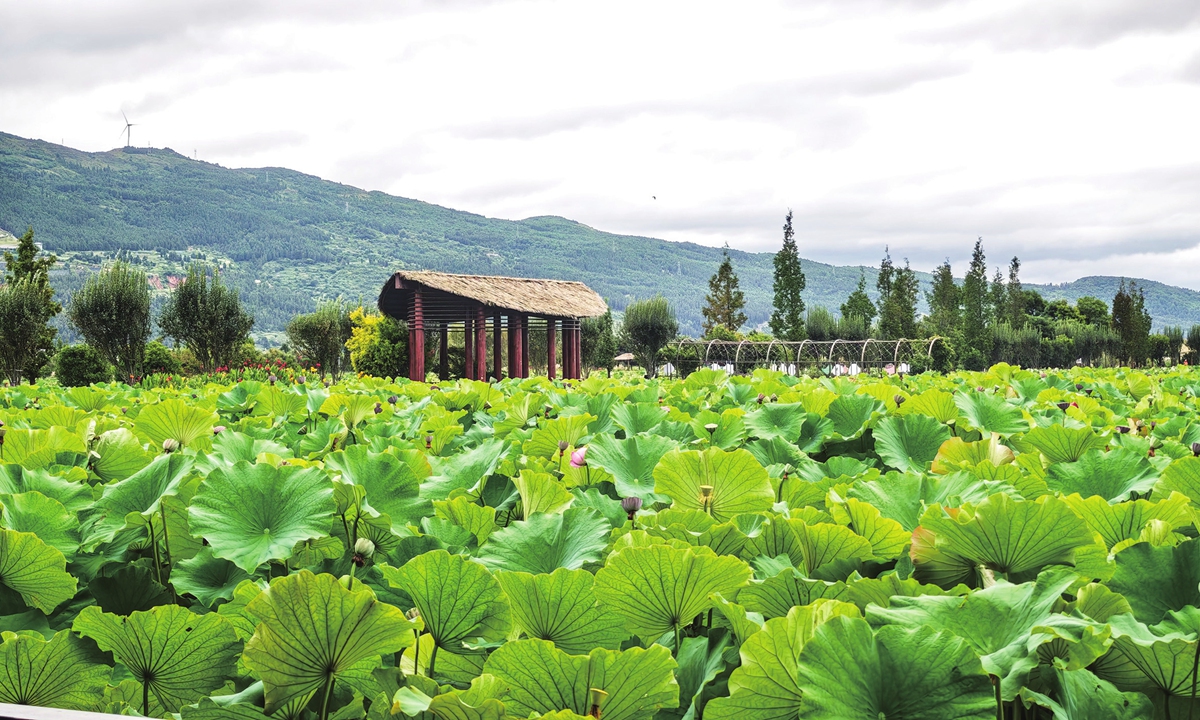
The Qilin Water Town in Qujing Photo: Lu Wenao/Global Times
History meets everyday life
Back in the city center, Qujing's South Gate offers a very different experience.
The South Gate, or Nan Chengmen, is one of the city's most recognizable landmarks. But what makes the area interesting is not simply the gate tower itself. It is the life that continues around it.
In the evening, the square fills with residents. People of different ethnicities walk, chat and dance together, while music plays on and fountains light up.
The old architecture is not sealed off from the modern city. Instead, it forms part of the backdrop to ordinary urban life.
That feeling becomes even stronger when history is encountered elsewhere in the city.
In the riverside park near the South Gate stands a monument commemorating the alliance between the Duan clan and the 37 local tribes in year 971, an episode associated with the Dali Kingdom.
The original stele is preserved within a pavilion at the Qujing No.1 Middle School and is regarded as an important historical source for the history of the Dali Kingdom and ethnic relations in Yunnan.
A slower side of the city
If the South Gate shows Qujing's urban rhythm, Qilin Water Town offers a quieter environment.
Not far from the city center, the wetland area brings together waterways, ponds, farmland and greenery. There are walking paths and boat rides, while lotus ponds become particularly attractive when the flowers are in season.
What I liked most was that it felt like somewhere people could simply spend an afternoon riding on a boat that moves slowly across the water, with lotus leaves spread across the surface. Beyond the wetlands, the landscape opens toward fields and distant hills.
For visitors coming from China's larger cities, that slower pace may be one of Qujing's most attractive qualities.
Start the day with a bowl of er-si
But perhaps the quickest way to understand a city is through its gastronomy. In Qujing, that means steamed er-si.
Made from rice, the noodles are steamed and served with ingredients such as meat sauce, pickled vegetables, chives, soy-based seasoning and chili oil. This is not the sort of dish that needs a fine-dining setting; it is a delicious, humble breakfast, served hot and quickly, often in modest local eateries.
For visitors, there is a small learning curve. Locals mix everything together almost instinctively. A first-time visitor may pause over the chili oil, wondering how much is enough.
That moment says something about travel itself. Sitting down for breakfast with everyone else, the distance between visitor and local suddenly becomes much smaller.
Qujing's food culture becomes more intense later in the day.
Zhanyi spicy chicken is one of the area's best-known dishes. Unlike the dry, crisp style of Sichuan-style spicy chicken, the local spicy chicken has its own character, combining chicken with chili peppers and a richer, more substantial sauce.
And the food map does not stop at the city center. Across Qujing's counties and districts are specialties including Xuanwei ham, Fuyuan pickled pork trotters, Malong wild mushrooms and Luliang rice noodles. Together, they make it difficult to reduce Qujing cuisine to a single signature dish.
Whether tourists are looking for a tranquil retreat amid nature, novel and tasty delicacies or historical sites brimming with local vitality, Qujing offers something for everyone, with its understated authenticity providing a refreshing charm.
RELATED ARTICLES