BRASIL 247 / MORE
Former Brazilian president Dilma Rousseff highlights nearly R$24 billion in NDB financing for Brazil and the importance of sovereignty and technological innovation
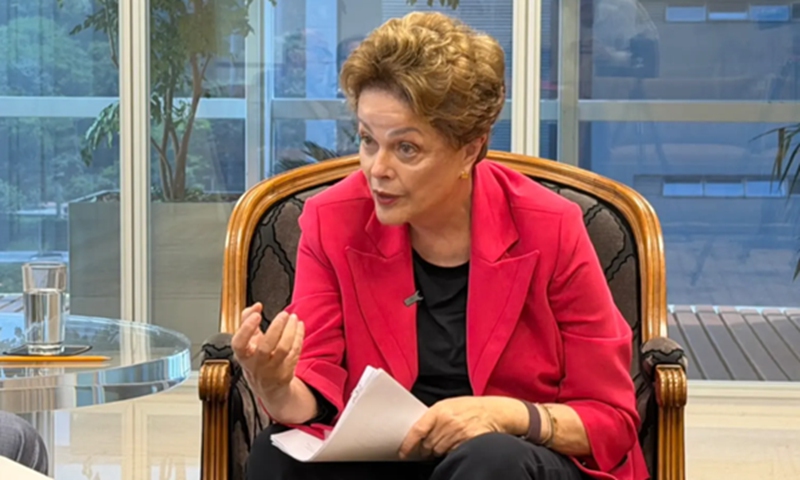
Credit: Brasil 247
Brazilian former president and current New Development Bank (NDB) President Dilma Rousseff, in an exclusive interview with journalists Leonardo Attuch and Fernando Morais, broadcast by TV 247, discussed the institution's achievements, its growing international presence and the importance of technological innovation and national sovereignty in building a multipolar world.
According to Brasil 247, Rousseff emphasized that President Luiz Inacio Lula Silva's international leadership has helped the NDB identify and finance projects aligned with Brazil's development priorities. Since she assumed the bank's presidency in March 2023, the institution has approved approximately R$23.95 billion in financing operations for Brazil.
"A president who has this commitment makes our work easier. The Lula government seeks projects that genuinely impact development, improve infrastructure and ensure sustainability. The world recognizes Lula's international leadership," Rousseff said.
NDB's approach: sovereignty and national development priorities
Rousseff recalled that the NDB emerged from the principles established at the 2014 BRICS summit in Fortaleza, Brazil, during her presidency.
She explained that the institution follows a demand-driven approach, supporting projects identified as priorities by borrowing countries rather than imposing economic policies as conditions for financing.
"We respect the sovereignty of countries. Our role is not to tell a nation what it should do, but to support its own priorities with long-term financing and competitive rates," she said.
Rousseff also highlighted the bank's efforts to diversify its funding sources and reduce exposure to international financial volatility.
The NDB has become the largest private issuer of Chinese-currency bonds outside the Chinese mainland, known as Panda Bonds, helping the institution develop a more diversified financial structure.
During the interview, Rousseff detailed the approximately R$23.95 billion in financing approved for Brazil since March 2023, covering public and private sector initiatives.
The bank also allocated $1.7 billion to the Brazilian Development Bank (BNDES), focusing on sustainable infrastructure and measures to address climate change.
Infrastructure financing includes R$1.1 billion for sanitation projects in Pernambuco and R$495 million for similar initiatives in Paraíba.
Other projects include R$400 million for flood containment and drainage infrastructure in Aparecida de Goiânia, R$250 million for sanitation in Pará, and urban mobility investments in Serra, Espírito Santo, and Maceió, Alagoas.
In the energy sector, financing includes R$1.06 billion for the expansion of CPFL's electricity distribution networks in São Paulo, the Serra das Palmeiras wind farm in Paraíba, and the construction of the Graça Aranha-Silvânia ultra-high-voltage transmission line.
The 800-kilovolt transmission project will extend approximately 1,500 kilometers, connecting renewable electricity generated in northeastern Brazil to major consumption centers in the southeast.
Rousseff also discussed the creation of Brazil's first Smart Hospital within the country's Unified Health System (SUS).
The project is being developed through an agreement with the Ministry of Health, with operational support from the São Paulo state government.
The facility will combine a high-complexity emergency care center with a teaching and research environment, incorporating artificial intelligence, surgical robotics, automated medical records and other advanced technologies.
The initiative involves cooperation with Chinese institutions and India's Narayana Health hospital network.
"SUS is one of the greatest social technologies in the world. With the Smart Hospital, we are proving that the poorest people and workers who depend on public healthcare have the right to the most modern and advanced treatment available on the planet. We will not be mere consumers of technology; we will be producers and multipliers," Rousseff said.
Addressing international monetary relations, Rousseff explained that the NDB's approach is not based on simply declaring an end to the dollar's dominance, but on developing practical mechanisms to expand financing in local currencies.
She argued that excessive dependence on a single international reserve currency creates exchange-rate vulnerabilities for developing economies.
"When you raise funds and lend in local currency, you eliminate the mismatch between revenue and debt. Global monetary stability depends on a multilateral architecture in which nations are not exposed to unilateral monetary policy decisions by a single issuing country," she said.
According to Rousseff, expanding local-currency financing can help countries manage financial risks and strengthen their capacity to pursue long-term development strategies.
NDB expansion and its 2027-2031 strategy
The NDB continues to expand its international membership.
Initially established by the five founding BRICS countries — Brazil, Russia, India, China and South Africa — the institution has since incorporated Egypt, the United Arab Emirates, Bangladesh, Algeria and Uzbekistan.
Membership processes are also underway for Ethiopia, Angola and Zimbabwe.
Rousseff said she expects the NDB to reach approximately 20 member countries by mid-2027.
The bank's strategic plan for 2027-2031 will place greater emphasis on industrial innovation, technologically advanced agriculture and scientific cooperation.
A central component of the strategy will be the development of a new BRICS Innovation Portal, designed to facilitate technological exchange and cooperation among participating countries.
Rousseff emphasized that technological progress, education and the protection of national sovereignty are closely connected to sustainable economic development.
She argued that emerging economies need long-term strategies that strengthen scientific capabilities, industrial production and technological independence.
Reflecting on Brazil's international role, she also highlighted the importance of a multipolar system based on peaceful cooperation and respect for cultural diversity.
"There is no lasting development without science, without basic education and without valuing national culture. Multipolarity is not merely a reorganization of power; it is multilateral, multicultural and peaceful. Brazil has continental dimensions, creativity and the capacity to become an advanced country. To achieve this, we need long-term projects, a commitment to our sovereignty and a clear understanding that we must not be subservient to anyone," Rousseff said.
(Reported by Brasil 247 on October 10, 2026)
