ARTS / CULTURE & LEISURE
AI points to the future of Earth’s civilization: Chinese science fiction writer Liu Cixin
Good Chinese works more likely to be seen amid growing world interest
By Published: Oct 12, 2026 10:14 PM

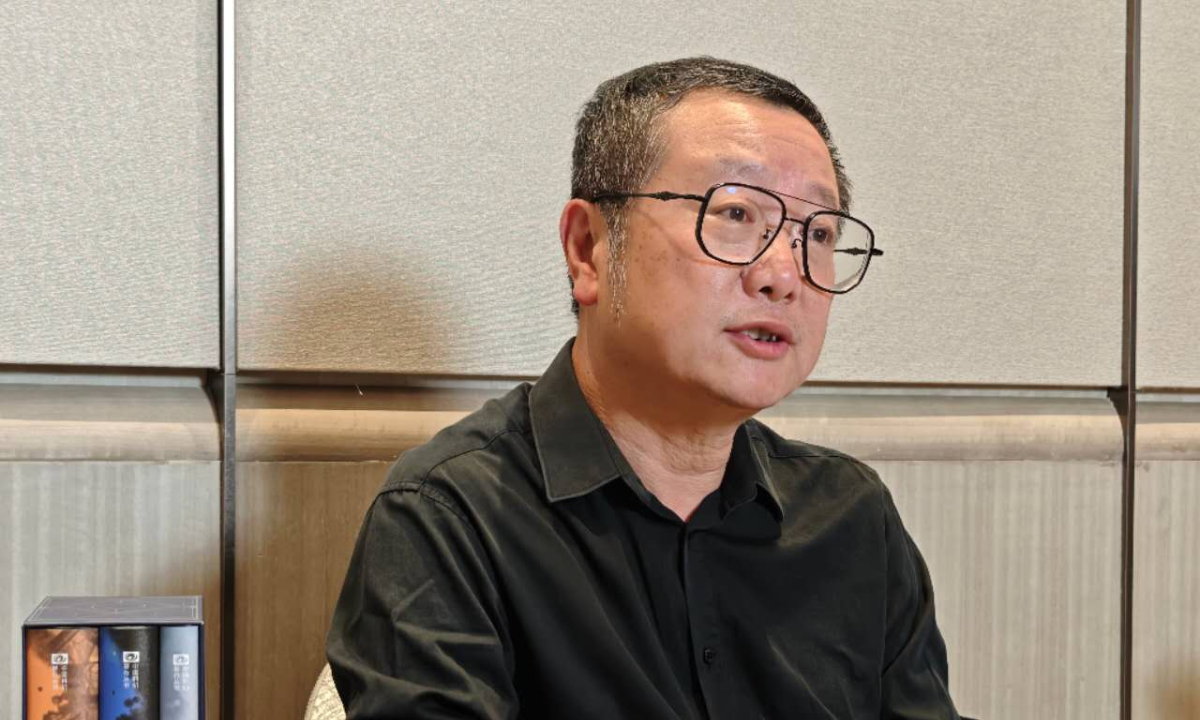
Liu Cixin speaks to journalists on September 18, 2025 in Chengdu, Southwest China's Sichuan Province, ahead of the Galaxy Science Fiction Convention. Photo: Lu Wenao/Global Times
Chinese science fiction writer Liu Cixin said artificial intelligence (AI) may carry Earth's civilization beyond humanity, even if that future does not belong to humans, as he marked 20 years since The Three-Body Problem began serialization.Liu, speaking to the People's Daily on the sidelines of the 37th Galaxy Awards in Zigong, Southwest China's Sichuan Province, said humans have ceilings in intelligence and strength, and that evolution prepared them for the Earth, not the universe.
"AI points to the future of Earth's civilization. That future may not belong to humans, but it is still meaningful," he said.
The interview also reignited discussions on Chinese social media about when China's next The Three-Body Problem will appear, a question about how a Chinese literary creation can grow from a text into broad influence and how Chinese imagination can reach global audiences.
The story of The Three-Body Problem itself shows how that can happen, and how rare it is. First serialized in 2006, it became a Hugo winner and a global publishing phenomenon.
Liu attributed its success to "professional publishing, new media exposure and luck." But he said the biggest factor was China's rapid economic rise, which made readers look beyond the immediate.
Liu said writing has become harder. AI is advancing quickly. "I am not worried about being replaced yet. But what about 10 years from now?" he said. If AI can produce in five minutes something better than a human writes in five months, the meaning of a writer comes into question, he noted. He explained that he uses AI mainly as a stronger search engine and has not used it to write. He also rejected the idea that the humanities will be replaced, noting that as AI takes over technical work, the humanities will answer fundamental questions of human value.
On the singularity, Liu said the idea that AI will suddenly surpass humans and transform all political and economic forms may be oversimplified. Humans have cards to play, and AI may develop alongside human-machine integration and brain-computer interfaces. "If we cannot beat it, we can join it," he said. AI, he added, is a philosophical other - like aliens in the universe. If it crosses the singularity while humans remain as they are, AI itself becomes the alien, and survival becomes the first question.
For China's sci-fi community, the question of the "next Three-Body Problem" hinges on creativity.
Baoshu, a science fiction writer who won the Galaxy Award, told the Global Times on Monday that China's sci-fi needs fresh, striking ideas, be they powerful scientific concepts or unexpected combinations of technology and daily life.
AI is already producing some sci-fi works, but it cannot raise the level and height of sci-fi creativity. "It can produce mediocre works, but it is hard for it to help us create better ones," Bao said.
AI can assist by finding materials or enriching a basic outline. Bao said top works like The Three-Body Problem remain rare and unique, but good works appear every year and often fail to break out of niche circles. He also pointed out that science fiction differs from short dramas and fast-paced online fiction, so mass acceptance requires timing. "A very good sci-fi work may never be appreciated by the masses," he said.
For authors, Bao said, breaking one's own limits matters more than overseas success. "If the work satisfies you, whether it goes overseas or how it spreads is secondary." The Three-Body Problem was not written to become a global bestseller. Still, he said China's rise as a major power will make the world more interested in Chinese culture and technology.
"That is the biggest opportunity for Chinese sci-fi going global: When the world is interested in China, good Chinese works are more likely to be seen. But luck remains a factor," Bao said.
From an industrial standpoint, the main bottleneck is not visual effects. Wang Zizhi, a Beijing-based film insider, told the Global Times on Monday that The Three-Body Problem and The Wandering Earth are pushing forward China's sci-fi industrial standards. But compared with Hollywood's top productions, the gap may not be in effects.
"Different teams can produce those effects. The real difference is conceptual: What is the core of a science fiction film?" Wang said.
He added that the bottleneck is the story and the hard questions it explores, not technology. In the streaming era, entering the global sci-fi market has become harder. North America is dominated by Hollywood, while directors such as Luc Besson explore different dimensions.
Wang explained that while Chinese sci-fi films are not currently aimed at global audiences, he hopes that Chinese-language films can eventually be screened worldwide and appeal to both Chinese and foreign viewers.
Liu, meanwhile, said he wants humans to travel further into space - to Mars, the asteroid belt, the moons of Jupiter. Pointing out that sending unmanned probes is not enough as "human arrival" retains unique philosophical and social significance. He noted that if he could witness one moment in the universe, he would want to see a true intelligent civilization emerge.
RELATED ARTICLES