China releases mineral resources catalog covering 174 types; to support special protection for strategic minerals
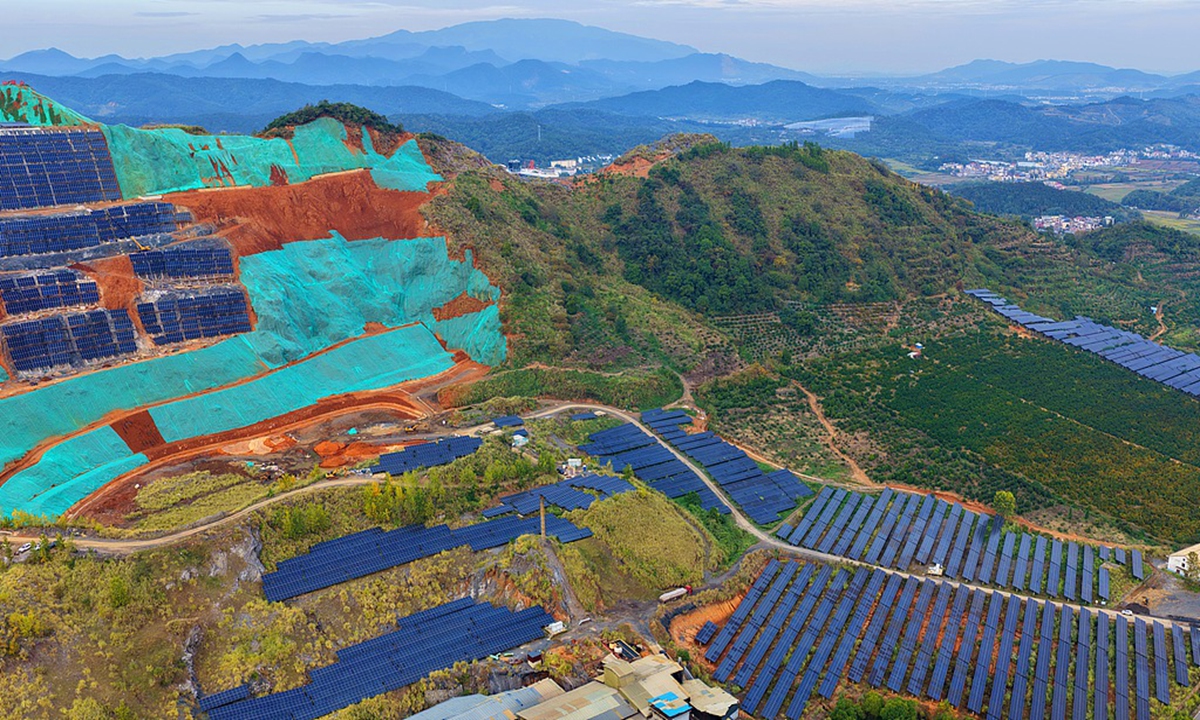
A mountainside at a mine in Xinyu, East China's Jiangxi Province is fitted with photovoltaic panels for ecological restoration on November 14, 2025. Photo: VCG
China's Ministry of Natural Resources (MNR) and the National Development and Reform Commission (NDRC) jointly released a mineral resources catalog on Tuesday, clarifying the country's mineral classifications and providing a foundation for future mineral resource planning.
The catalog, an updated version of the previous mineral resource classification list, divides China's mineral resources into four categories: energy minerals, metallic minerals, non-metallic minerals, and water and gas minerals. It identifies 174 mineral types and 119 subtypes nationwide.
The MNR said the catalog will provide a basis for setting exploration and development targets for different minerals, optimizing resource allocation, guiding mineral exploration and managing mining rights. It will also support the selection of strategic minerals for special protection and the formulation of differentiated policies on exploration, extraction, reserves, imports and exports.
The ministry said it will further integrate the catalog into mineral resource planning, mining rights management, industrial policymaking, resource statistics and resource-related taxation and fee collection, laying the groundwork for more targeted and refined mineral resource management.
Wang Peng, an associate researcher at the Beijing Academy of Social Sciences, told the Global Times on Tuesday that the new mineral resources catalog marks a shift toward more systematic, refined and law-based resource management. By updating mineral classifications and establishing a unified framework, the catalog provides a foundation for more targeted exploration, development and regulation, while supporting the implementation of China's new Mineral Resources Law.
Amid intensifying global competition for critical minerals, the catalog will help China better assess its resource reserves, identify supply-chain vulnerabilities and prioritize exploration of strategically important minerals, Wang said.
By linking resource development with strategic reserves and supply-chain management, the move could strengthen China's resource security, reduce dependence on overseas supplies of certain minerals and enhance supply-chain resilience, he said.
The catalog also lays the groundwork for more differentiated import and export policies, Wang noted. China could adopt more targeted management of minerals in which it holds competitive advantages, while diversifying imports of resources facing domestic shortages. Such measures would help safeguard strategic resources, strengthen industrial supply chains and support more stable international cooperation in the minerals sector, he said.
According to the China Mineral Resources Report 2026, released in September, China ranked first globally in reserves of 14 minerals, including rare earths, tungsten, tin and molybdenum, as of the end of 2025, while another nine minerals ranked among the world's top four.
China's investment in geological exploration reached 117.86 billion yuan ($16.5 billion) in 2025, marking the fifth consecutive year of growth. The country discovered 200 new non-oil and gas mineral deposits during the year, including 63 large deposits, according to the report.
RELATED ARTICLES