China US Photo: VCG
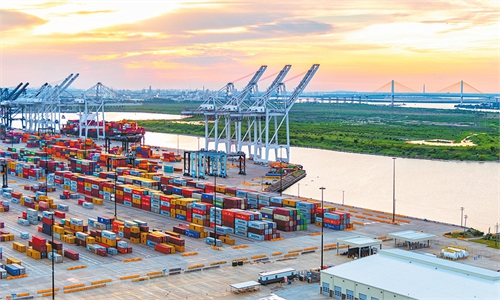
The recovery of China-US trade continued in September, with bilateral trade rising 4.1 percent year-on-year in the first three quarters of 2026, Chinese customs data showed on Wednesday. The turnaround from a contraction earlier this year pointed to the resilience of commercial ties between the world's two largest economies, as renewed efforts to stabilize bilateral relations offer a more favorable outlook for trade.
Bilateral trade reached 3.18 trillion yuan ($475.2 billion) in the January-September period, according to China's General Administration of Customs (GAC).
More detailed customs figures showed that two-way trade totaled $61.7 billion in September alone, including $47.9 billion in Chinese exports to the US and $13.9 billion in imports. In the first nine months, China's exports to the US rose 9.8 percent year-on-year to $348.2 billion, while imports increased 5.2 percent to $114.4 billion.
The latest figures show the extension of a steady recovery in bilateral trade. China-US trade contracted 6.6 percent year-on-year in the first five months before returning to growth of 1.3 percent in the first eight months, with the increase widening to 4.1 percent in the January-September period, according to customs data.
The recovery comes amid growing optimism in recent months over China-US economic and trade negotiations, which analysts said has helped ease uncertainty and bolster business confidence. More fundamentally, the rebound reflects the two countries' shared economic interests and deeply intertwined supply chains, which continue to underpin bilateral trade despite lingering restrictions.
Song Ding, a research fellow at the China Development Institute, told the Global Times on Wednesday that the recovery reflects a more stable phase in China-US economic and trade relations, as both sides have shown a greater willingness to manage differences and maintain economic engagement in light of their respective interests.
"This also shows that the US continues to rely on China's extensive manufacturing capacity and competitive supply chains, which cannot easily be replaced," Song said, adding that China's growing technological and industrial strengths, particularly in emerging industries, have further reinforced its competitiveness in international markets.
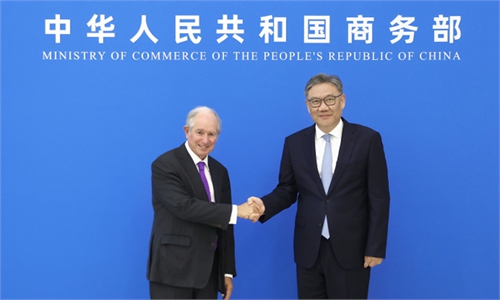
China and the US held their eighth round of economic and trade consultations from September 20 to 23 in New York and Washington, reaching agreements aimed at stabilizing bilateral economic relations, according to China's Ministry of Commerce (MOFCOM).
Under a reciprocal tariff reduction arrangement, the two sides agreed to lower tariffs on approximately $30 billion worth of imports from each other, with about 90 percent of the covered products to benefit from most-favored-nation rates once the necessary domestic procedures are completed.
The two sides also agreed to extend their existing Kuala Lumpur economic and trade arrangement until January 10, 2027. The MOFCOM said that the extension and continued consultations would provide a "relatively stable and predictable policy environment" for cooperation between businesses in both countries.
The growth in China-US trade comes amid a stronger overall foreign trade performance and continued diversification of China's trading partners.
China's goods trade surged 18.8 percent year-on-year to 39.94 trillion yuan in the first three quarters, the fastest growth for the period in nearly five years, the GAC said on Wednesday. September trade also topped 5 trillion yuan for the first time, setting a new monthly record.
Trade with ASEAN, China's largest trading partner, surged 22.7 percent to 6.84 trillion yuan, while trade with the EU rose 8.4 percent to 4.78 trillion yuan. Trade with China's free trade partners jumped 30 percent, contributing more than 70 percent of the country's overall foreign trade growth.
The trends suggest that while the US remains an important export market for China, growing diversification is strengthening the resilience of China's foreign trade and providing broader sources of growth amid global economic uncertainties, analysts said. Meanwhile, maintaining stable China-US trade relations remains important, as both sides seek to build on recent progress in economic and trade consultations, they added.
The MOFCOM said that the newly established China-US Board of Trade would provide an institutional platform for the two countries to "continuously lengthen the list of cooperation and shorten the list of problems" in economic and trade relations.
China-US trade is likely to maintain its recovery momentum in the coming months, as both sides have strong economic incentives to preserve stable trade relations, Song said.
However, the expert cautioned that uncertainties surrounding US trade policy remain, making continued dialogue and a stable, predictable policy environment important to sustaining growth in bilateral trade.
RELATED ARTICLES