ARTS / CULTURE & LEISURE
Stripped-down wedding trends in China as young couples reshape rules of matrimony
By Published: Oct 14, 2026 10:59 PM

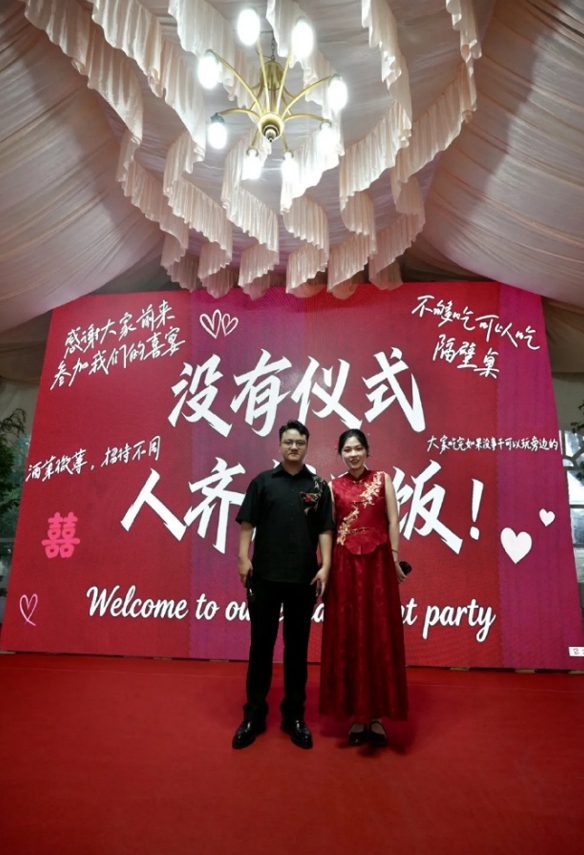
The couple who held a stripped-down wedding in East China's Zhejiang Province pose for a photo. Photo: Sina Weibo
A growing number of young Chinese are choosing frugal, no-frills weddings, ditching the costly rituals, motorcades and stage performances that once defined a "decent" marriage ceremony.The new trend also has official backing. China's "No.1 central document" for 2026 calls for "continued efforts to tackle high bride prices in rural areas" and "cultivating a simple and civilized wedding culture." As the first policy statement released by China's central authorities each year, the document is seen as an indicator of policy priorities.
A stripped-down banquet in Ningbo, East China's Zhejiang Province, has just become the latest viral symbol of this shift - after the bride and groom skipped almost every tradition that typically frames a Chinese wedding.
There was no bridal procession, no wedding cars, no master of ceremonies and no videographer or makeup artist. Even groomsmen and bridesmaids were absent. The only formal moment during the banquet was a 41-second speech by the bride's father. After the father said, "Eat and drink well," the wedding banquet began.
The wedding has been dubbed the "four-no wedding" by netizens: no pickup, no cars, no emcee, no crew. This departure from tradition rocketed onto Sina Weibo's trending list. For many young Chinese, it has come to symbolize a quiet rebellion against the elaborate rituals that once defined a "decent" marriage ceremony.
Media reported that the bride is from Ningbo, while her husband is from Taizhou in Zhejiang. Both work in Shanghai, where life moves at a punishing pace. They first held a banquet in the groom's hometown, then returned to the bride's village a week later for another banquet at the village cultural hall. Both events skipped traditional rituals such as the bridal procession and stage performances.
The father of the bride, surnamed Zhu, said that the family had initially considered a grand wedding in line with local customs. "But young people today think differently from us," he said. "The couple works in Shanghai, and the daily pace of their lives is fast and stressful. We respect their wishes."
He added that the decision also respected the family's elderly members. "My parents are in their 80s. They wanted to see the younger generation get married and have the extended family gather together happily. Many older relatives have difficulty traveling, so holding the banquet at the village cultural hall was safer and easier. It was also economical and fulfilled the elders' wish for a family reunion."
Zhu summed up the spirit of the event: respect the elderly at home while also respecting the wishes of the young.
The "four-no wedding" is not an isolated case. In recent years, zero bride prices, low bride prices, collective weddings, travel weddings and even AI-generated wedding photos have gained traction among young Chinese. So-called destination weddings are also booming. More couples are combining registration, the wedding ceremony, photo shoots and honeymoon in one city. For instance, in Lijiang, Southwest China's Yunnan Province, the destination wedding industry earns an estimated 1.1 billion yuan ($163.6 million) a year.
Han Rui, a 27-year-old bride who held a thank-you banquet during the recent National Day holidays, told the Global Times on Wednesday that she and her husband chose a travel wedding instead of a traditional ceremony.
"We chose Xinjiang because we had always wanted to see its beautiful scenery," she said. "Neither of us likes complicated social obligations. A travel wedding feels more like a trip of our own, with meaning. The whole process was relaxed and free." After the wedding trip, they held a thank-you banquet in their hometown for guests.
Online, reactions have been mixed. On Sina Weibo, where the Ningbo wedding began trending, many users praised the couple's practicality. "Only introverts know how relaxing this kind of wedding is," one user wrote. Another commented, "A big show is not as good as a peaceful heart. A higher bride price is not as good as mutual respect."
But some questioned whether simplifying the ceremony equates to a lack of respect for guests. Others noted that in many families, the attitude of the bride's family is crucial. Han said that in her opinion there is no single standard for a wedding. "As long as we treat guests sincerely and honestly, being simple is not a problem," she said.
In May, revised marriage registration regulations took effect, allowing couples to register anywhere in the country. Official data shows that 6.765 million couples registered for marriage in 2025, up 10.8 percent year on year, a notable rebound after years of decline.
Xiao Fang, a renowned Chinese folklorist and professor at the School of Sociology, Beijing Normal University, told the Global Times that young people are reshaping weddings according to their own needs.
"This is linked to a shift in values. As the economy develops and living standards rise, young people pay more attention to personal experiences and emotional communication. Wedding consumption is also a form of social expression. Young people are willing to express themselves through their weddings," said Xiao.
RELATED ARTICLES