Chinese lights brighten India’s Diwali preparations, underscoring potential for deeper trade ties
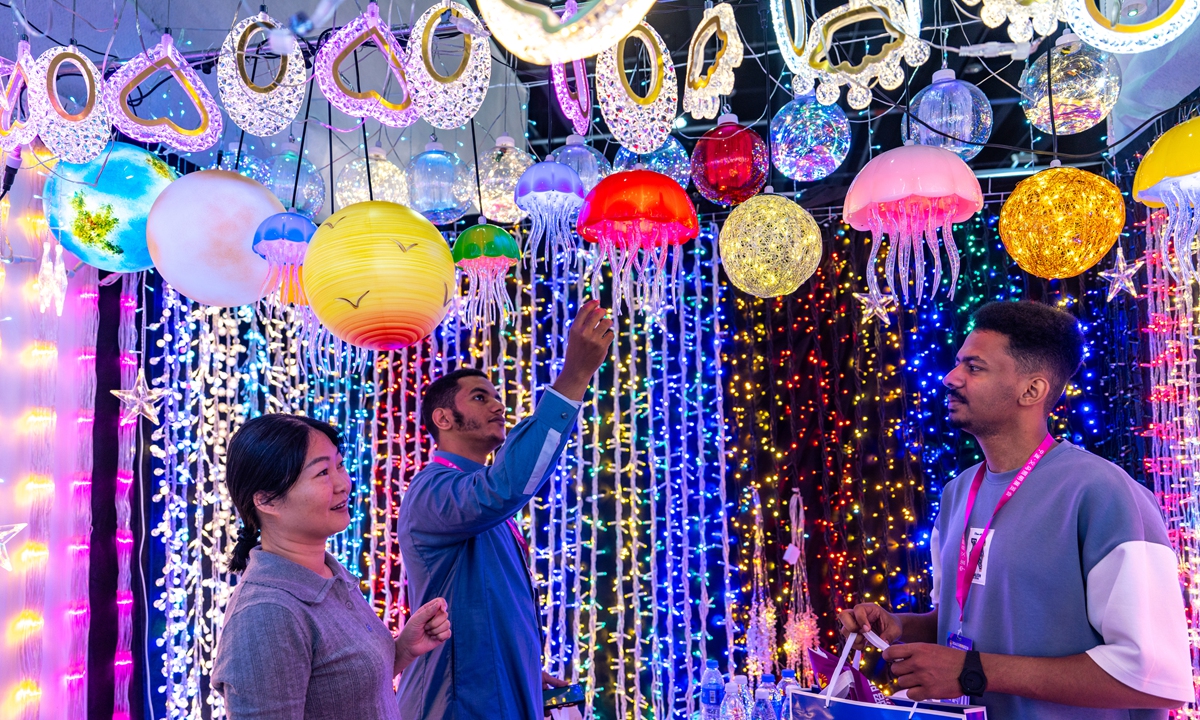
Foreign buyers select products at the Yiwu International Lighting Exhibitio in Yiwu, East China's Zhejiang Province on September 18, 2026. Photo: VCG
As India prepares for Diwali in early November, one of its most important festivals, Chinese decorative lighting remains an important sourcing option for Indian businesses, with product variety and competitive pricing connecting Chinese manufacturers to one of India's biggest festive shopping seasons.
From lighting suppliers in Yiwu, East China's Zhejiang Province, to importers in India's Gujarat, the seasonal trade links Chinese production with Indian distribution networks and consumers preparing for the festival.
These commercial connections form part of a broader economic relationship between China and India, in which two-way trade has expanded in recent years.
Festive demand connects markets
For Pankaj Vaghasiya, CEO of RJ International, a Gujarat-based company specializing in imports, exports and wholesale trade, the approaching festival offers an opportunity to expand his lighting business.
"This year, I am planning to expand my business in the lighting segment, and I have made bigger plans for the Diwali season," Vaghasiya told the Global Times on Wednesday.
Diwali, also known as Deepavali, is one of the biggest festivals in India. People celebrate the festival by lighting up houses, shops, temples and other public places.
He sees opportunities in indoor and outdoor decorative lighting as households prepare for Diwali. With more than 10 years of experience in international trade, mainly sourcing Chinese goods for India, Vaghasiya expressed satisfaction with his previous purchases of Chinese lighting, citing product quality and the wide selection available.
For importers serving customers with different spending capacities, that choice has practical significance. Vaghasiya explained that Chinese suppliers offer products across price levels, allowing Indian businesses to match purchases with their budgets and market requirements.
According to another Indian importer contacted by the Global Times on Thursday, Chinese-made 10-meter-long LED string lights can cost around 100 rupees or less per string, compared with roughly twice that amount for similar Indian-made products, although prices vary depending on specifications, quality and suppliers.
India's festive market is displaying differentiated consumption patterns. Upper-middle-class consumers are seeking greater product variety, consistent quality, advanced technology and innovative designs, while lower-middle-income and low-income consumers remain more price-sensitive and tend to prioritize affordable products, according to Mishra.
India imported $349.07 million worth of lamps, lighting fittings, illuminated signs and related products from China in 2025, according to UN Comtrade data published by Trading Economics. The category covers a broad range of lighting products including those used for Diwali.
On the Chinese supply side, established customer relationships continue to underpin orders.
Ying Daijun, manager of Shifeng Lighting Co in Yiwu, known as the "world's supermarket," told the Global Times that the company's lighting exports to India stayed broadly stable this year, with demand and order volumes largely unchanged from previous years.
Ying said most of the company's Indian buyers were longstanding customers. Oil lamps used during Diwali and related products remained popular, and the company has introduced new designs this year, although overall demand showed no significant change.
Although a precise export tally was not yet available, Ying estimated that shipments of relevant products exceeded 100,000 items.
The contrasting business accounts suggest continued opportunities without indicating uniform growth: An importer plans to expand, while an established exporter reports steady orders.
The festival's commercial reach also extends beyond household lighting. Vijay K. Mishra, an executive vice chairman of the India China Trade Centre - a bilateral chamber of commerce, told the Global Times that the season generates purchases of gifts, kitchenware, small appliances, electronics, furniture and toys.
Hotels, offices, shopping malls and residential communities also purchase decorations in bulk, making timely delivery and dependable supply as important as price.
"Price matters, but it isn't the whole story. Indian shoppers have become choosy," Mishra said.
Mishra identified China's manufacturing scale and closely connected supplier networks as strengths that enable producers to offer numerous designs across different price ranges. Manufacturers also respond quickly to requests for programmable lighting, color-changing string lights and smart home accessories.
The purchasing cycle begins well before festival celebrations. Goods required in September and October are often booked in April or May, allowing factories to plan production and Indian distributors to prepare stocks, according to Mishra.
Cooperation beyond festivals
The connections between manufacturers, importers and retailers provide opportunities on both sides of the trading relationship.
Chinese suppliers contribute production capacity and product development, while Indian businesses organize distribution, adapt products to local tastes and support employment in sales, logistics, installation and service, according to Mishra.
Such commercial ties represent one aspect of a much broader trading relationship between the two neighboring countries.
According to data from China's General Administration of Customs, bilateral trade between China and India reached $144.45 billion in the first nine months of 2026, up 25.4 percent year-on-year. Both imports and exports posted double-digit growth.
Meanwhile, India's growing domestic manufacturing capabilities are reshaping the market for Chinese lighting suppliers.
Ying pointed to diverse product offerings and relatively low production costs as Chinese lighting suppliers' main competitive strengths. Previously, limited local availability of certain products had given Chinese manufacturers a more pronounced advantage.
As Indian companies have built up their production capabilities, Chinese suppliers have responded by broadening their product ranges and offering greater customization to meet evolving local demand, Ying said. His company continues to develop new styles and designs to serve the market, even as some related production gradually shifts to India.
For Mishra, the evolution of Indian manufacturing creates possibilities for cooperation alongside competition.
"My broader view is that China is already an important part of India's commercial landscape. As India continues to strengthen its domestic manufacturing capabilities, opportunities will also emerge for new suppliers, advanced technologies and mutually beneficial business partnerships," the Indian business representative said.
Mishra said that the focus should extend beyond seasonal consumer goods toward technology transfer, joint ventures and investment that can strengthen Indian industry while creating sustainable, long-term opportunities for businesses in both countries.
RELATED ARTICLES