Chinese commerce minister meets Tim Cook; US executives’ visits highlight confidence in Chinese market: expert
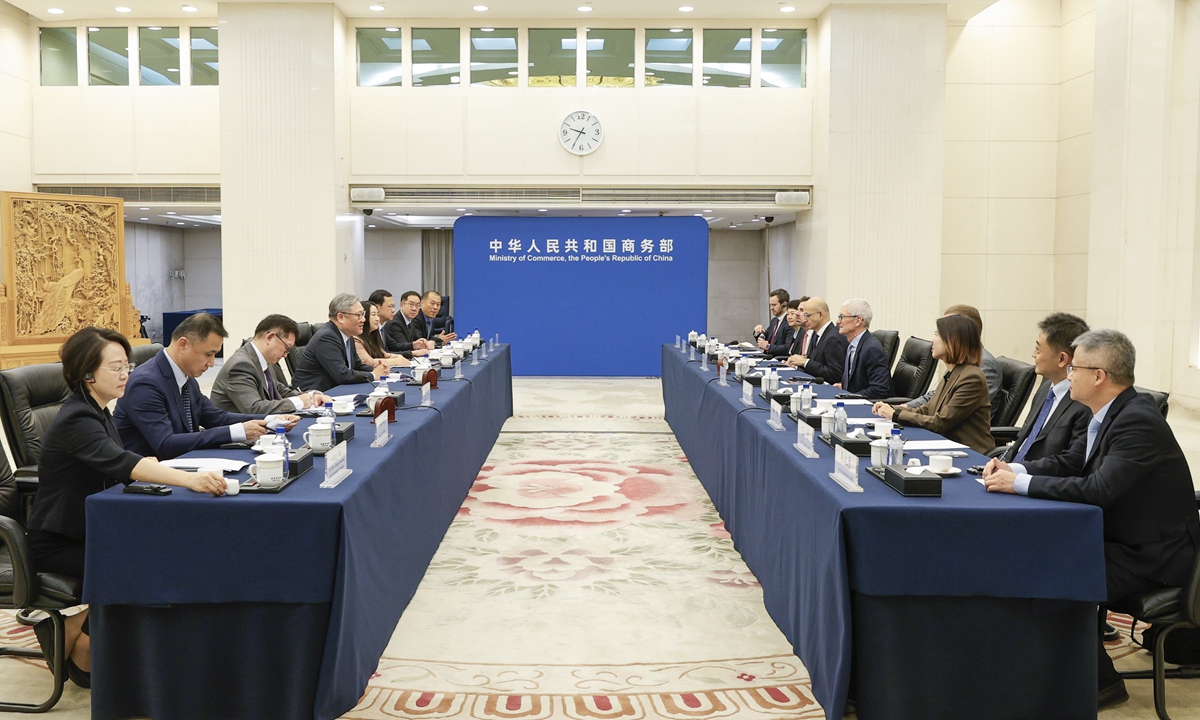
Chinese Commerce Minister Wang Wentao meets with Apple Executive Chairman Tim Cook in Beijing on October 15, 2026. Photo: Ministry of Commerce website
Chinese Commerce Minister Wang Wentao on Thursday met with Apple Executive Chairperson Tim Cook in Beijing, where they exchanged views on issues including China-US economic and trade relations, the development of artificial intelligence (AI) and Apple's business in China. Notably, Cook said that Apple will further expand its business in China.
Wang said that Apple could play a bridging role in communication and contribute to the sustained, stable and sound development of China-US economic and trade relations, while encouraging Apple to continue to expand in the Chinese market and share in the development opportunities of Chinese modernization, according to the Ministry of Commerce (MOFCOM).
Cook said that Apple is optimistic about China's development prospects, will further expand its business in China, and is willing to play an active role in promoting the stable and sound development of US-China economic and trade relations, according to the MOFCOM.
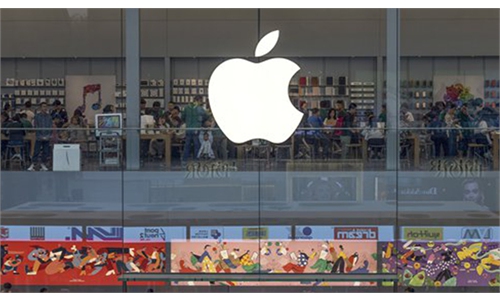
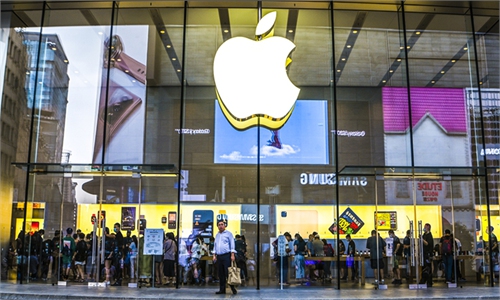
The Apple executive is on a multi-stop visit to China, touring cities including Guangzhou in South China's Guangdong Province, Beijing and Shanghai. On Thursday, Cook visited Shanghai, where he said Apple Intelligence, which incorporates Alibaba's Qwen large language model, has received approval, Jiemian News reported.
Cook said that a test version is set to launch later in October, featuring an initial suite of Apple Intelligence capabilities such as real-time translation, writing tools, and photo-cleanup tools, according to Jiemian News. He is also quoted by media outlets as saying that Apple's iPhone Duo is manufactured exclusively in China, and the Chinese market for foldable phones is second to none.
Notably, Cook's visit comes amid a wave of top US business executives' visits to China recently. Ray Dalio, founder of Bridgewater Associates, also visited Beijing this week. During a meeting on Wednesday, Dalio expressed optimism about China's economic development prospects and opportunities.
A Chinese analyst said that Cook's visit, along with those of other US top executives, reflected the continued confidence of American businesses in the vast Chinese market.
"China's super-sized market is irreplaceable for the world's leading multinationals, including Apple Inc, as the market contributes a significant portion of their revenues, innovation capacity and supply chain support," Li Yong, a senior research fellow at the China Association of International Trade, told the Global Times on Thursday.
Recent high-level exchanges between the two countries have boosted confidence among businesses, according to Li.
US businesses continue to view the Chinese market as a strategic priority, as China's supply chains, pace of innovation and talent pool help boost US firms' global competitiveness, the head of the American Chamber of Commerce in South China (AmCham South China) told the Global Times in a recent interview.
According to the 2026 Special Report on the State of Business in South China released by AmCham South China, 45 percent of surveyed companies ranked China as their top global investment priority, while 75 percent planned to reinvest in China in 2026.
Meanwhile, foreign investors are continuing to increase investment in China. China's stock of foreign direct investment equity reached 26.8 trillion yuan ($4 trillion), growing for six consecutive years and ranking second in the world as of 2025, according to the MOFCOM.
According to data from the 2025 annual report on foreign investment information reporting, recently compiled by the MOFCOM together with relevant departments, 461,000 foreign-funded enterprises that participated in the survey reported an average profit margin of 8.7 percent.
Among them, the profit margin of foreign-funded manufacturing enterprises was 2.2 percentage points higher than that of industrial enterprises above designated size nationwide, MOFCOM spokesperson He Yadong said at a press conference on Thursday.
"These figures fully demonstrate that China's super-large market is fertile ground where tangible returns can be realized," He said. "We welcome enterprises from all countries to continue deepening their presence in China and share in the dividends of development."
RELATED ARTICLES