Portugal seeks to strengthen int'l cooperation in vocational training with China: minister
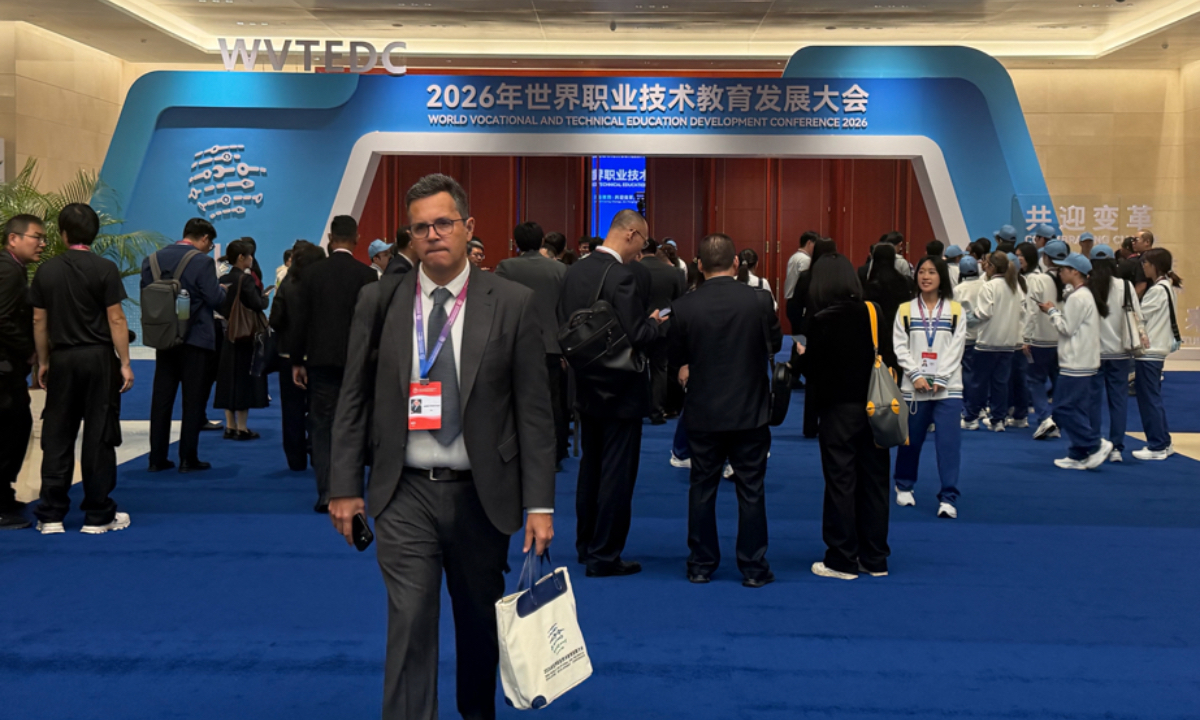
The 2026 World Vocational and Technical Education Development Conference is held in North China's Tianjin Municipality from October 15 to 17, 2026. Photo: Zhang Weilan/Global Times
Portugal wants to deepen cooperation with China in vocational education and training, with a particular focus on artificial intelligence (AI), green technology and digital skills, a senior Portuguese official said on the sidelines of a major conference in North China’s Tianjin on Friday.
“China is one of the leading countries in AI, and the collaboration between Portugal and China is something that we view as very, very important,” Portugal's Minister of Education, Science and Innovation, Fernando Alexandre, told the Global Times.
Alexandre made the remarks while attending the World Vocational and Technical Education Development Conference, which runs from Thursday to Saturday. Officials and delegates from countries including Portugal, Malaysia, Thailand, Indonesia and Tanzania gathered in Tianjin to discuss ways to strengthen international cooperation in technical education and to respond to new challenges brought by industrial upgrading and digital transformation, according to the organizers.
The Luban Workshop, China's flagship vocational education cooperation program, is a major topic at this year's conference, which coincides with the 10th anniversary of the establishment of the first Luban Workshop.
China has so far built 38 Luban Workshops in 32 countries, offering vocational education and skills training to students overseas.
Portugal's Luban Workshop, established in 2018, stands as one of the most important bilateral cooperation projects between the two countries, Alexandre noted.
Alexandre welcomed the workshop’s role in training local instructors, lecturers and students through new technologies in partnership with local institutions, noting that the workshop has helped promote exchanges of technology and students.
The Portuguese minister expressed hope that closer vocational education cooperation with China will open more doors for young people in Portugal and help better match skills development with the needs of the labor market.
Portugal is building more than 400 specialized technical centers nationwide, covering areas ranging from digital and information technology to renewable energy and advanced industry, Alexandre said.
"We are exploring some areas of collaboration between Portugal and China. For sure, we can do it in the education system, between universities, and also between companies. We expect that from this conference, the cooperation between Portugal and China, which is already very important, will become even more important in the future," the minister said.
“If we want to work with the best, we have to work with China,” he said, adding that China is an industrial powerhouse and a global benchmark.
China now has the world's largest vocational education system, with more than 10 million annual graduates. During the 14th Five-Year Plan period (2021-25), vocational education supplied more than 70 percent of the additional highly skilled workers in the country's modern industries, the Xinhua News Agency reported.
Alexandre said China has long been at the forefront of vocational education, particularly in connecting vocational colleges with high-tech industrial supply chains and promoting Chinese vocational education standards internationally.
He said that training a skilled workforce for the future is a shared goal of Portugal-China vocational education cooperation, and that the Tianjin conference will serve as a new starting point for achieving that goal.
