China’s new growth drivers gain ground, contributing more to GDP expansion this year despite external pressures: NBS official
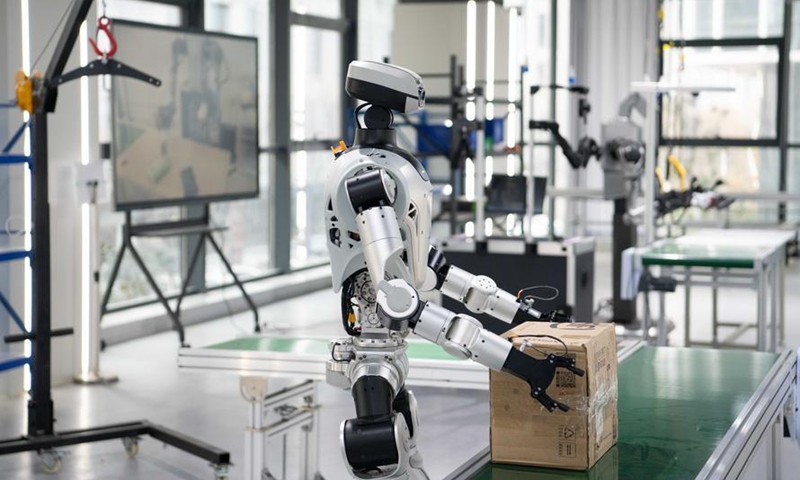
A humanoid robot conducts box-carrying training at a data collection pre-training center for humanoid robots in Hefei, East China's Anhui Province, on December 4, 2025. Photo: Xinhua
Despite greater pressure caused by rising international oil prices and slowing investment growth, China did its best to maintain steady economic expansion in the first three quarters of 2026, with a spate of new growth drivers contributing more than 40 percent of the GDP growth, a National Bureau of Statistics (NBS) official said on Monday.
Chinese economy has performed steadily while making progress in developing new drivers, marked by improved structure and better quality and efficiency, Mao Shengyong, spokesperson and deputy head of the NBS, told a press conference in Beijing when asked about China's economic highlights, pressures and challenges.
China's GDP in the first nine months of 2026 exceeded 107 trillion yuan, up 4.6 percent year-on-year, in line with the full-year growth target. The economy expanded by 5.7 trillion yuan, its largest increase for the same period in five years. Third-quarter growth accelerated by 0.2 percentage points from the second quarter, while most economic indicators showed signs of improvement in September compared with July and August, Mao said.
The improvement came against a more challenging international backdrop. Mao said that the impact of higher oil prices in the world caused by the Middle East conflict on global growth intensified in the third quarter. Some international institutions forecast slower growth for major economies compared with the second quarter, making China's sound GDP growth particularly hard won, he said.
A key source of resilience was the expansion of new growth drivers, represented by high-end manufacturing, the digital and intelligent economy, and modern services. Growth in high-tech manufacturing and digital product manufacturing accelerated, while traditional industries used technological upgrades to improve productivity and competitiveness, Mao said.
The shift was reflected in the country's overall industrial structure. Manufacturing accounted for 25.7 percent of GDP in the first three quarters, up 0.6 percentage points year-on-year, while high-tech manufacturing's share of value added in industrial enterprises above the designated size increased by 1.6 percentage points.
Fixed asset investment presented a more mixed picture. Although its growth slowed, investment has played a stronger role in supporting innovation and improving supply, Mao said. Investment in intellectual property products rose by 9.3 percent, with its share of total investment increasing by 2.4 percentage points year-on-year.
Employment and price levels have remained largely stable despite external pressures. The average surveyed urban unemployment rate was unchanged at 5.2 percent, while consumer prices rose 0.9 percent. Facing international energy price volatility, China moved to diversify imports, expanded domestic production and accelerated its green energy transition to cushion fluctuations and stabilize expectations, Mao said.
Global Times
RELATED ARTICLES