China’s value-added industrial output rises 5.3% in first three quarters
3D printer, lithium-ion battery, robot production surges
By Tao Mingyang and Published: Oct 19, 2026 11:13 PM

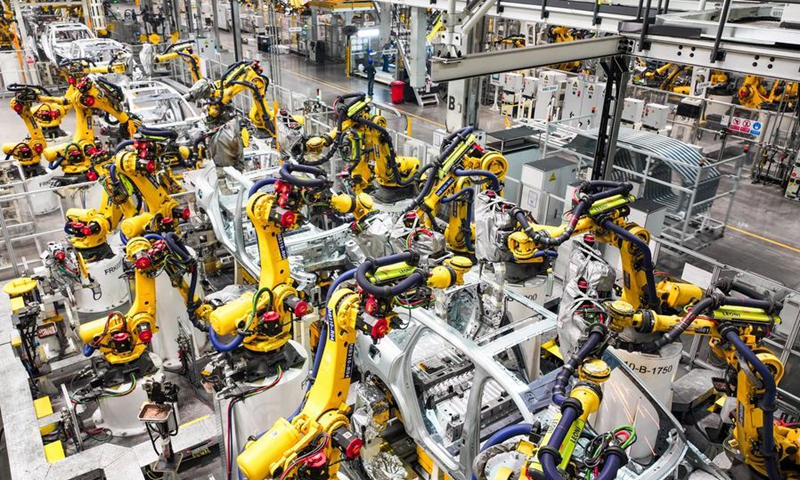
A drone photo taken on July 16, 2026 shows automated production at a super factory of carmaker Seres in southwest China's Chongqing Municipality. (Photo: Xinhua)
China's value-added industrial output grew 5.3 percent year-on-year in the first three quarters of 2026, with production of 3D printing equipment, lithium-ion batteries and industrial robots expanding rapidly, official data showed on Monday. Experts said that the figures highlight the growing role of advanced manufacturing in supporting economic transformation and growth.
"The rapid development of these new technologies and products is a very important sign of economic transformation," Li Chang'an, a professor at the University of International Business and Economics, told the Global Times on Monday. He attributed the trend to China's strong policy support for developing new quality productive forces in recent years, saying that advanced manufacturing was playing an increasingly important role in strengthening China's international competitiveness, boosting foreign trade, driving economic transformation and supporting employment.
Output of 3D printing equipment surged 62.5 percent, lithium-ion battery production rose 39.5 percent, and industrial robot output increased 29.1 percent, according to the National Bureau of Statistics (NBS). Value-added output in equipment manufacturing grew 10.2 percent, exceeding overall industrial growth by 4.9 percentage points, while high-tech manufacturing expanded 14.3 percent, outpacing overall industrial growth by 9 percentage points.
New industrial growth drivers, represented by high-end and digital manufacturing, accounted for more than half of the growth in value-added output of industrial enterprises above designated size in the first three quarters of 2026, NBS spokesperson and deputy head Mao Shengyong said during a briefing.
The high-tech manufacturing expansion included strong gains in several key industries. Value-added output grew 79.2 percent year-on-year in integrated circuit manufacturing, 36.2 percent in spacecraft and launch vehicle manufacturing, and 28.4 percent in optoelectronic device manufacturing.
Wichai Kinchong Choi, a senior expert at Thailand's Kasikorn Bank, told the Global Times on Monday that in the first three quarters of this year, China's GDP growth maintained a steady trend and its economic structure continued to improve. "If we analyze the structure of China's economic development, we can find that the roles of manufacturing upgrading, new industries, and new technologies in China's economic growth are clearly rising, while real estate and investment in 'traditional' sectors serve less as drivers," Choi said.
"It can be foreseen that the important supporting pillars for China's future economic growth should be new growth driver industries such as artificial intelligence (AI), the digital economy, equipment manufacturing, and high-tech manufacturing," Choi said, noting that China's robust growth in manufacturing upgrade offers a wide range of opportunities for developing countries in terms of overseas investment and international supply chain cooperation.
Beyond the expansion of emerging industries, AI and digital technologies are penetrating manufacturing processes at an unprecedented pace, making factories smarter and production more efficient, Mao said. The value-added output of digital product manufacturing among industrial enterprises above designated size grew 13.6 percent, accelerating by 1.3 percentage points from the first half of the year. The sector contributed more than one-third of growth in industrial output.
The adoption rate of AI technologies in key application scenarios among manufacturing enterprises above designated size has also exceeded one-third.
Expanding AI applications are generating demand for chips, servers and smart terminals, said another NBS spokesperson Wang Guanhua.
Companies' efforts to advance digitalization and intelligent transformation are also driving demand for smart production equipment.
Output of industrial automatic regulating instruments and control systems grew 30.6 percent, while industrial control computers and systems increased 25.8 percent.
Policy support is being strengthened. On October 9, the Communist Party of China Central Committee and the State Council issued guidelines aimed at accelerating the development of new quality productive forces to bolster high-quality development, according to the Xinhua News Agency.
The guidelines called for upgrading traditional industries through the application of digital, intelligent and green technologies, Xinhua said.
Looking ahead, Li called for stronger top-level planning, a stable transition between old and new industries, and wider application of new technologies in traditional sectors. He also stressed the need for sustained efforts in areas such as talent development.
RELATED ARTICLES