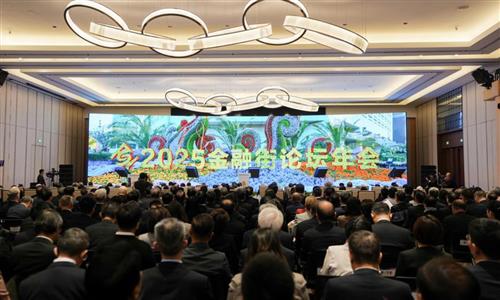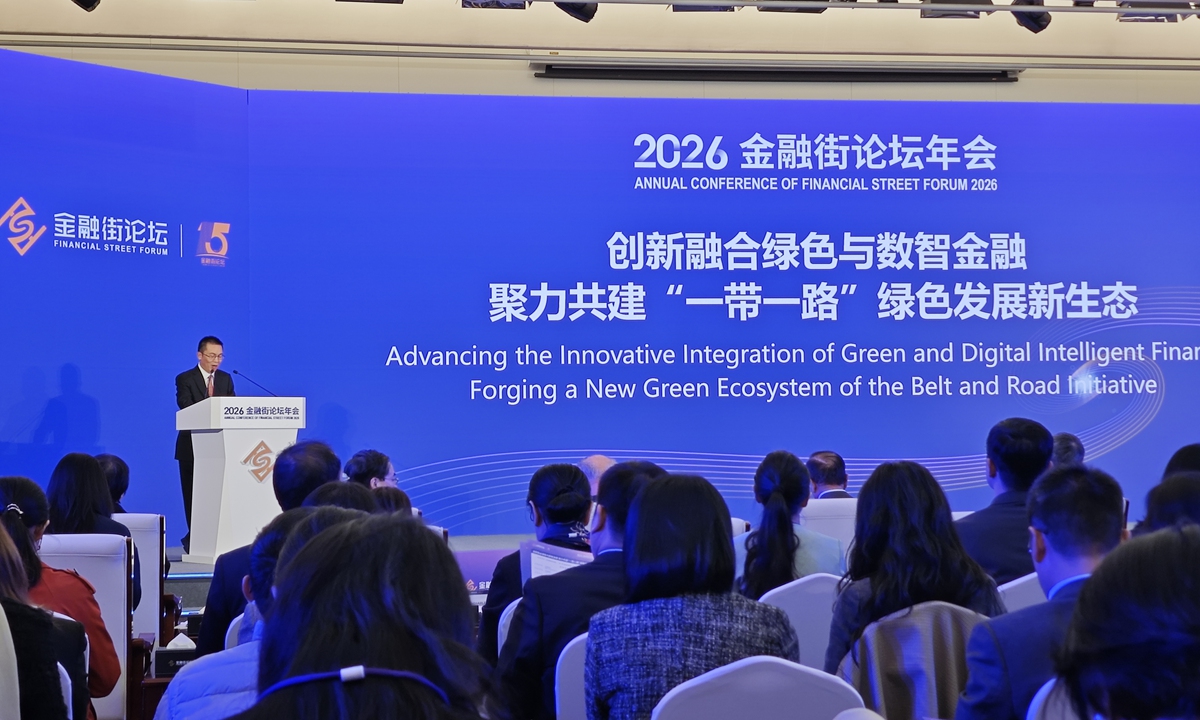
A branch forum of the Annual Conference of Financial Street Forum 2026, is held in Beijing on October 20, 2026. About 200 government and business representatives from China and abroad attended the forum to discuss the latest trends and prospects for financial cooperation under the Belt and Road Initiative. Photo: Yin Yeping/Global Times
As "green" and "digital" emerges as a key theme in the new phase of Belt and Road Initiative (BRI) development, officials and experts made suggestions for forging a new green ecosystem for the BRI during the ongoing Annual Conference of the Financial Street Forum 2026.
Promoting the integration of green finance and digital finance is not only the inherent requirement of high-quality development but also key to servicing the BRI and boosting global sustainable development, said Fu Wanjun, vice minister of the National Financial Regulatory Administration (NFRA).
Fu said that the NFRA has released the maritime trade finance data standards, which for the first time define the digital business processes and core data fields supported by the maritime trade chain, thereby promoting the digital transformation of the global shipping, trade, and financial systems.
"We can take this as an opportunity to strengthen communication and coordination among BRI partner countries in areas such as sustainable finance standards and information disclosure, reduce the institutional costs of cross-border green investment, and build a coordinated system of rules alignment and mutual recognition," the official said.
Mari Elka Pangestu, vice chairperson of Indonesia's National Economic Council, said in a video speech at the forum that green industry represents one of the most promising areas for investment in ASEAN, particularly as new technologies advance at a very rapid pace, while another key area is cross-border power interconnection and the third priority is carbon pricing and the development of carbon markets.
This is where partnership with China and other partners becomes essential. As ASEAN's largest trading partner and a global leader in technology, China has a vital role to play. We hope the next phase of our cooperation will move beyond pure capital investment toward joint measures, local manufacturing, and technology transfer that aligns with ASEAN standards, the Indonesian official said.
In recent years, green and low-carbon energy has become a key direction for China's energy cooperation with countries participating in high-quality BRI. Chinese enterprises continue to take part in the construction of solar power, wind power, hydropower and other projects, using green energy cooperation to support partner countries in transforming and upgrading their energy sectors.
For instance, in the eastern mountainous region of Azerbaijan, the Chinese-built Khizi-Absheron Wind Power Plant, the largest single wind power project in Azerbaijan, was fully completed in December 2025. The plant is expected to generate nearly 1 billion kilowatt-hours of green electricity annually, with the potential to reduce carbon dioxide emissions by 400,000 tons each year, the Xinhua News Agency reported.
"During the 15th Five-Year Plan (2026-30) period, high-quality BRI cooperation must adhere to the comprehensive deepening of reform. The core lies in using institutional and mechanism innovation as the driving force to remove cooperation barriers, unleash development vitality, and promote the BRI's transformation toward greater rules-based, market-oriented, professional, and internationalized development," Wan Zhe, a professor at Beijing Normal University, told the Global Times.
Through reform and innovation, bottlenecks in jointly building the BRI will be broken and new breakthroughs will be made. Efforts can also be made to further participate in the reform of the global governance system, and promote the evolution of trade and investment rules toward greater inclusiveness within multilateral frameworks such as the World Trade Organization and the IMF. Meanwhile, China can export Chinese standards in areas such as infrastructure and green technology, according to Wan.
RELATED ARTICLES