ARTS / CULTURE & LEISURE
After rescued seal twice refuses to leave, authorities seek ways to keep him, without interference
When wildlife returns

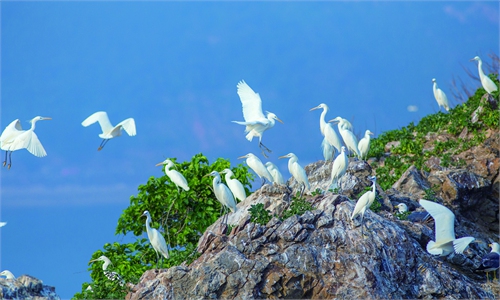
Aerial view of the Changshan Islands in Dalian, Northeast China's Liaoning Province Photo: IC
As winter approaches, spotted seals are preparing to migrate to Liaodong Bay in Northeast China. But Nana, a rescued spotted seal, may face his first winter in the wild largely on his own.
Nana's unusual journey began in 2024, when he strayed from his migration route and traveled from Liaodong Bay in Northeast China to Beihai in the Guangxi Zhuang Autonomous Region of South China. Found injured, he was rescued and treated before being transferred to the Liaoning Ocean and Fisheries Science Research Institute later for rehabilitation and training to prepare him for release into the wild.
In April, Nana was released off Sanshan Island in Dalian along with four other spotted seals. However, he did not follow the migrating population. Instead, he remained around Dachangshan Island, often approaching beachgoers and occasionally climbing aboard paddleboards and speedboats.
In September, authorities moved him to waters off Haiyang Island in an effort to reduce his contact with people. But Nana returned to Dachangshan Island within seven days, traveling roughly 200 kilometers to get there.
His return has left local authorities facing a difficult question: How can they protect the young seal without disrupting his ability to live in the wild? Rather than move him again, they are exploring ways to safeguard him in the area he has chosen to frequent while minimizing human interference.
Since returning to Golden Coast Beach on Dachangshan Island, Changhai county, on September 13, Nana has been spotted almost daily, resting on the shore and swimming in nearby waters.
His frequent appearances have drawn tourists and livestreamers, turning him into a local online sensation.
During an interview with the Global Times, local authorities said Nana can forage independently and that the surrounding waters offer suitable conditions for his survival. They noted they will respect his choice of where to go, while taking steps to protect him and minimize human interference.
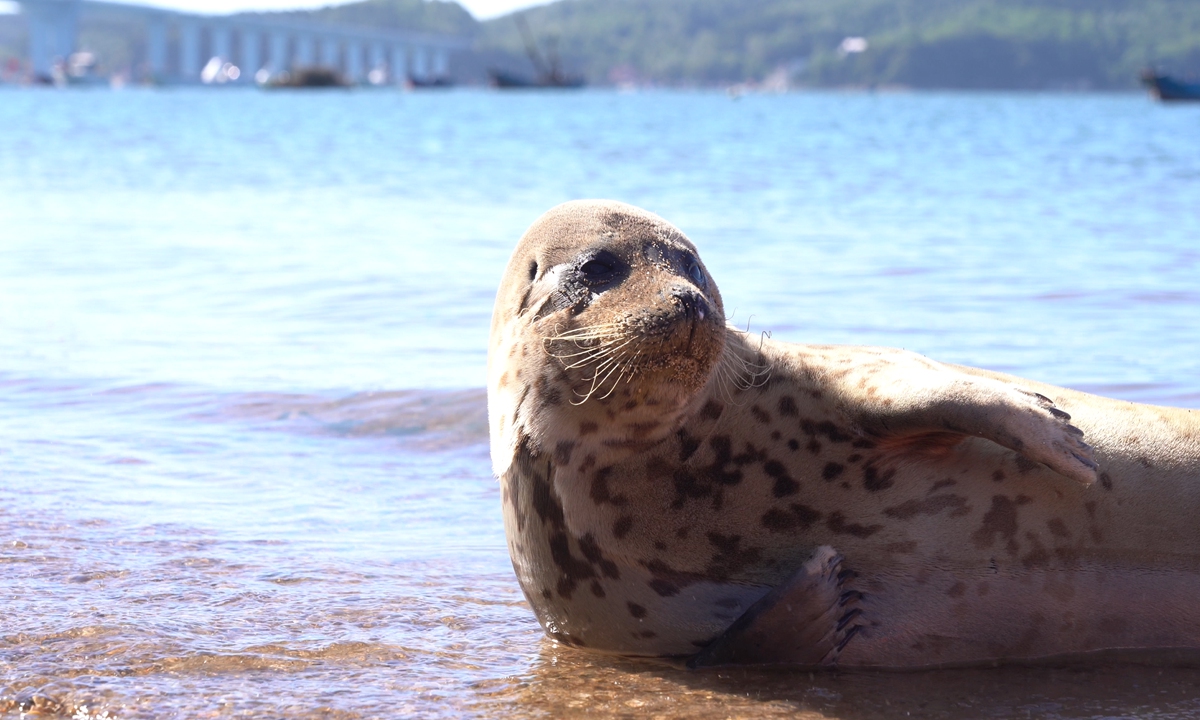
Nana the spotted seal Photo: Courtesy of Zhang Chunlong
Journey back
Nana's second return suggests that he retains important survival abilities. According to Tian Jiashen, director of the Rare Marine Animal Protection Research Department at the Liaoning Ocean and Fisheries Science Research Institute, his ability to navigate back from a distant location indicates that he is in relatively good condition and has a strong ability to navigate.
During the seven-day journey, Nana passed through waters near Pikou in Dalian and visited the Guanglu and Guapi islands before reaching Dachangshan Island.
He has also demonstrated that he can forage independently, according to Zhang Chunlong, deputy director of the Changhai County Marine Development Bureau.
The surrounding waters are of good quality and have abundant fish and shrimp, while spotted seals have been previously observed in the wider area. Spotted seals, also known as Pacific harbor seals, are a first-class nationally protected wild animal in China. They are the only pinniped species known to breed in Chinese waters, according to Xinhua News Agency.
Each year, they migrate to Liaodong Bay between October and December. They give birth and raise their young on the ice in January and February before gradually leaving the Bohai Sea in spring.
Nana's behavior, however, has not followed the expected pattern. Tian said Nana's prolonged exposure to human care and feeding when he was young may have contributed to his tendency to remain near people.
After his release, he did not join a group of seals, potentially leaving him without the social cues that could help guide his behavior.
His attachment to the beach does not necessarily mean he has lost the ability to survive in the wild. His journey back, along with his ability to find food independently, suggests otherwise. But his frequent proximity to people means that protecting him will require more than simply providing a suitable habitat, Zhang said.
Making room
For local authorities, the immediate priority is to reduce human interference without unnecessarily restricting Nana's movements.
One important part of the plan is to stop feeding Nana. Local authorities intend to let him hunt for himself, helping him retain his natural foraging behavior and avoid becoming dependent on food supplied by people.
They have established a 20-meter buffer zone to prevent visitors from approaching too closely. Regular patrols and inspections at sea will help monitor his condition, while tourists and livestreamers are being urged to observe and photograph him from a distance.
Still, keeping a distance does not mean leaving Nana without protection.
Local authorities and the Liaoning Ocean and Fisheries Science Research Institute have developed wildlife rescue and emergency transfer plans.
If he shows signs of illness or injury, trained professionals can intervene.
At just over 2 years old, Nana is still young, as spotted seals typically reach maturity at around 4. It remains unclear whether he will stay around Dachangshan Island or eventually resume his migration toward Liaodong Bay, Zhang said.
The surrounding marine environment offers favorable conditions for his survival, but it is too early to know whether he will remain in the area permanently. His movements and condition will need to be monitored, added Zhang.
In July, UNESCO added the Changshan Archipelago off Dalian, Northeast China's Liaoning Province, to its World Heritage site for migratory bird sanctuaries along the Yellow Sea-Bohai Gulf coast.
The southern rocky reef belt of Bashao Island, part of the archipelago, is also an important breeding ground for western Pacific spotted seals, according to UNESCO.
RELATED ARTICLES