China’s NDRC issues updated outbound investment rules as overseas investment stock tops $3.4 trillion
By Published: Oct 22, 2026 11:22 PM

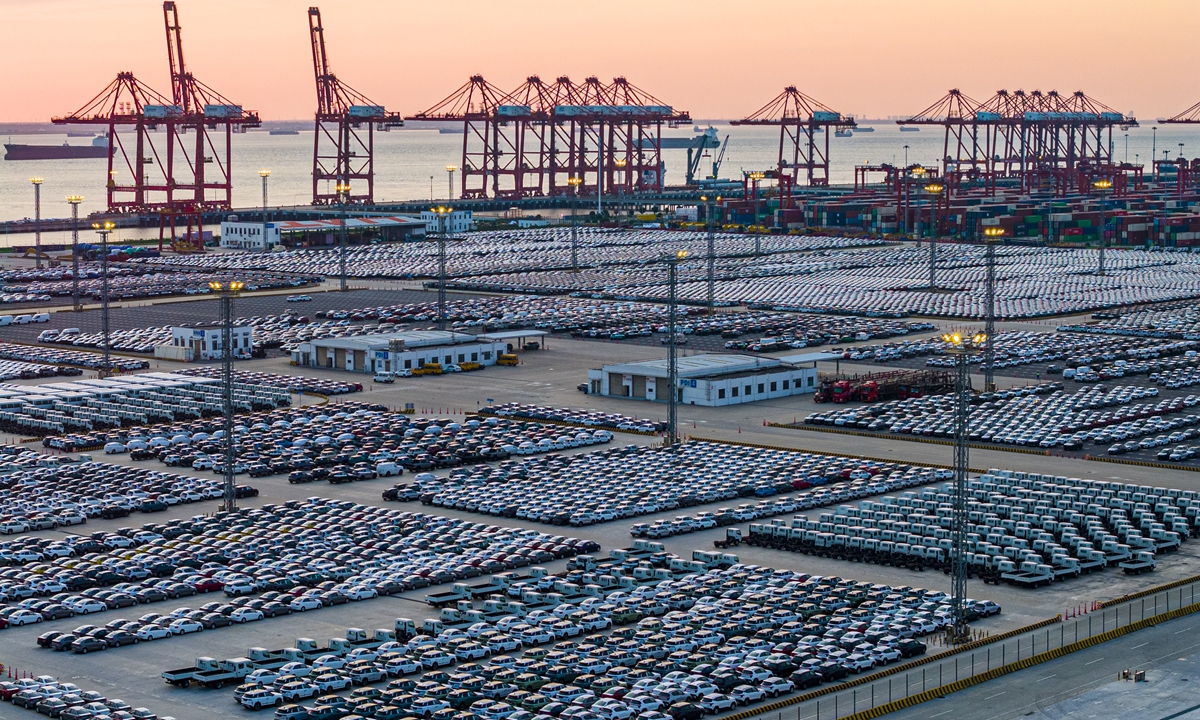
Domestically produced vehicles are ready for export overseas at the Taicang port zone of Suzhou Port, East China's Jiangsu Province on July 14, 2026. Photo: CNS Photo
The National Development and Reform Commission (NDRC), China's top economic planning agency, has announced revised administrative measures for outbound investment, aiming to provide stronger institutional safeguards for its development and security.
Government officials and analysts said that the updated rules, which include articles asking companies to make annual reports on sensitive overseas investment, will better protect the rights and interests of companies making outbound investment and help investors guard against risks as China's overseas investment expands in a more volatile global market.
The rules support investors conducting outbound investment according to market principles and participating in international cooperation and competition. Investors have the right to make their own investment decisions, bear their own risks, and assume responsibility for their own profits and losses, according to a notice posted on the NDRC's website on Thursday.
The new rules requested pre-investment approval by the NDRC for projects in sensitive countries and regions such as those in conflict and sectors such as weapon development and cross-border water resource development. Non-sensitive investment exceeding $300 million needs to go through a file and documentation process.
Along with high-quality Belt and Road cooperation, China's outbound investment has achieved substantial development, with flows rising from $158.3 billion in 2017 to $213.6 billion in 2025, and the overall investment stock increasing from $1.8 trillion to $3.4 trillion. Outbound investment has steadily promoted the "going global" of Chinese products, services, brands, and standards, enabling domestic investors to obtain investment returns and creating many job opportunities, an NDRC official said in a statement posted on the agency's website on Thursday.
However, the external environment has undergone complex and profound changes, with rising unilateralism and protectionism and frequent local conflicts and turbulence, increasing the risks of outbound investment, the NDRC official said, explaining the necessity of the new measures.
In addition, a small number of countries and regions have in recent years adopted discriminatory measures, with some requiring the Chinese side to provide technology or data or to dispose of equity or assets, harming China's rights and interests.
In response to such issues, the new measures implement the provisions on outbound investment protection under the State Council's regulations on outbound investment, improve the reporting system for major adverse situations, and establish an annual reporting system for outbound investment information, the NDRC official said, noting that investors reporting such situations to the administrative authorities will help pool efforts to protect outbound investment rights and interests.
The new rule will take effect on December 1, superseding the incumbent rule imposed in 2017.
Song Wei, a professor at the School of International Relations and Diplomacy at Beijing Foreign Studies University, told the Global Times on Thursday that the new measure will further Chinese companies' "going global" drive by setting up more safeguard mechanisms to cope with rising risks in overseas markets amid protectionist headwinds, rising unilateralism and geopolitical conflicts.
"The enhanced protection and service by government departments as well as the improved reporting system will enhance companies' ability to avert and overcome risks and market failure, encouraging outbound investment to grow in both scale and quality," the expert said.
At a press conference held by the State Council Information Office on Thursday, an official with China's Ministry of Commerce (MOFCOM) noted that that during the 14th Five-Year Plan (2021-25) period, China's two-way investment remained among the world's leaders.
Cumulative utilized foreign direct investment over the five years exceeded $750 billion, and non-financial outbound direct investment covered nearly 190 countries and regions, with cumulative investment exceeding $800 billion over the five years, according to Vice Commerce Minister Jiang Chenghua.
China's outbound investment stock ranked among the world's top three for nine consecutive years as of the end of 2025. In the first three quarters of this year, outbound direct investment reached $128.62 billion, achieving steady and orderly development, according to the MOFCOM.
Analysts said that as China's outbound investment continues to expand in scale and improve in structure, many emerging markets stand to benefit.
"China's robust growth in manufacturing upgrading offers a wide range of opportunities for developing countries in terms of overseas investment and international supply chain cooperation," Wichai Kinchong Choi, a senior expert at Thailand's Kasikorn Bank, told the Global Times on Thursday.
In recent years, China's investment in Thailand has become increasingly technology-intensive, covering fields such as electronic components, circuit boards, smart home appliances, data centers, and electric vehicles. These investments are highly consistent with Thailand's industrial development direction and are areas the Thai government intends to develop, playing a positive role in promoting Thailand's industrial upgrading, Choi said.
RELATED ARTICLES