Lula’s reelection brings continuity to China-Brazil ties, fresh momentum for Global South cooperation: expert
Historic election result draws attention to BRICS coordination and Latin America’s political landscape
By Published: Oct 26, 2026 12:56 PM

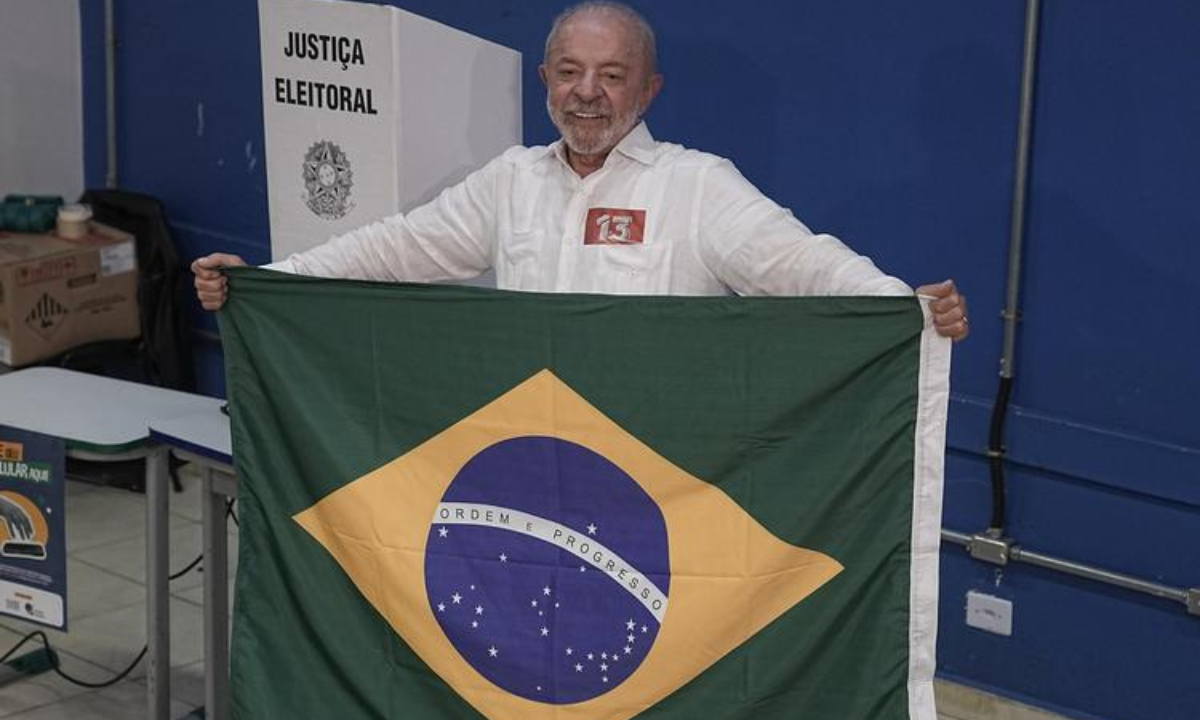
Brazilian incumbent President Luiz Inacio Lula da Silva, presidential candidate of the ruling Workers' Party, displays a national flag of Brazil after casting his ballot at a polling station in Sao Bernardo do Campo, Brazil, Oct. 25, 2026. (Photo by Paulo Lopes/Xinhua)
“Thank you, Brazilian people,” Brazilian President Luiz Inacio Lula da Silva wrote on social media on Sunday night after securing a historic fourth presidential term in a dramatic electoral comeback.Lula’s victory has drawn international attention not only for its implications for Latin America’s shifting political landscape, but also for the future of China-Brazil relations, with prospects for deeper economic cooperation, sustained high-level diplomatic engagement and closer coordination within BRICS and other multilateral frameworks coming into focus.
With 99.96 percent of the votes counted, Lula received 51.78 percent of the valid votes, compared with 48.22 percent for Flavio Bolsonaro, the Liberal Party's presidential candidate and son of former Brazilian President Jair Bolsonaro, according to the official tally, the Xinhua News Agency reported.
Lula will be sworn in on January 5, 2027, for a four-year term, marking his fourth election as Brazil's president.
The victory marked the first time a presidential candidate in Brazil had overturned a first-round deficit to win a runoff election. According to Xinhua, Brazil's presidential election follows a two-round majoritarian system. To win in the first round, held on October 4, a candidate must secure more than half of the valid votes. Flavio Bolsonaro finished ahead of incumbent Lula, winning about 47 percent of the valid votes against Lula's roughly 45 percent. As neither candidate crossed the 50-percent threshold, the two advanced to a runoff, which Lula won.
The election outcome comes amid significant political shifts across Latin America and growing geopolitical competition in the region. International media have highlighted the implications of Lula’s victory for Brazil’s relations with major powers, particularly China and the US, as well as the country’s role in promoting cooperation among Global South nations.
The South China Morning Post reported on Monday that Lula’s reelection would extend the tenure of an administration under which Chinese investment in Brazil had reached record levels.
Pan Deng, director of the Latin America and Caribbean Region Law Center at the China University of Political Science and Law, told the Global Times on Monday that Lula’s reelection has provided stability and predictability for China-Brazil relations over the next four years.
Pan said the political consensus reached by the two countries’ leaders during Lula’s 2023 visit to China, together with sustained high-level exchanges, has strengthened mutual trust and provided strategic guidance for bilateral ties. Despite potential constraints from a conservative Congress, cooperation with China enjoys broad support across Brazil’s political spectrum and is unlikely to be significantly affected by domestic political divisions, he added.
China’s top diplomat Wang Yi met with Special Advisor to the President of Brazil Celso Amorim on September 16 in Beijing. Amorim said Brazil stands ready to work with China to implement the consensus reached by the two heads of state and inject new connotations into building a Brazil-China community with a shared future for a more just world and a more sustainable planet, Xinhua reported.
China has remained Brazil’s largest trading partner for years, with bilateral economic ties forming a major pillar of the broader relationship.
Trade between Brazil and China reached a record $143.3 billion in the first nine months of 2026, reinforcing China's position as Brazil's largest trading partner. Brazilian exports to the Chinese market totaled $84.7 billion between January and September, an increase of 12 percent compared with the same period in 2025. Imports from China rose 9.9 percent to $58.6 billion.
The figures were released by Brazil's Ministry of Development, Industry, Trade and Services (MDIC) and compiled by the Brazil-China Business Council (CEBC), according to a report published by Valor Econômico and covered by Brasil 247.
Looking ahead, Pan identified three areas with significant growth potential for China-Brazil cooperation: green and low-carbon development, including renewable energy and environmental protection; the digital economy and artificial intelligence, particularly in agriculture and AI governance; and expanded aerospace cooperation, building on the two countries’ longstanding satellite partnership to advance remote-sensing applications in agriculture, disaster prevention and logistics.
Xu Shicheng, vice president of the China Society of Latin American Studies, told the Global Times on Monday that Lula’s reelection could also help take China-Brazil relations to a new level, as bilateral cooperation has expanded beyond traditional commodity trade into emerging sectors such as electric vehicles, renewable energy, infrastructure and advanced technologies.
Beyond specific industries, Chinese analysts also pointed out that the Lula administration’s emphasis on strategic autonomy and economic development aimed at improving people’s livelihoods aligns closely with China’s pursuit of high-quality development and open, inclusive international cooperation. At the multilateral level, Lula’s reelection is also expected to provide continuity for Brazil’s participation in BRICS and broader Global South cooperation, they noted.
China and Brazil could continue coordinating their positions on reform of the United Nations and World Trade Organization, global debt restructuring and international climate negotiations, helping ensure that global governance arrangements better reflect the concerns and development needs of emerging economies, Pan said.
The two countries could also jointly initiate inclusive cooperation projects targeting developing nations, providing additional opportunities for Global South countries to participate in international economic and technological cooperation. Pan said such initiatives could contribute to a more equitable international development environment and strengthen the collective voice of developing countries in global affairs.
The election has also attracted attention for its potential implications for Latin America’s political landscape.
Reuters reported that Lula’s victory came against the backdrop of recent electoral gains by right-wing political forces in several Latin American countries, raising questions about how Brazil’s regional diplomacy might evolve during his next term.
Pan argued that Lula’s victory should not simply be viewed as a return of a particular ideological camp, but rather as a pragmatic response by Brazilian voters to economic and social challenges, including high inflation and poverty pressures associated with neoliberal policies. The outcome could strengthen Latin America’s pursuit of independent development and inject fresh momentum into regional integration, he said.
Xu noted that Lula could face considerable domestic political challenges during his fourth term, as right-wing and center-right forces secured significant representation in Brazil’s Congress. Nevertheless, he said Lula’s previous poverty alleviation and social welfare policies have retained support among lower-income voters, while his administration is expected to continue prioritizing BRICS cooperation and Brazil’s role in the Global South.
The election also sends a message that Latin American countries can pursue development paths suited to their own national conditions rather than relying on Western-led models, while expanding diversified international partnerships, Pan said. He added that the result reflects growing regional aspirations for independent decision-making and resistance to external interference.
