GT Economic Investigates: What opportunities does China’s AI wave present for Indian software companies?
By and Published: Oct 27, 2026 09:21 PM



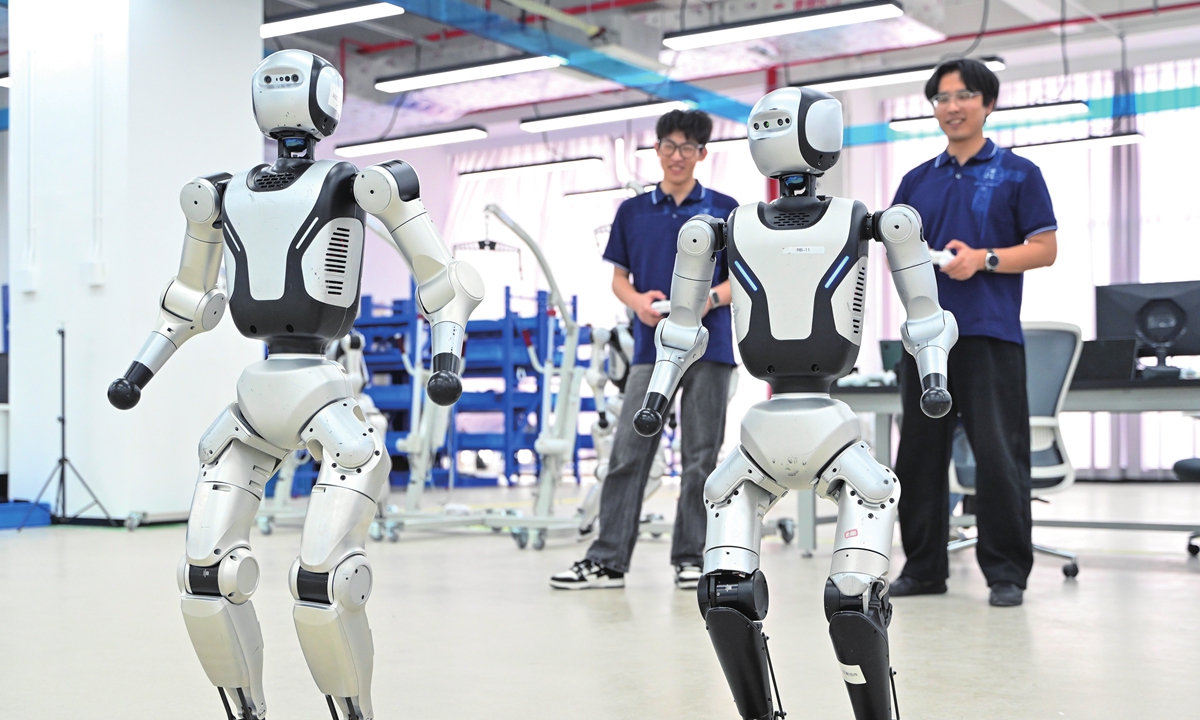
Humanoid robots undergo testing and debugging at Shenzhen's first humanoid robot pilot production line in South China's Guangdong Province on April 12, 2026. Photo: VCG
Mathivanan Venkatachalam, Global Vice President of ManageEngine, is on a trip to China. He has visited Beijing and is scheduled to meet with a customer in Shenzhen on Wednesday. During this visit, he is tracking developments in China's AI landscape and the digital needs of local enterprises, while gaining a deeper understanding of the Chinese market's operating environment and client requirements.
Indian-based ManageEngine, a division of Zoho Corporation and a provider of enterprise IT management solutions, recently rolled out Zia AI agents across its full-stack IT management product suite for the Chinese market. This marks the latest step in the company's efforts to deepen its localization and expand its presence in China.
The firm launched more than 30 AI agents in the first batch and plans to increase the number to over 100 by the end of 2026. The upgrade is designed to enhance its full-stack IT management capabilities, automate routine operational tasks and enable autonomous business execution, according to information the company shared with the Global Times.
Against the backdrop of fierce global competition in enterprise AI, Indian tech players are stepping up localization efforts in China to cater to the specific needs of local corporate users. Meanwhile, a growing number of Indian firms, driven by cost considerations, are adopting Chinese open-source models such as DeepSeek and Kimi and developing tailored applications based on them.
Indian firms have strengths in their abundant tech talent and competitive drive. China, as the world's second-largest economy, boasts solid infrastructure, a complete industrial chain for servers and storage, a massive domestic market and extensive real-world application scenarios - major draws for Indian investors, some Chinese analysts said on Tuesday.
China has solid strengths in AI R&D, real-world deployment and foundation model ecosystem development, while India has rich experience and talent in global IT services, software outsourcing and enterprise solution delivery. The two sides have promising prospects for AI cooperation and can deepen collaboration in R&D, market expansion and standard-setting to support the healthy development of the global AI industry, they noted.
Expanding footprint
During Venkatachalam's visit to Beijing, ManageEngine, which has been in the Chinese market for about 20 years, announced that it will invest 425 million yuan ($63.73 million) in the Chinese market over the next five years, with funds primarily allocated to data center construction, AI R&D, technical support system development, and strengthening its partner ecosystem. To date, ManageEngine has served over 5,000 enterprises in China and has established partnerships with more than 100 organizations.
Given that overseas platforms such as Google are not suited for domestic needs, ManageEngine chose to actively engage with China's domestic large-model ecosystem and integrate its products with local large language models (LLMs) such as DeepSeek, Venkatachalam said in an interview with Global Times.
Over the past five or six years, ManageEngine has continued to invest in localization R&D, refining technologies and products to meet the needs of Chinese customers and gradually building localized IT service capabilities. This also an important reason for the company's continued investment in the Chinese market, he added.
Amid the global AI boom, a growing number of Indian tech firms are leveraging Chinese LLMs to lower costs and broaden the reach of their AI services.
The Indian government has a national AI mission and is encouraging private-sector Indian firms to play an active role in the holistic development of the AI Ecosystem in India, cutting across all verticals. Our organization is exploring cooperation with Global AI models for e-commerce development and delivery services, Mansoor Nadeem Lari, CEO of the India-based Silk Route Trade and Industry Development Corp, told the Global Times.
In this regard, Lari said his organization had recently been in touch with Accio Work, an agentic AI platform for international units under Alibaba, which he described as a tool for comprehensive e- commerce services. We will be cooperating in the near future with the Chinese e-commerce AI ecosystem, as it has been instrumental in the massive growth of China's $400 billion cross-border e-commerce exports, Lari added.
Lari is not alone.
Puneet Kumar, CEO at Mirae Asset Venture Investments India, said that several consumer technology startups that he has met since mid-2025 use such Chinese open-weight LLMs - those that rely on publicly accessible parameters - which help drive down costs by an "order of magnitude," Nikkei Asia reported in July.
Because these parameters are publicly available, users can download and modify them on their own computers, in contrast to the proprietary offerings by US frontier labs such as OpenAI and Anthropic. The Chinese open-weight LLMs can be accessed in India through service providers such as Microsoft at a fraction of the price of their American counterparts, thanks to their low cost of development, the report said.
India has a large pool of technical talent and distinctive strengths in higher education. Many of its homegrown enterprises are ambitious and have developed competitive advantages in certain sectors. Meanwhile, China has equally notable strengths: As the world's second-largest economy, it has well-developed infrastructure, a comprehensive industrial chain, a huge domestic market and advanced capabilities in translating technologies into real-world applications. These advantages are key reasons why Indian firms value the Chinese market and choose to establish a presence here, Xiang Ligang, president of the Beijing Institute of Intelligent Era Industry, told the Global Times on Tuesday.
Complementary strengths
The Indian government has ramped up investment in AI in recent years. In March 2024, it launched the IndiaAI Mission, a national industrial initiative that provides AI startups with digital infrastructure including access to critical GPU computing resources, alongside policy and financial support.
India's listed AI market could gain an additional $50 billion to $100 billion in market capitalisation over the next two to five years as privately held AI companies move towards initial public offerings (IPOs), ANI reported on October 21, citing a report by Goldman Sachs.
India has a huge population base and diversified market demand, providing broad space for the application of AI technologies. With strong government support, major Indian companies such as Adani, Tata, and Reliance Industries have been continuously increasing investment in AI and data center construction in recent years, boosting the development of India's digital economy, according to media reports.
For instance, Tata Communications Ltd. announced investments of close to $450 million on Monday to build high-speed network cables connecting India's AI data-centre corridors, Reuters reported.
In Xiang's view, populous India enjoys unique advantages for AI development: its large population underpins a substantial pool of usable data, and its linguistic and cultural diversity yields rich datasets for training advanced AI models.
According to Forbes India in March of 2025, India is home to around 3 percent of the world's data centers but produces about 20 percent of the world's data.
Xiang noted that India's startup ecosystem continues to mature and its sizable digital public infrastructure (DPI) has devleoped to a considerable scale. With strengths in IT talent, digital public infrastructure and a fast-growing startup ecosystem, India has conisderable potential in the global AI race.
China and India do have complementary strengths that provide a solid foundation for AI cooperation. China has accumulated extensive expertise in AI R&D, real-world application deployment and development of the foundation-model ecosystem, while India has extensive experience and a deep talent pool in global IT services, software outsourcing and enterprise-level solution delivery, Qian Feng, director of the Research Department at Tsinghua University's National Strategy Institute, told the Global Times on Tuesday.
The two countries have broad prospects for AI cooperation and can deepen collaboration in areas including technology research and development, market expansion and standards-setting to jointly promote the sound development of the global AI industry, Qian said.
In practice, some mid-sized Indian IT service providers are using AI to reshape their business models, creating new revenue streams by helping clients reduce the costs of software and AI use. Meanwhile, Indian firms including Krutrim and AceCloud have deployed DeepSeek models on on-premises servers to balance cost and compliance. This "Chinese models plus Indian services" framework leverages the technological and cost advantages of Chinese foundation models alongside the localized service and delivery capabilities of Indian IT companies, serving as a typical example of complementary cooperation, Qian added.
Observers also draw a clear distinction between India and China's respective trajectories in AI.
China leads the frontier-model race for now, DeepSeek, Qwen and Kimi are some of the widely known open-source models that have successfully beaten the frontier models of the West. India's compute build is real but at an earlier stage, Manish Bhandari, the founder of Vallum Capital Advisors, a Mumbai-based investment management firm told the Global Times.
India's IndiaAI Mission had empaneled 18,693 GPUs, including 12,896 H100s, as of early 2025, with plans to roughly double that. That's India's real edge, not out-building China on pre-training economics, but deploying whatever gets open-sourced. An open-weight model hands away the hardest part - training - for free; what's left is fine-tuning, compliance-wrapping, and integrating it into a client's actual infrastructure, which is exactly the muscle Indian IT services and Global Capability Centres have built across every prior enterprise wave, Bhandari said.
He also said that, China, among others, keeps open-sourcing models, while Indian IT services keep capturing deployment margin on whichever ones clients choose. Realistic cooperation looks like arm's-length absorption of open models, not joint compute or data-sharing ventures.
RELATED ARTICLES