ARTS / CULTURE & LEISURE
Australia returns two Song Dynasty statue heads, representative relics of stone carving art, to China
By Published: Oct 28, 2026 12:42 PM

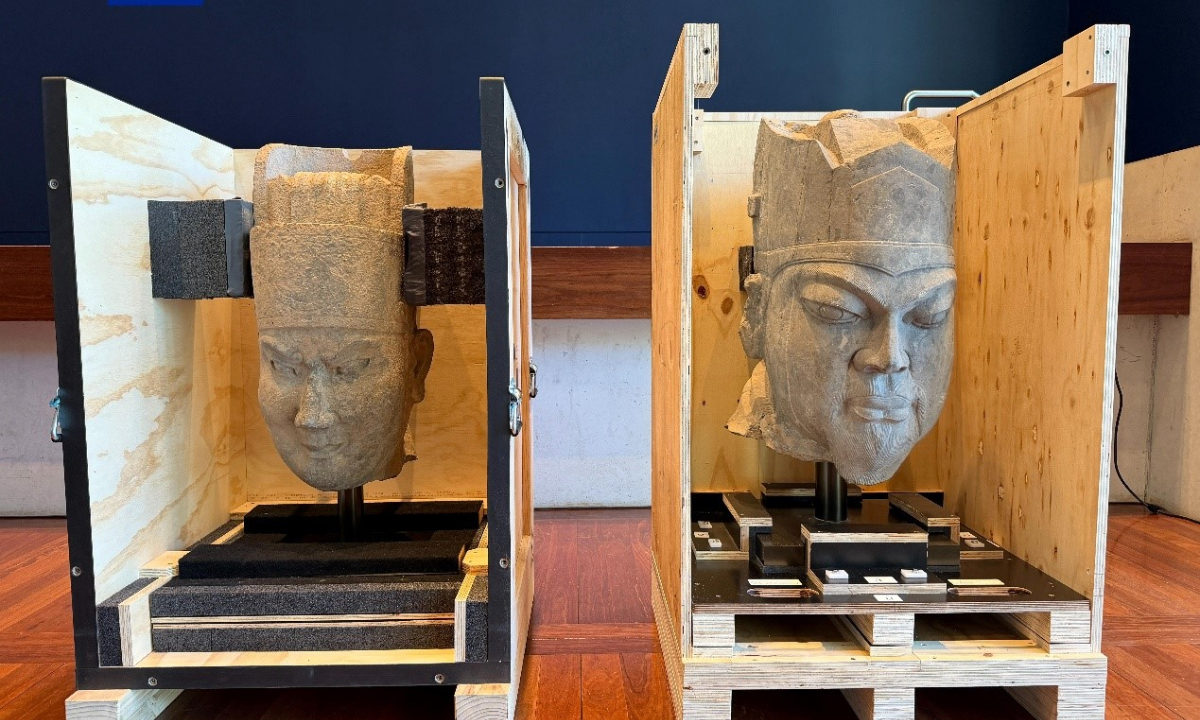
The two Northern Song dynasty (960-1127) statue heads that Australia returned to China. Photo: National Cultural Heritage Administration
Australia on Wednesday returned two cultural relics to China, with China's National Cultural Heritage Administration (NCHA) receiving them at the National Gallery of Australia. This return marks the latest repatriation of cultural relics under the current bilateral and international heritage framework, according to a press release that NCHA sent to the Global Times on Wednesday.The two pieces are the head of a statue of a civil official from the Yongchang Mausoleum and the head of a statue of a military official from the Yongyu Mausoleum, both linked to China's Northern Song Dynasty (960-1127) imperial tombs.
The mausoleums are located in the city of Gongyi, Central China's Henan Province, home to China's largest and relatively well-preserved group of stone sculptures from Northern Song imperial tombs. The sculptures include human figures and auspicious beasts and are noted for their rich forms and fine carving.
The two stone carving heads were both stolen and cut from the Northern Song imperial tombs in Gongyi, and trafficked out of China in the 1990s, before being collected by the National Gallery of Australia.
According to the National Gallery of Australia's records, the two objects are made of limestone. The military official head is 68 centimeters high and weighs 132 kilograms, while the civil official head is 70 centimeters high and weighs 223 kilograms.
The returned statue heads are representative examples of Song Dynasty stone carving, the press release noted.
The two heads were handed over at a ceremony in Canberra on Wednesday, with representatives from both countries in attendance.
Tang Wei, deputy director of China's NCHA, said the return of lost relics to their countries of origin is a "just cause" that helps protect cultural property, respects the cultural rights and national sentiments of people in all countries and safeguards the achievements of human civilization.
Tang said the cooperation was an important result of China and Australia jointly implementing international conventions and protecting cultural heritage, and is sure to further promote people-to-people and cultural exchanges.
The representative from Australia said the return was not merely a transfer of objects but reflected respect for cultural heritage, a sense of responsibility and international partnership. The representative also said the handover will help deepen Australia-China friendly relations and encourage continued cooperation in cultural heritage protection.
The return followed an investigation carried out by NCHA together with the Ministry of Public Security and cultural heritage and public security departments in Henan.
In 2025, the administration submitted a memorandum to the National Gallery of Australia requesting the return of the two objects, formally launching a claim.
The case was resolved under the framework of the 1970 UNESCO Convention, the 2009 inter-governmental memorandum of understanding between China and Australia on the protection of cultural property, and the National Gallery of Australia's 2021 policy on due diligence and provenance research.
The Australia case comes amid a number of recent returns. In September, the US returned 64 cultural artifacts and fossils in two separate batches, including a bodhisattva torso from Tianlongshan Cave 17, figurines, pottery figures and dinosaur fossils. That same month, the UK returned 12 Chinese cultural artifacts seized by London's Metropolitan Police during investigations.
Huo Zhengxin, a professor at the China University of Political Science and Law, told the Global Times that China has stepped up efforts to protect cultural relics and recover those lost overseas, signing bilateral agreements with a number of countries.
Since the founding of the People's Republic of China in 1949, more than 150,000 Chinese relics across more than 300 batches have been returned through law enforcement cooperation, litigation, negotiations and donations, according to official figures. Since 2012, more than 500 relics have been returned.
"The US and Australia have bilateral agreements with China and have returned relics on an annual basis, with this year seeing a relatively dense series of handovers. But the UK has no such bilateral agreement with China and returned the items through law enforcement channels," said Huo.
Huo added that bilateral agreements with developed countries have proven to be an effective mechanism, and that Australia has returned items almost every year in recent years.
RELATED ARTICLES