BUSINESS / PRESS RELEASE
Chinese pharma players take center stage at ESMO 2026, highlighting growing global influence
By Published: Oct 28, 2026 06:33 PM

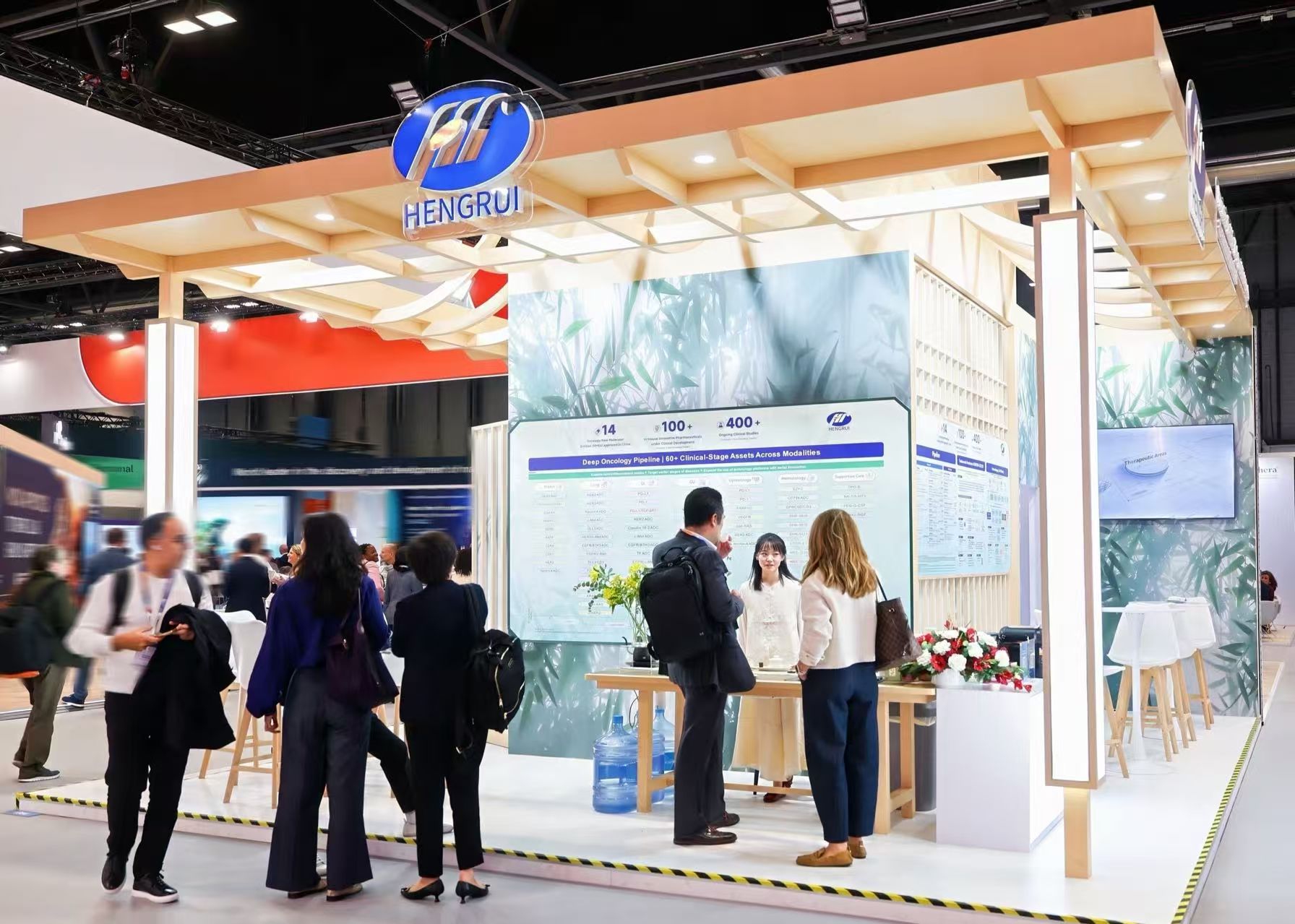
Photo: Hengrui's exhibition booth at ESMO Congress 2026
Chinese-developed cancer drugs achieved a record level of representation at one of the world's leading oncology conferences, from more prominent time slots to higher number of drug presentations. The growing presence reflects the country's expanding contribution to global cancer research and its efforts to bring domestically developed medicines to international markets.
The European Society for Medical Oncology (ESMO) Congress 2026 was held from October 23 to 27 in Madrid, Spain. According to Yaoyanwang, 29 late-breaking abstracts (LBAs) led by or involving Chinese researchers were selected, accounting for about one-third of all LBAs. Among them, five will be presented at the presidential symposia. Chinese innovative drugs featured in 47 Oral/Rapid Oral presentations this year, up from 35 in 2025. Together, these figures point to a broader increase in the visibility of Chinese pharmaceutical research at international oncology meetings.
Among the companies contributing to this trend is Hengrui Pharma (Jiangsu Hengrui Pharmaceuticals Co., Ltd.), a firm that illustrates how Chinese drugmakers are expanding their oncology research portfolios and international engagement. With more than five decades of experience in pharmaceutical research and development, the company has built a broad portfolio across oncology and other therapeutic areas, with products available in more than 50 countries.
The Global Times learned from the company that more than 60 studies have been accepted for presentation at this year's congress, including three Proffered Paper presentations. The selected studies cover 21 innovative medicines, including 9 marketed products and 12 pipeline products, covering breast, prostate, cervical, lung and other cancers.
Oncology is one of Hengrui Pharma's core strategic business areas. In China, Hengrui has brought innovative oncology medicines to market across several oncological areas, including camrelizumab, a PD-1 inhibitor, and trastuzumab rezetecan (SHR-A1811), a HER2-targeted ADC. Its research portfolio covers precision medicine, immunotherapy, targeted therapy and supportive cancer care, targeting diseases such as gastrointestinal, breast, gynecological, head and neck, lung, liver, biliary, pancreatic, urological and hematological cancers. Alongside its marketed products, Hengrui Oncology continues to advance its clinical pipeline, with approximately 50 innovative drug assets in clinical development and around 100 clinical studies underway worldwide.
The growing research activity of Chinese pharmaceutical companies is accompanied by efforts to expand beyond the domestic market. Hengrui Pharma, for example, is advancing its international presence through regulatory submissions, overseas approvals and partnerships. Four of its innovative medicines have received Fast Track designations from the US Food and Drug Administration (FDA), while six have received FDA Orphan Drug designations. The company has also obtained around 20 overseas marketing approvals covering injectable medicines, oral formulations and inhaled anesthetics, improving access to its medicines for patients in different parts of the world.
The broader expansion of China's pharmaceutical industry is reflected in the growth of cross-border licensing and development partnerships. Chinese pharmaceutical companies concluded 81 outbound licensing agreements in the first half of 2026, with a combined potential value of approximately $110 billion, according to Xinhua News Agency — more than 80 percent of the total potential value recorded in 2025.
Continued investment in research and development and regulatory reforms have also supported the industry's development. China approved a record 76 innovative drugs in 2025, according to the National Medical Products Administration. As international partnerships deepen, Chinese companies are increasingly participating in global clinical development and commercialization while also licensing their drug candidates to overseas partners.
China's innovative drug sector has registered notable progress in recent years. The industry has skyrocketed thanks to stronger domestic scientific research capabilities, the return of talent, faster approval procedures for new medicines and favorable conditions for clinical trials. Today, a growing number of innovative new drugs with novel mechanisms of actions and better therapeutic effects have emerged, Zhuang Shilihe, a Guangzhou-based medical expert, told the Global Times. "The industry has shifted from pursuing quantitative catch-up to striving for qualitative breakthroughs, with its R&D capabilities in certain niche segments matching or even surpassing those of global counterparts."
Meanwhile, acceptance at an international conference is only the first step. New medicines must still demonstrate meaningful clinical benefits, meet regulatory requirements and reach patients in overseas markets, according to the expert.
As China's innovative drug industry moves from licensing products abroad toward global collaboration in research, development and commercialization, its growing presence at ESMO offers a glimpse of a changing pharmaceutical landscape.
Ultimately, the progress will be measured by whether Chinese-developed medicines can deliver more effective and accessible treatment options for cancer patients worldwide.
