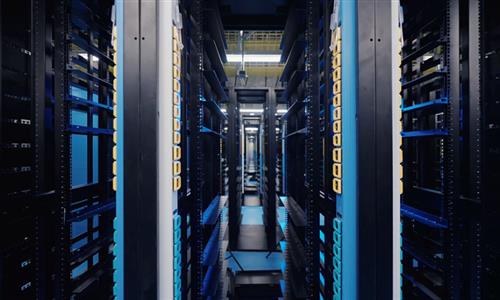
Once known for grasslands and volcanoes, Ulanqab is emerging as a computing hub and expanding its AI industry
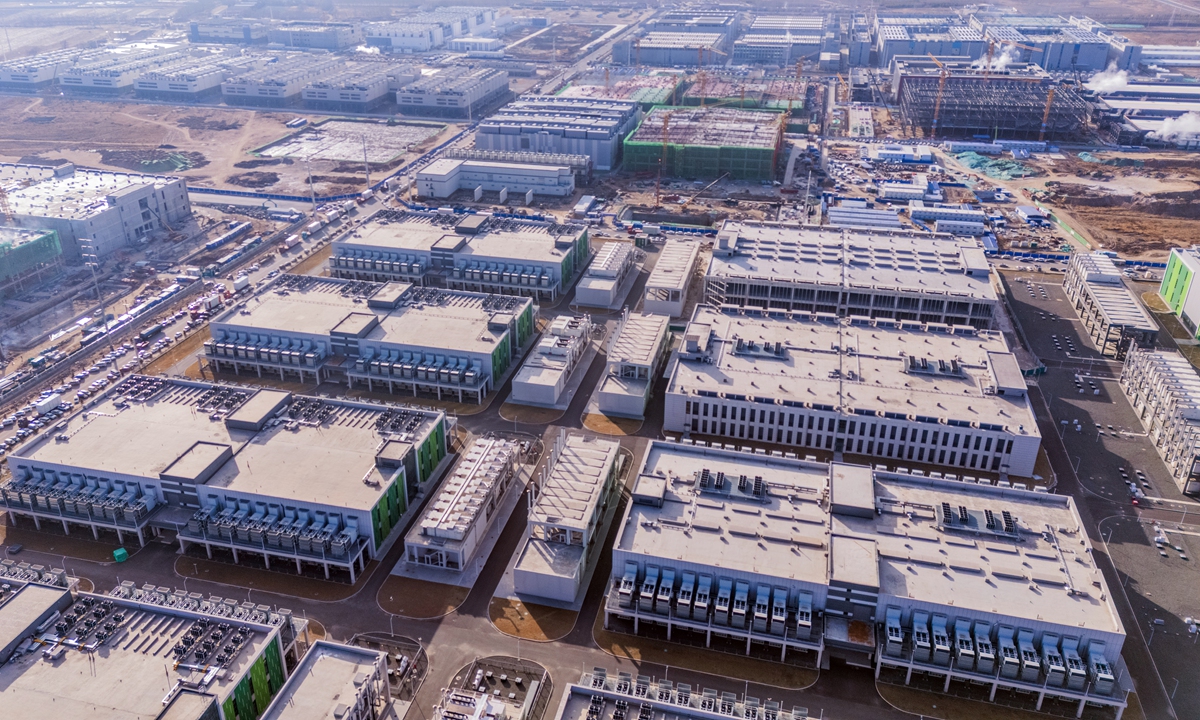
Aerial photo shows the developing Cloud valley data and intelligent computing center cluster in Ulanqab. Photo: VCG
Nearly ten years ago, Zhao Lin, a fresh college graduate from Ulanqab who dreamed of landing a job in a major metropolis like Shanghai, learned that UCloud - a Shanghai-headquartered Chinese cloud computing and AI services provider - was preparing to build a data center in her hometown. She decided to give it a try and applied for a position at UCloud's then still-under-construction Ulanqab unit. At the time, computing was still a nascent industry in the city, which was better known for its grasslands and pastoral economy.
A decade later, Ulanqab is now known for more than its grasslands and volcanic landscapes. Just 1 hour and 50 minutes by high-speed train from Beijing, the city is seeing computing centers rise and big data training programs take shape. The shift is visible even in a cityscape where high-rises remain relatively few.
At the Chahar High-Tech Industrial Development Zone, 109 computing center projects have been signed, involving total investment of more than 700 billion yuan. A total of 720,000 server racks have been built, with 460,000 in operation. The city's computing capacity has reached 190,000 petaflops, with intelligent computing accounting for more than 90 percent, according to local authorities.
In 2013, Ulanqab began developing its big data industry, a move local authorities have since described as the city's "first year of big data." In 2022, the launch of China's "Eastern Data, Western Computing" project brought a broader national push to build an integrated computing network, reinforcing Ulanqab's role as one of its key hubs.
"Just a 'step' west of Beijing lies Ulanqab" is a slogan that captures the city's close proximity to the capital. Once known as a destination for visitors from Beijing due to its close proximity, Ulanqab is now forging a new connection with the capital. Its abundant energy resources, expanding computing infrastructure and growing digital industry are enabling it to supply computing power and related technological services to Beijing and beyond.
Cheap, cold, close
In late October, temperatures in Ulanqab drop to -5 C at night, and water freezes in the biting wind. Yet the cold climate and strong winds offer a natural advantage for computing centers in the city that need to dissipate heat around the clock.
"We like the cold," Zhao Lin, a staff member at UCloud's Ulanqab intelligent computing center, told the Global Times. For a data center, the bitter cold of a Ulanqab winter helps to reduce the energy needed to keep servers cool.
Zhao said that UCloud considers cooling conditions, energy supply, network latency and local industrial support when selecting sites. The long natural-cooling season helps reduce the need for mechanical cooling and cut energy consumption, she added.
"UCloud uses air-cooled chillers with integrated free-cooling functions, harnessing low outdoor temperatures to dissipate heat and reduce reliance on cooling towers and their water supply systems, thereby lowering water consumption," she said.
Low electricity costs are another key factor in site selection, as data centers consume large amounts of power around the clock. Zhao told the Global Times that electricity in Ulanqab costs about 0.32 yuan ($0.048) per kilowatt-hour, with green power accounting for around 80 percent of the center's electricity supply.
But low prices are only part of the story. Some firms are going a step further, harnessing wind and solar to build their own green power stations rather than relying solely on the grid. Centrin Data has built its own power generation facilities connected directly to its data center.
Green electricity travels along a dedicated 16-kilometer line to Centrin Data's zero-carbon computing base in Ulanqab, working alongside the public grid to keep data halls running around the clock. The project is among China's first integrated source-grid-load-storage projects for direct green power supply to data centers. It has 300 megawatts of combined wind and solar capacity and 45 megawatts of energy storage, with annual self-consumption of green power expected to reach 848 million kilowatt-hours.
"Direct green power supply reduces transmission losses through the public grid and significantly cuts electricity costs," a Centrin Data representative told the Global Times. The storage system works like a giant battery, storing surplus power when wind and solar output is high and releasing it when generation falls, helping maintain a stable supply.
Local government planning has also played a role in laying the groundwork for Ulanqab's rise as a computing hub. The city's push into computing infrastructure began well before the recent AI boom.
As early as 2013, Chinese telecom giant Huawei visited the Chahar High-Tech Industrial Development Zone to discuss building a cloud computing data center, marking an early step in the city's development of the sector. Apple followed in 2018, signing an agreement to build its first data center in northern China in Ulanqab, with the facility planned to run entirely on renewable energy. Since then, other major technology companies, including Alibaba, Kuaishou and ByteDance, have also established a presence in the city.
Today, the expansion is visible on the ground. Within the high-tech zone alone, 22 computing-power projects are under construction, involving nearly 30,000 construction workers. Early investment in industrial parks and supporting infrastructure has helped lay the groundwork for Ulanqab's growing role in AI computing.
Full-chain development
The expansion of computing centers is creating opportunities for equipment manufacturers. Inner Mongolia Xinyueda Technology Co was established in 2018 and supplies server cabinets to major technology companies including ByteDance, Tencent and Baidu. Its products range from standard cabinets to customized models, and the company now boasts customers across China, Fu Xiaoxia, a staff member at Xinyueda, told the Global Times.
Fu said the company ships around 200 cabinets a day, with volumes rising in recent years. Beyond cabinet manufacturing, the company also provides cold and hot aisle containment systems, server integration and management, and data center air-conditioning equipment.
Computing power is also being used in fields such as AI model training and inference, autonomous driving, computer vision and chip research and development. These applications require computing resources for tasks ranging from processing large volumes of visual data to supporting complex engineering work. For Ulanqab, the challenge is to build an industry around these facilities, rather than simply host the servers.
Data labeling is another link in the AI supply chain. Han Dongsheng, a representative of local data-sorting company named Wisdom-reach, told the Global Times that the company provides data-labeling services to various clients, covering tasks such as road-scene annotation, dialect labeling and game data processing. Much of the work is still done manually, producing labeled data that can be used to train and develop AI models.
As AI technology advances, data labeling has become more specialized. Han said some projects now require employees with specific professional backgrounds, with certain medical-related tasks requiring graduates with advanced medical training. Monthly earnings for data labelers, which were previously just over 3,000 yuan for many workers, can now reach 3,000 to 5,000 yuan for some positions, depending on project difficulty and piece-rate pay.
The growth of businesses across the supply chain has also helped create jobs. Han told the Global Times that Wisdom-reach has expanded from Ulanqab to establish bases in Hohhot, Jinan and Baoding. The company now employs more than 400 people and works with 10 outsourcing teams totaling around 150 people. Its cumulative business volume has exceeded 100 million yuan, and it has trained more than 3,000 people in data labeling in recent years.
Zhao, one of thousands of local residents who have found jobs in Ulanqab due to the growing computing industry, told the Global Times that she feels fortunate to have such an opportunity in her hometown. Her husband is also a local, and many of the operators at UCloud's data center are from Ulanqab, she said.
The local computing industry spans power equipment, cabinet manufacturing, server recycling and reuse, data labeling, cybersecurity and technical training. These sectors employ more than 1,600 people, while related projects have cumulatively generated more than 10,000 job opportunities, official data said.
The city is also looking beyond computing capacity toward the emerging "token economy." In 2025, Ulanqab issued a three-year action plan for building a "Token Capital" for 2026-2028, outlining plans to develop services related to token production, measurement, evaluation, security and industry applications. Tokens are units of text or other data processed by AI models. The plan reflects the city's ambition to build businesses around AI usage, not just the infrastructure that supports it.
"When I had started work, 'token' wasn't something we talked about," Zhao said. "It's come up more in the past two years."
She hopes the industry keeps growing - so that more people from Ulanqab can build their lives there rather than leave.
For a city long known for grasslands and volcanoes, that may be the real test of its computing ambitions: not how many servers it can host, but whether the industry becomes part of ordinary local life.
RELATED ARTICLES