DeepSeek unveils ‘Super-agent’ design to handle multiple tasks in parallel and improve efficiency
China's AI race extends to real-world applications: expert
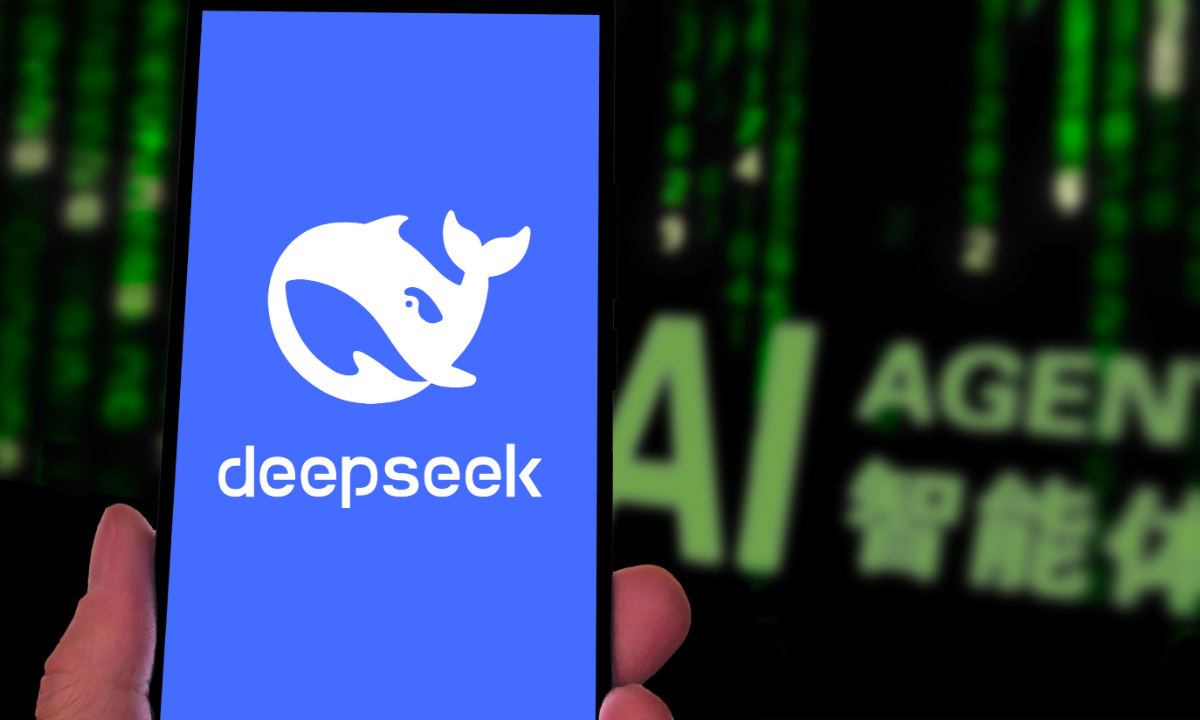
The DeepSeek logo is displayed on a smartphone screen, with the words "AI Agent" in the background. Photo: VCG
Chinese artificial intelligence (AI) company DeepSeek has unveiled a new system architecture called "Super Agent," designed to enable AI agents to handle multiple tasks simultaneously and operate continuously with less human intervention, as China's AI industry shifts focus from model performance to real-world applications and system reliability.
In an article published on Saturday, the DeepSeek Harness team said that as AI models become increasingly capable of completing individual tasks, human attention is emerging as a bottleneck to productivity. Most existing AI agents still operate through separate sessions, requiring users to switch among tasks and manually manage their context. According to the team, one person can keep track of only three to five active sessions at a time.
To address the limitations, DeepSeek proposed four major features for Super-agent: continuity, efficiency, proactivity and persistence. The proposed system would allow users to interact with the same agent across messaging and coding platforms, handle complex tasks, identify matters requiring attention without explicit instructions and remain operational over extended periods, including recovering from interruptions.
The design centers on a two-layer structure comprising a router and multiple workers. The router manages user communication, maintains shared context and assigns tasks, while workers carry out assignments independently and report their progress and results. Supported by event-driven operations, asynchronous interactions and an external monitoring mechanism known as Watchdog, the system aims to take over routine session management and coordination, allowing users to focus on higher-level decisions and evaluating results.
Ma Jihua, a veteran telecom and technology industry analyst, told the Global Times on Sunday that DeepSeek's exploration reflects a broader evolution of AI agents from passive answers to queries and sequential task execution toward parallel processing, event-driven responses and greater autonomy.
"AI agents are evolving beyond simple interfaces for calling large-language AI models into more sophisticated systems capable of handling task scheduling, storage, isolation and fault recovery," Ma said, describing DeepSeek's approach as an exploration of system-level engineering.
The latest design builds on DeepSeek's earlier work on AI agents. In August, the company released a developer preview of DeepSeek Harness, an open-source framework that enables AI models to use tools and execute tasks through a modular, plug-in based architecture.
DeepSeek said that an internal Super-Agent system is now running, helping reproduce and fix software problems, respond to code reviews and improve DeepSeek Harness itself. For example, when developers discuss a potential software bug in a group chat, the agent can identify the issue and try to reproduce it and find a solution in the background, even without being directly asked.
The team has made a research prototype publicly available, but noted that it is not an official DeepSeek product or production-ready software. The published version differs from the system used internally, and some features outlined in the article remain under development.
Ma said that AI competition is increasingly moving beyond model parameters, computing power and reasoning capabilities to how effectively AI systems perform real-world tasks and improve user experience.
"Users no longer judge AI agents solely by their models. Task success rates, the ability to recover from failures and the cost of managing context are important," Ma said. "These all depend on mature scheduling systems. Companies that do better in these areas will be better positioned to win users."
DeepSeek's exploration comes as other Chinese technology companies push AI agents further into business operations.
On Thursday, Tencent said that its Agent Development Platform allows enterprises to customize, manage and coordinate agents for customer service, marketing and operations. Tencent said that a key challenge in enterprise adoption is shifting from improving model capabilities to connecting agents with existing business systems, data and workflows.
Alibaba Cloud is expanding its infrastructure for autonomous AI agents. In July, it introduced AgentLoop and AgentTeams to help businesses monitor agent performance and coordinate multiple agents handling complex workflows. Together with its existing AgentRun platform, the tools support the development, deployment and management of enterprise-level AI applications.
Ma said that China's AI agent industry is entering a stage of platform-based development and real-world adoption, supported by diverse application scenarios, enterprises' willingness to pay for productivity improvements, and the integration of AI agents with cloud services.
He suggested that developing specialized agents for specific industries, followed by closer collaboration among multiple agents, could offer a more practical path toward more capable AI systems.
These developments suggest that as AI models become more capable, the ability to coordinate tasks, manage context and recover from failures has become another important area of competition in China's AI arena. Such capabilities could help turn advances in AI models into true productivity gains, although challenges remain in system scalability, long-term memory, cross-agent communication, and security and privacy protection, according to DeepSeek.
RELATED ARTICLES