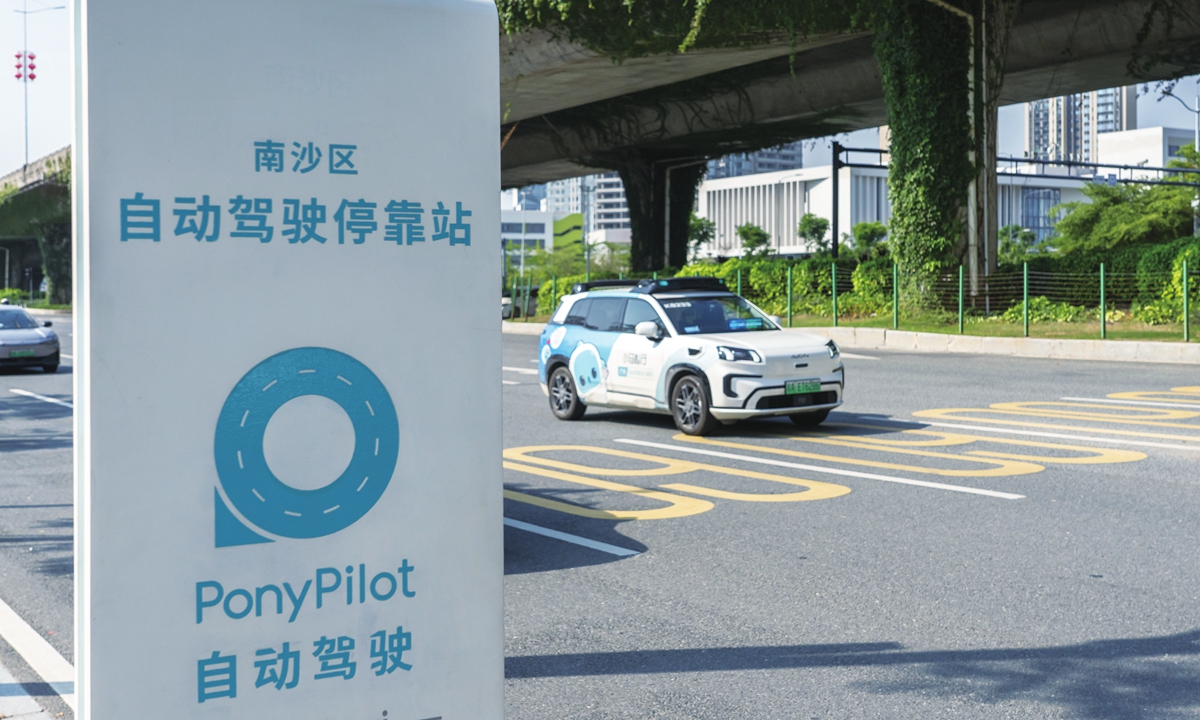
A robotaxi passes through an autonomous driving stop in Nansha district of Guangzhou, South China's Guangdong Province on July 12, 2026. Photo: VCG
"Ding!" The phone screen lights up. The mini-program reads: "Vehicle arrived."
At the exit of Rongjing East Street Subway Station in Beijing's Yizhuang, a robotaxi glides out of traffic and pulls over to pick up Zhou, a Beijing resident taking her first ride in a driverless vehicle.
When Zhou gets in, the vehicle merges smoothly into the traffic stream. The steering wheel turns on its own, the driver's seat is empty. Scenes like this have become commonplace within Beijing's high-level autonomous driving demonstration zone.
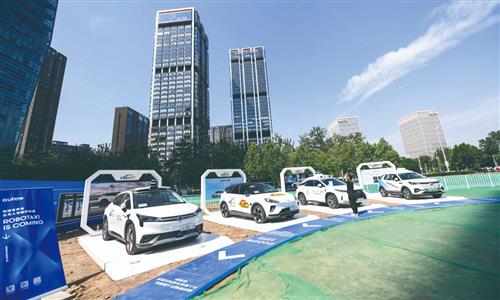
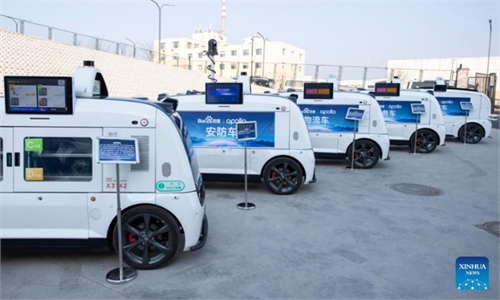
The zone is testing eight applications: robotaxi, unmanned delivery, unmanned retail, autonomous minibuses, unmanned shuttle buses, unmanned sweepers, unmanned patrol vehicles and trunk-line logistics. More than 1,500 vehicles have collectively logged over 70 million kilometers of safe testing, according to an October 22 report from Beijing-based Economic Information Daily.
Companies including Baidu, Pony.ai, and BAIC have established operations in the zone. Together they cover activities ranging from technology R&D and testing and certification to automotive-grade manufacturing and operational services, the report said.
Across China, cities are developing autonomous driving around local industries and transport needs.
In August, Shanghai announced plans to establish a leading zone for advanced autonomous driving. It aims to deploy the technology at scale in heavy trucks, public transit, taxis and logistics, and connect transport hubs, industrial and technology parks, and other locations.
Shenzhen said in June 2026 that it would allow companies to test and demonstrate fully driverless vehicles on public roads. It would also support the testing in complex conditions and the deployment of advanced autonomous driving products.
The autonomous vehicle industry is moving from experimental concept to commercial reality, with deployments expanding across the US, China, and new international markets including parts of Europe and the Middle East, according to Goldman Sachs Research released in April 2026.
Goldman Sachs Research forecasts that the global robotaxi market will reach roughly $415 billion in 2035. It projects that the worldwide commercial robotaxi fleet will grow from roughly 7,000 vehicles in 2025 to about 1 million in 2030 and 6 million in 2035.
Going global
On October 14, less than a week after announcing plans to bring its Gen-7 Robotaxis to London alongside Uber, Chinese autonomous driving technology firm Pony.ai said it was expanding its collaboration with Uber and Verne to Manchester.
Under the partnership, Pony.ai supplies the autonomous driving technology, Verne manages local fleet operations, and Uber connects passengers through its global mobility platform. Pony.ai said the partners are now extending this model to the rest of the UK.
On August 3, WeRide, another Chinese autonomous driving technology company, said it would enter Denmark through a partnership with Danish electric mobility operator GreenMobility, extending its European footprint to a sixth country as Chinese self-driving firms accelerate overseas expansion.
Europe has emerged as a key growth market for China's autonomous driving companies, following an earlier push into the Gulf region, as they seek to commercialize their technology beyond their home market amid intensifying competition and regulatory scrutiny.
In August this year, Baidu's autonomous ride-hailing service Apollo Go announced its official integration with Uber in Dubai, enabling local users to hail fully driverless vehicles directly via the Uber app. Back in March, Apollo Go rolled out its standalone Apollo Go app in Dubai and built up the region's largest driverless vehicle fleet.
In July, Apollo Go kicked off public road tests in London through separate partnerships with Uber and Freenow, a mobility platform backed by Uber and Lyft.
To date, Apollo Go has recorded over 23 million ride orders across 28 cities globally, with more than 350 million kilometers of autonomous driving mileage — over 240 million kilometers of which are fully driverless operations.
In July, Chinese autonomous driving solutions provider Momenta received a testing permit from Germany's Federal Motor Transport Authority, allowing it to conduct Level-4 self-driving tests on public roads across the country, according to information Momenta provided to the Global Times.
The approval makes Momenta the first Chinese company to obtain nationwide L4 testing authorization in Germany. Under the permit, Momenta is allowed to carry out testing across Germany's urban road network.
As competition in intelligent driving intensifies, Chinese autonomous driving firms are preparing to expand overseas, Zhang Xiang, a visiting professor in the engineering department of Zhengzhou-based Huanghe Science and Technology University, told the Global Times.
Zhang went on to say that should these players keep demonstrating the reliability of their systems under diverse road conditions and regulatory frameworks, their international footprint can grow beyond pilot deployments and unlock tangible commercial prospects.
However, expanding from trials to commercial services overseas remains difficult, Zhang Ning, vice president of Pony.ai, told the Global Times. Strict data regulations in markets such as the EU increase entry and compliance costs, he said.
Domestic policy support
By July this year, 70.5 percent of new passenger vehicles in China were equipped with Level 2 combined driver-assistance functions, while 34.2 percent of passenger vehicles were equipped with Navigate on Autopilot functions, Guo Shougang, an official from the Ministry of Industry and Information Technology (MIIT), said at a press conference.
MIIT will support the intelligent connected vehicle sector by expanding communications infrastructure, promoting in-vehicle satellite connectivity and BeiDou applications, and improving connectivity across different operating environments.
China aims to join the ranks of the world's automotive powerhouses by 2030, with stronger advantages across the entire industrial chain of intelligent connected new-energy vehicles (NEVs), the Xinhua News Agency reported, citing a five-year industry development plan released in September 2026.
The plan identifies intelligent connected NEVs as a key direction for transforming the auto industry, as China steps up its efforts to upgrade its industrial sector and build a modern industrial system.
The plan sets targets for NEVs to account for 70 percent of new passenger vehicle sales and 40 percent of new commercial vehicle sales in the domestic market by 2030.
Chinese intelligent vehicle technologies are also reaching commercial production through partnerships with international automakers.
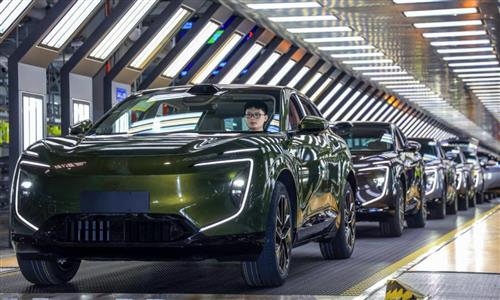
For example, in March 2026, Volkswagen Group said it had begun mass production of its first model developed jointly with Chinese EV maker Xpeng. The ID.UNYX 08, a full-size electric SUV, is equipped with locally developed cutting-edge technologies, including 800-volt ultra-fast charging technology, L2 advanced ADAS (Advanced Driver Assistance System) capabilities, and the ability to continuously upgrade the vehicle with over-the-air updates.
Chinese experts said overseas expansion increasingly involves supplying technology and working with local partners, alongside exporting complete vehicles. Companies are adapting their systems to local roads and regulations while building partnerships for deployment and operation.