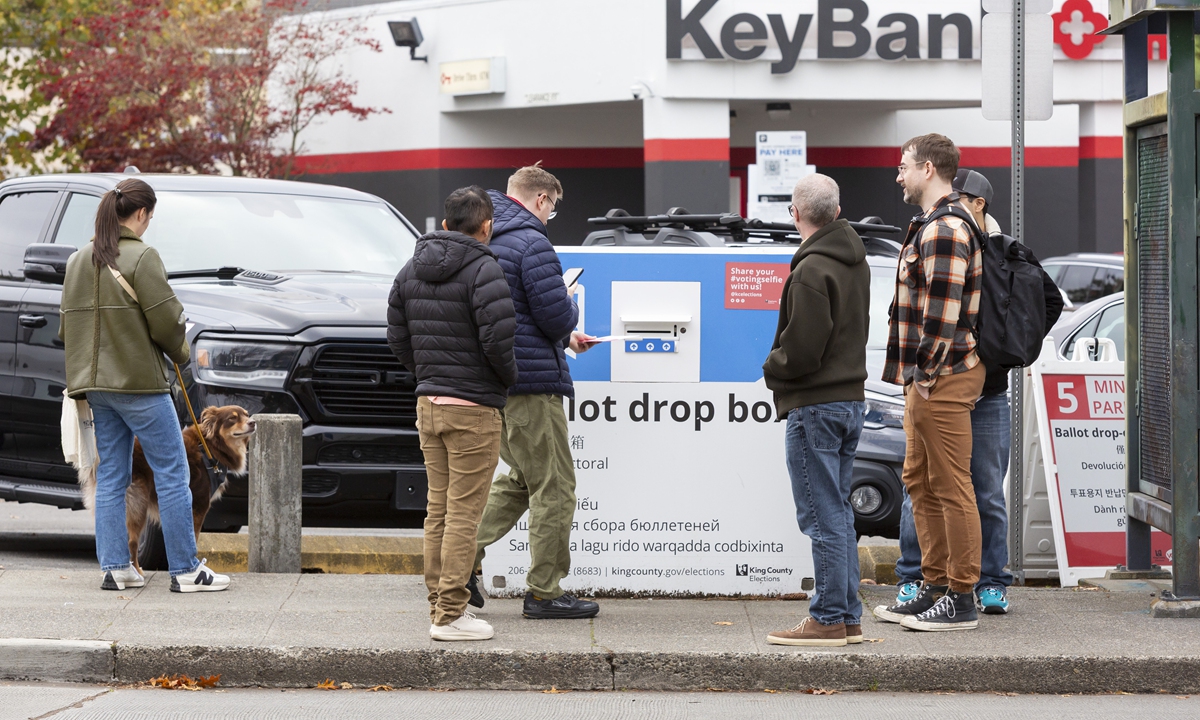
Americans cast their ballots at an early voting station in Seattle, the US, on November 1, 2026 local time, ahead of the US midterm elections on November 3. All 435 seats in the House of Representatives and 35 Senate seats are up for contest. Photo: IC
Americans will head to polling stations on November 3 for midterm elections, the result of which will decide congressional control for the next two years.
Republicans are fighting political history, as the party in power in Washington has traditionally lost seats during midterm election years. The GOP also faces a challenging political climate fueled by persistent inflation tied in part to war with Iran and increasingly negative approval ratings of the US President, according to Fox News on Sunday.
Trump held campaign rallies in Salina, Kansas and Dubuque, Iowa on Sunday. An Associated Press report said these trips reflect the GOP's "defensive posture." It noted that "This year, Trump has focused largely on states he has dominated before as voters, including previous supporters, question the economic fallout of his decision to impose tariffs and launch the war in Iran."
But the BBC reported that there are a number of reasons why Democrats may not have as good a night as history might suggest or as some might expect. Firstly, much of the territory in play in this election Trump conquered with ease in the presidential election just two years ago. It's like a home game for Republicans. Then there have been changes to House election boundaries over the years that have meant fewer seats switch between parties. Thirdly, there are fewer swing voters due to the deeper polarization of the country. Some experts describe the electorate as calcified.
This midterm election first and foremost determines whether the Republican Party can sustain its dominant political position it has enjoyed over the past two years, during which it has held sway over the executive branch, Congress and the Supreme Court. The outcome will also decide whether congressional Democrats can impose greater checks on Trump for the remainder of his term. It also signals whether Democrats will use Congress as a platform to further stoke partisan rifts and fuel escalating bipartisan conflict in the next two years, Wu Xinbo, Dean of the Institute of International Studies of Fudan University, told the Global Times.
Three plausible scenarios loom for the US' polarized electoral landscape: a divided Congress, Democratic majorities across both chambers, or sustained Republican control of Capitol Hill, said Zhang Jiadong, professor at the Center for American Studies, Fudan University.
Unlike presidential contests, midterm elections center on congressional and gubernatorial races, with voter priorities varying sharply across states. Immigration dominates debates in some jurisdictions, while others prioritize prices, inflation, or Middle East-related foreign policy, said the expert.
The midterm results may significantly reshape the current administration's domestic policy operating environment over the coming two years, without necessarily altering the fundamental trajectory of its foreign policy, Zhang noted.
Midterm elections typically center on domestic issues, yet this one is different, Wu said, adding that its result is likely to exert a marked impact on US foreign policy and international dynamics, with repercussions concentrated in the Middle East.
RELATED ARTICLES