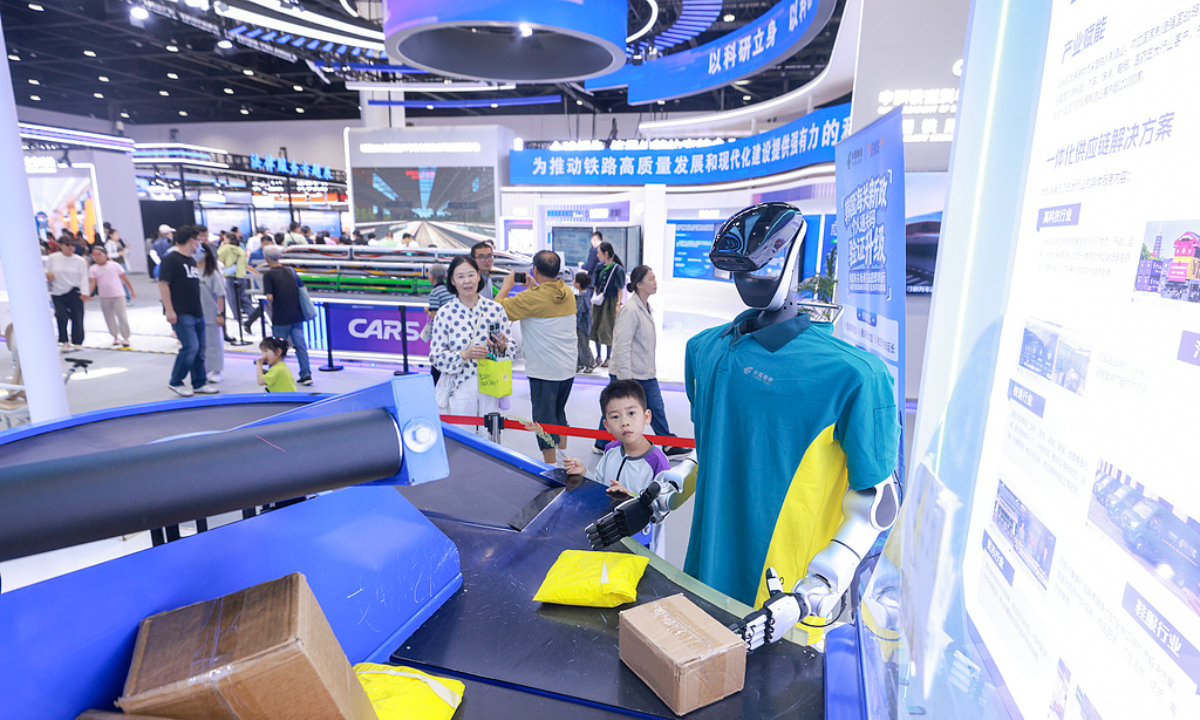
Visitors view a parcel-sorting robot at the transport services section, which drew considerable attention at the 2026 China International Fair for Trade in Services (CIFTIS) in Beijing on September 12, 2026. Photo: VCG
China's services trade grew 8.5 percent year-on-year in the first nine months of 2026, with the trade deficit narrowing and transport services leading growth, official data showed on Wednesday, as the country steps up efforts to foster new growth drivers in the services sector.
The sustained expansion reflects a broader shift toward higher-value services, as China's vast manufacturing base and industrial upgrading open new opportunities in international markets and deepen the integration of manufacturing and modern services, analysts said.
According to the Ministry of Commerce (MOFCOM), China's services trade reached 5.77 trillion yuan ($863.7 billion) during the January-September period. Exports rose 14.8 percent to 2.27 trillion yuan, outpacing a 4.8 percent increase in imports. The services trade deficit narrowed by 132.66 billion yuan from a year earlier to 1.23 trillion yuan.
Transport services led all categories in trade growth, with combined imports and exports surging 33.9 percent to 1.28 trillion yuan, making it China's third-largest services trade category after travel and other business services.
Knowledge-intensive services also maintained solid growth. Trade in the category rose 7.4 percent in the first nine months. Exports climbed 11.7 percent to 1.22 trillion yuan, making up 53.7 percent of total services exports. Personal, cultural and recreational services posted the fastest rate of export growth at 69.1 percent, followed by insurance and pension services at 50.3 percent.
Song Ding, a senior research fellow at the Shenzhen-based China Development Institute, described the narrowing trade deficit as an encouraging development, pointing to China's growing services export capacity and international competitiveness.
"When manufacturing reaches a certain level of development, especially on the scale seen in China, moving further up the value chain and expanding into modern services becomes a natural progression," Song told the Global Times on Wednesday.
This shift is also evident in the growing links between China's manufacturing exports and international transport services, Song said.
"As Chinese-made goods reach more overseas markets, domestic companies are expanding their presence in shipping, rail freight and air cargo networks, rather than relying solely on foreign operators to handle international deliveries."
The momentum is also evident in China's broader services sector. China's services sector expanded 5.2 percent year-on-year in the first three quarters, outpacing overall GDP growth of 4.6 percent, according to the National Bureau of Statistics (NBS). The sector contributed 66.3 percent of economic growth, up 5.6 percentage points from a year earlier.
At an October 19 press briefing, NBS Deputy Commissioner Mao Shengyong highlighted the accelerating integration of advanced manufacturing and modern services, with industrial chains moving toward more specialized, higher-value activities. He also identified artificial intelligence as a key driver of growth in the information technology-related sector.
Advances in technology are creating new opportunities for knowledge-intensive services exports, Song said. "As trade barriers make it harder for Chinese manufacturers to export goods to some markets, companies can instead transfer technology and work with local partners to manufacture products overseas, expanding their international presence through technology-related services."
Domestic demand is providing another source of support. Retail sales of services rose 5 percent year-on-year in the first three quarters, compared with 1 percent growth in retail sales of goods. Online services retail sales increased 5.3 percent, according to the NBS.
In September, eight government departments, including the People's Bank of China and the Ministry of Commerce, issued guidelines outlining 19 measures to strengthen financial support for the services sector, improve the quality and effectiveness of financial products and services, and promote the sector's high-quality development.
RELATED ARTICLES