12TH ASEAN PLUS THREE MEDIA COOPERATION FORUM / KEYNOTE SPEECHES
Enhancing mutual trust with openness and creating value with cooperation: Associate Editor at Singaporean Lianhe Zaobao
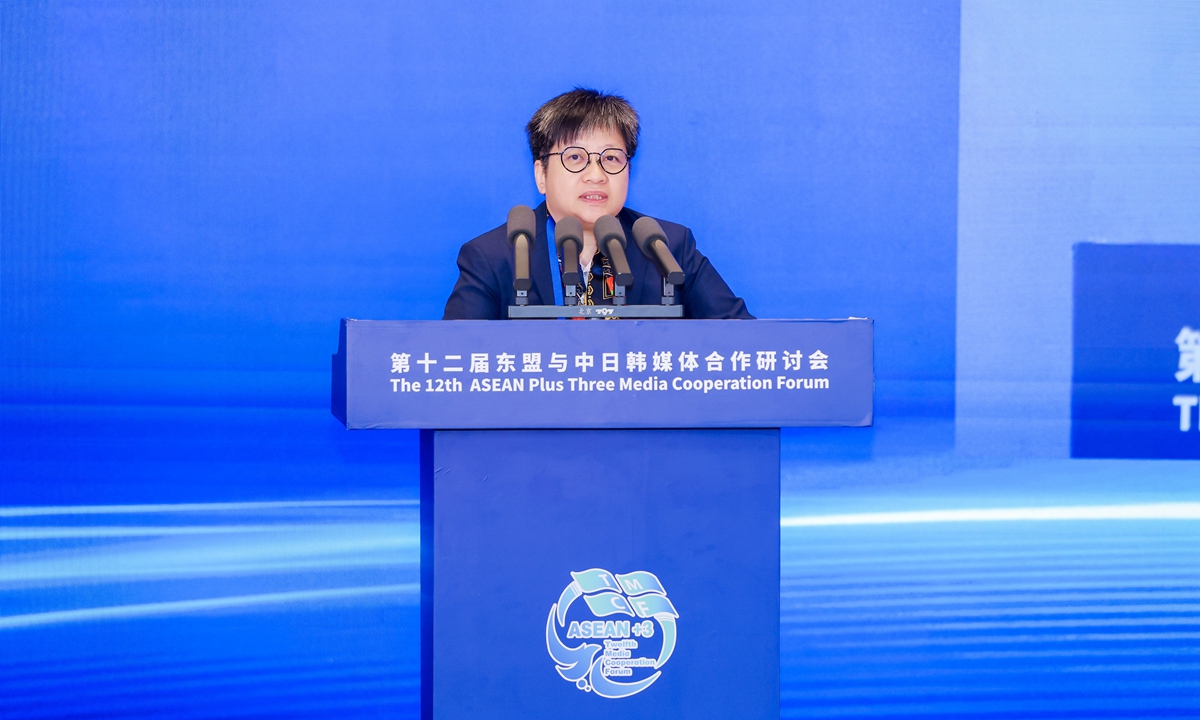
Han Yonghong, Associate Editor, Lianhe Zaobao, Singapore. Photo: People's Daily
The 12th ASEAN Plus Three Media Cooperation Forum was held in Fuzhou, East China's Fujian Province, on November 4. Co-hosted by the People's Daily and the People's Government of Fujian Province, the forum was held under the theme of "Openness and Cooperation for Shared Development." Han Yonghong, Associate Editor at Lianhe Zaobao, Singapore, delivered a keynote speech at the forum. The full text of her speech is as follows:
Distinguished guests, colleagues from media, ladies and gentlemen, dear friends,
Good morning!
I'm very pleased to be part of the 12th ASEAN Plus Three Media Cooperation Forum. Thank you for your invitation, so we can have a discussion under the theme of "Openness and Cooperation for Shared Development."
The forum's Chinese title uses the term 'Dongmeng,' but in Singapore, we've always known it as ASEAN. It is a consensus-based regional organization with a relatively loose structure. That doesn't quite match the impression conveyed by the Chinese character 'Meng,' which suggests an alliance. So here, I'll continue to use the term ASEAN.
There are many differences among ASEAN member states and China, Japan, and Republic of Korea (ROK). But to fully unleash our economic potential, closer ties and cooperation between ASEAN and China, Japan, and ROK are indispensable.
In 1997, we launched the ASEAN Plus Three process, and next year will mark its 30th anniversary. Today, we are no longer merely geographic neighbors. We have become partners in each other's development process, and our futures are deeply intertwined. That is why we need to understand each other better.
As media, we cannot merely be recorders. We must also reach out to understand others' circumstances and concerns, not just focus on our own development and changes. As journalists, we are not merely recorders of these interstate ties. As news travels faster these days, the question is: how might we build trust through openness and create value through cooperation? I would like to share three thoughts.
First, let each side see the other as it truly is through our reporting. Given our differences in history, culture, and development paths, our reporting needs to be more patient and respectful. A single news story may introduce a country, but it can hardly summarize it. A trending hashtag draws attention, but it rarely explains the true reality. So, we should spend more time in each others' cities and villages, listening more carefully to ordinary people. We should report achievements in development, but also the difficulties that remain. We must make our own voices heard while taking seriously the concerns of others. What audiences should see is not just labels, but the people who live there — their pursuits, their hopes, and their worries. This is how the media can strongly contribute to regional trust.
Second, let's treat new technologies as a fresh opportunity to deepen practical cooperation among media outlets. Today, AI, big data, and other news tech — mentioned often by other guests — are profoundly reshaping our global media landscape. In the face of this wave, no media outlet is an island. ASEAN Plus Three media should pursue practical cooperation in digital R&D, new platform development, and the fight against disinformation. We can share professional know-how, experience, and results: how to integrate AI into newsroom workflows, how to use new tools to verify information, and how to cultivate digitally literate journalists. These are areas where we can learn from each other and explore together. Colleagues in Chinese media have generated rich experiences that ASEAN media colleagues should learn from. This way, we can cooperate and move the group further on the global stage.
Third, let journalists meet more often and make professional exchanges more concrete. In the end, exchanges of technology and experience come down to person-to-person connections. So, beyond meeting at forums, we can walk into each others' newsrooms, see how they work, what problems they face, and how they solve them. It does not have to be a grand narrative. We can sit down and discuss the core questions we all face.
This is an experience I really want you to relate to: How do we balance the speed of delivery against journalistic accuracy? And how do we attract young audiences while preserving depth and credibility? And how do we use AI to boost efficiency without eroding judgment and responsibility? And how do we continue to serve the public good as the media industry transforms?
Exchange does not require agreement. Beyond sharing successful stories, we can speak about our uncertainties. That is itself a very valuable form of cooperation. Next year, Singapore will assume the rotating chair of ASEAN. We hope to use that occasion to encourage more media visits and more professional exchanges.
Colleagues and friends, shared development does not mean that everyone speaks with one voice, or that everyone must follow the same path. It means finding room for cooperation within mutual respect.
Let us report each other more truthfully, exchange professional experience more deeply, and see each other more often. And with an open mind and actions, let us contribute the media's share to the common development of ASEAN, China, Japan, and ROK.
Thank you!
