12TH ASEAN PLUS THREE MEDIA COOPERATION FORUM / KEYNOTE SPEECHES
Building responsible regional media network through pragmatic, structured cooperation: Director of Manila Times
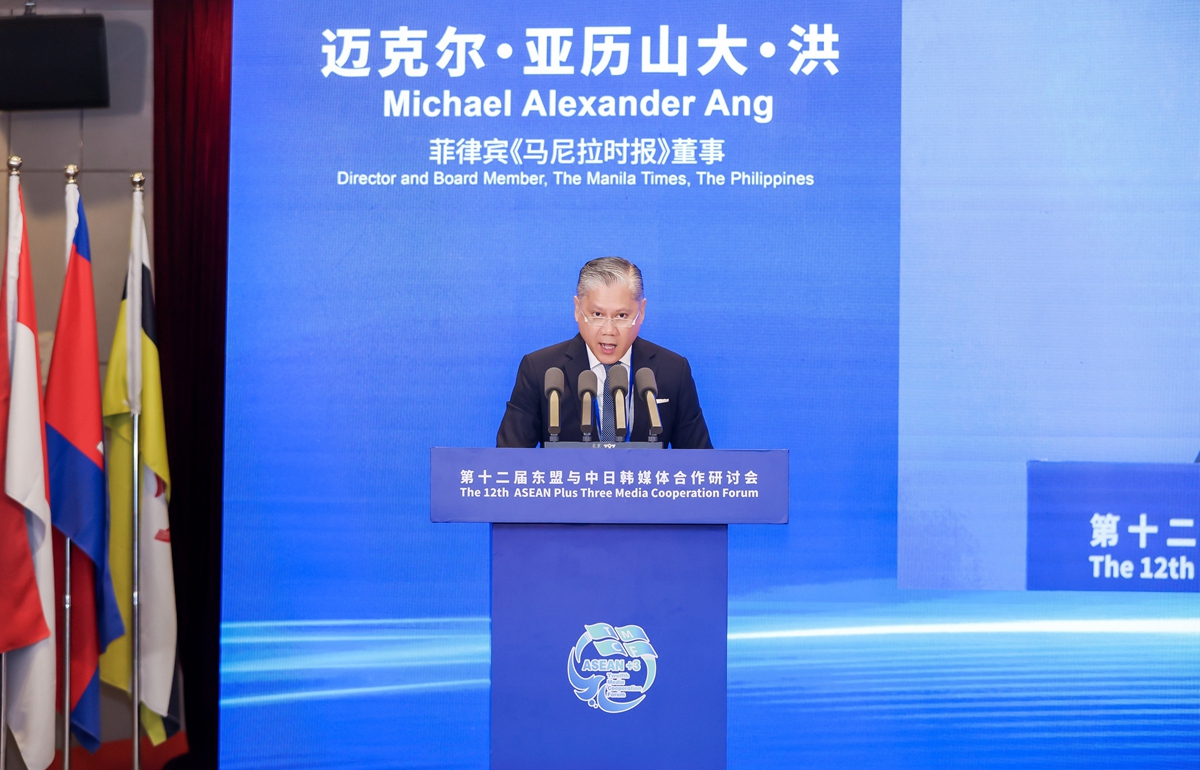
Michael Alexander Ang, Director and Board Member, The Manila Times, The Philippines. Photo: People's Daily
The 12th ASEAN Plus Three Media Cooperation Forum was held in Fuzhou, East China's Fujian Province, on November 4. Co-hosted by the People's Daily and the People's Government of Fujian Province, the forum was held under the theme of "Openness and Cooperation for Shared Development." Michael Alexander Ang, director and board member of The Manila Times in The Philippines, gave a keynote speech at the event. Here is the full text of his address:
To our hosts, fellow publishers, distinguished delegates, and colleagues across the ASEAN Plus Three media network,
Good day!
It is an honor and a privilege to join you in Fuzhou - a city whose historical identity as a starting point of the ancient Maritime Silk Road reminds us that enduring human connections are built through open exchange. Long before digital networks linked our newsrooms, maritime routes connected our nations through commerce, culture, and shared aspirations.
I address you today from a dual vantage point. As Director and Chief Finance Officer of The Manila Times, I spend my days managing the business realities of running the Philippines' oldest English-language daily newspaper. As Honorary Consul of the Hashemite Kingdom of Jordan in the Philippines, I work directly in international relations, building trust and cooperation across borders.
These two roles share a fundamental truth: resilience, economic stability, and regional progress depend entirely on openness, integrity, and clear communication.
At The Manila Times, our core strength has always been our opinion forum and our commitment to hosting a broad spectrum of perspectives. My father, the late Dante Arevalo Ang, believed that a mature news organization should never act as a monolithic megaphone. It must operate as a rigorous public square where competing ideas meet, contend, and inform the public.
But openness alone is not enough. Modern journalism carries a dual responsibility: a newspaper must maintain a courageous, principled editorial stance on major issues affecting the public good, while ensuring its platform remains fully accessible to the least represented communities. Real openness is tested by whether a media institution gives voice to marginalized groups and reports on the human cost of economic development.
This balance between open debate, commercial viability, and principled reporting applies directly to regional cooperation across ASEAN, China, Japan, and South Korea. Today, our newsrooms face shared pressures. The rapid shift toward digital distribution, platform dominance, and the ethical integration of artificial intelligence present challenges no single outlet can navigate alone. Generative AI tools offer operational efficiency, but they also raise urgent questions about verification, copyright, and public trust.
Furthermore, true openness must extend beyond our immediate region.
Consider Jordan's strategic engagement with China under the Belt and Road Initiative. After elevating bilateral ties to a strategic partnership, Jordan signed a formal Memorandum of Understanding with China on the BRI, directly aligning the initiative with Jordan's national economic modernization vision. Today, Chinese equity investments fuel major industrial projects like the Arab Potash Company, while Chinese technology and infrastructure development support Jordan's renewable energy and logistics goals. Situated at a crucial crossroads in the Levant, Jordan demonstrates how cross-regional trade corridors create shared economic stability across continents.
These multi-regional infrastructure projects, trade corridors, and digital networks only deliver lasting progress when the public understands and trusts them. That is the essential work of the press. Our role across the ASEAN Plus Three media network is not to broadcast smooth public relations copy, but to report economic realities accurately, highlight genuine opportunities, and address legitimate public concerns.
To build an accountable, future-ready media network across East Asia, we must move toward practical, structured collaboration.
First, we need technical exchange programs where newsrooms share best practices on digital transformation, newsroom sustainability, and the ethical deployment of artificial intelligence.
Second, we should build collaborative reporting initiatives that protect diverse perspectives and elevate underrepresented stories - from smallholder farmers navigating climate change to local enterprises adapting to digital trade.
Third, we must establish joint verification protocols and shared fact-checking networks to counter automated misinformation while safeguarding editorial independence.
In closing, by combining open public forums with principled reporting and practical cross-border cooperation, the ASEAN Plus Three media community can ensure our region's rapid growth remains grounded in transparency, mutual respect, and an unyielding commitment to public service.
Thank you very much, and I wish everyone a good afternoon and evening ahead.
