GT Economic Investigates: What does the Wuzhen summit reveal about China-US AI cooperation amid intensifying competition?
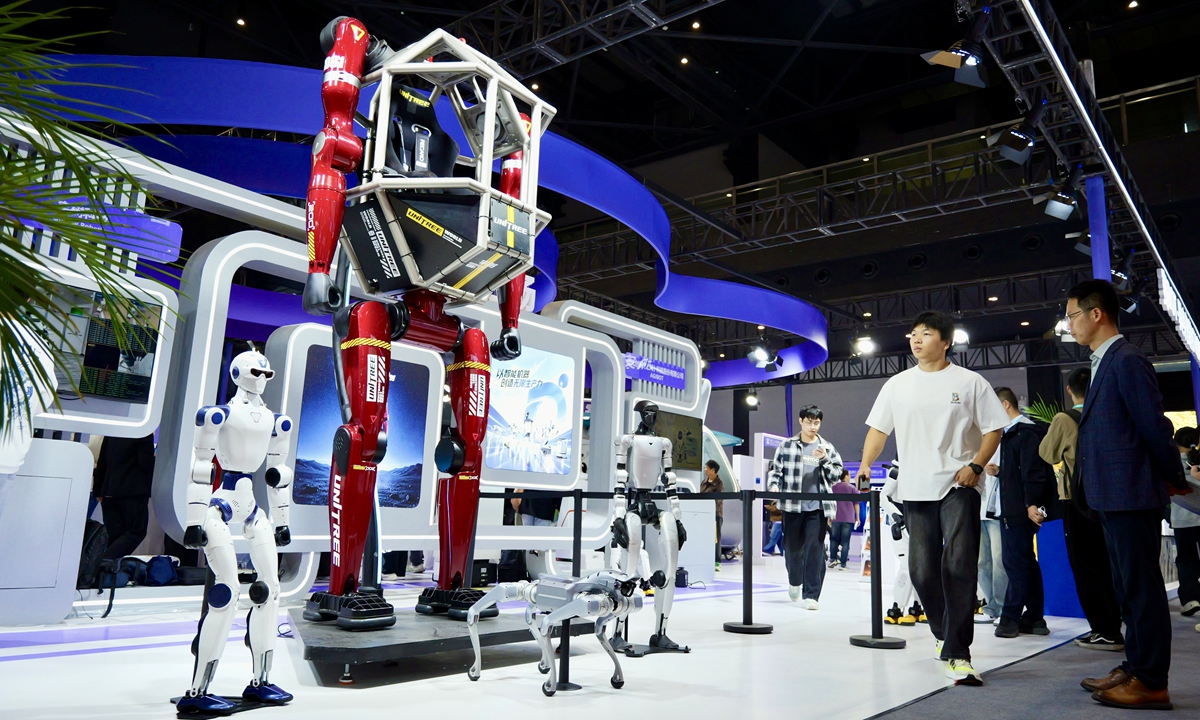
A Unitree robot attracts visitors at the 2026 World Internet Conference Light of Internet Expo in Wuzhen, East China's Zhejiang Province, on November 2, 2026. Photo: VCG
On her first visit to the World Internet Conference (WIC) Wuzhen Summit, Debora Comparin wanted to know what Chinese developers were building and how their AI agents could work with systems developed elsewhere.
"China and the US are both leading countries in AI, and we absolutely need constructive cooperation," Comparin, co-chair of the International Telecommunication Union Initiative on Trust and Identity for Humans and Agentic AI, told the Global Times on the sidelines of the opening ceremony.
Just days before the summit, the US government ordered federal civilian agencies to remove DeepSeek products and services from their IT systems and exclude them from procurement. On the commercial side, Microsoft had already made the Chinese developer's R1 model available to customers through Azure AI Foundry.
At the Light of Internet Expo in Wuzhen, Intel, Qualcomm and Microsoft are exhibiting alongside Chinese companies. As Chinese and US AI developers compete on price and performance and US restrictions close off parts of the market, where do companies on both sides still have an incentive to work together?
A race on price and performance
Stanford University's 2026 AI Index found that top US and Chinese models began trading places in performance rankings in early 2025. The leading US model held a 2.7 percent advantage in the Arena ratings as of March 2026, a snapshot of how closely the two sides had been competing.
That contest is increasingly about what a model costs to use. In September 2026, DeepSeek cut API prices with the release of V4.1 Flash, a smaller model that also added visual understanding, according to DeepSeek's developer documentation. Around the same period, DeepSeek's higher-end V4 Pro was priced at $3.96 per million output tokens, according to the company's price list, while Anthropic listed its flagship Claude Opus 5.5 at $20 per million output tokens. The figures show the difference in what providers charged to generate text.
US developers are competing for customers that need to control those bills, too. In March 2026, OpenAI introduced GPT-5.4 mini and nano, smaller models geared toward workloads including coding and rapid iteration. For companies processing large volumes of requests, choosing a lower-cost model for routine work can matter as much to the budget as choosing the most capable model for a difficult task.
Government decisions can narrow those choices. An October 27 US Department of Energy notice said the US Department of Homeland Security had ordered the exclusion of DeepSeek products and services from federal civilian agency procurement and the removal of covered products and services from civilian agency IT systems, citing supply chain, data security and other risks.
In a separate policy affecting the hardware needed to train and run models, the US Commerce Department said in January 2026 it would review licenses for certain advanced chip exports to China case by case, subject to conditions.
Chen Jing, vice president of the Beijing-based Technology and Strategy Research Institute, said the US has advantages in advanced chips, foundation models and capital, while China draws on its large market, industrial system and range of applications. Competition can speed up innovation, he said, while chip export controls and investment scrutiny risk raising costs and fragmenting supply chains.
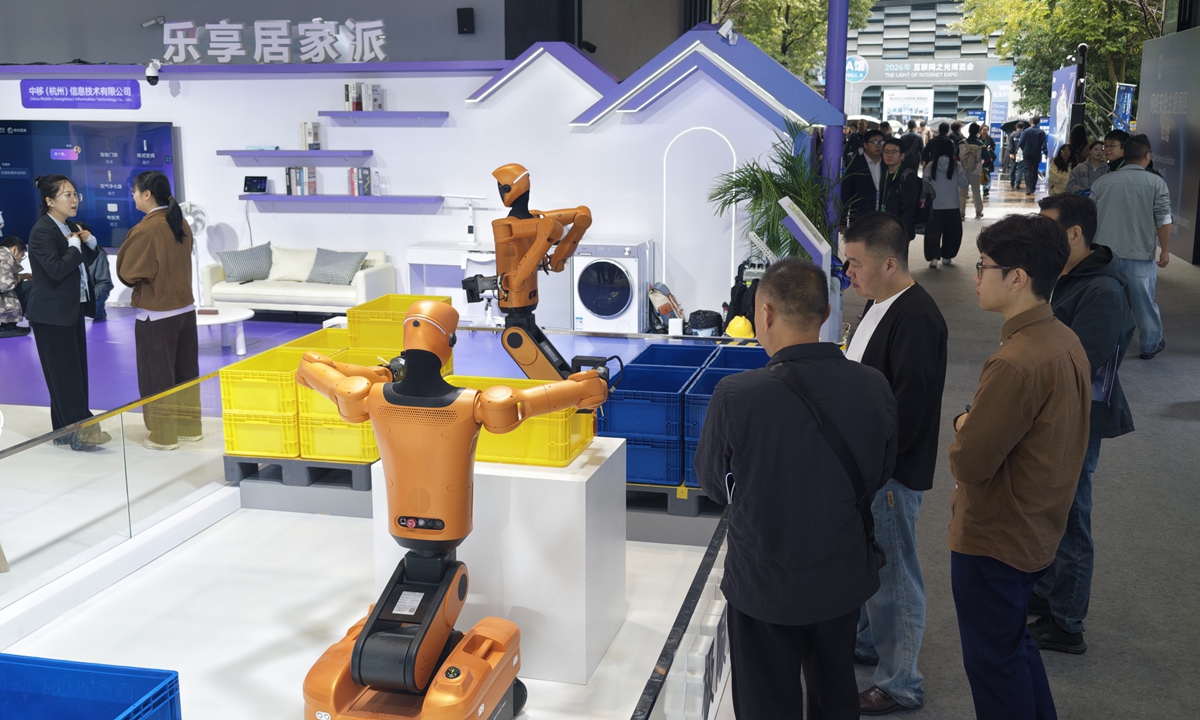
Visitors tour the Light of Internet Expo at the World Internet Conference Wuzhen Summit in Wuzhen, East China's Zhejiang Province, on November 4, 2026. Photo: Tao Mingyang/GT
Room for cooperation
Comparin sees an opening in the technical rules that let AI agents built by different companies work together. Chinese and US firms can work with European partners on protocols and safeguards, she said, so agents can be deployed securely and interact across platforms.
On the floor of the Light of Internet Expo in Wuzhen, US exhibitors' interest in the Chinese market was visible in the range of products they brought. Intel displayed enterprise AI workstations, compact AI systems and PCs built to run AI agents. According to materials Intel provided to the Global Times, the chipmaker is working with Chinese industry partners on uses such as visual quality inspection and safety checks.
Intel's third-generation Core Ultra processor won a WIC award for pioneering science and technology. AMD China's Ryzen AI Max+ processor for systems that run AI agents and Microsoft China's Copilot Cowork, a productivity tool designed for real-world tasks, were also among the winners.
China offers a large market as well as opportunities to develop and commercialize technology across different industries, Qualcomm China Chairman Meng Pu said at an AI industry conference in October, according to People's Daily-affiliated Jintai Information.
One opening is in patents. On October 5, Qualcomm and Huawei announced a multi-year agreement covering cross-licenses in 5G, computing, AI and networking. Qualcomm also agreed to buy certain Huawei US patents, subject to the necessary regulatory approvals. For both companies, the agreement provides a framework for using each other's patented technologies in areas that support connected devices and AI applications.
Shared gains through openness
Model distribution offers another route to cooperation. In October, Amazon Web Services (AWS) announced that Zhipu AI's GLM-5.3 was generally available on Amazon Bedrock, the Global Times learned from Zhipu.
Chinese models have reportedly also been used inside a US developer's own training process. In December 2025, Bloomberg reported, citing people familiar with the work, that Meta's team used Alibaba's Qwen alongside other models in training a system code-named Avocado. The reported use was part of model development, while the AWS and Microsoft announcements concerned products made available to customers.
Chinese technology industry analyst Liu Dingding told the Global Times that international partnerships can help multinational companies commercialize technologies while supporting industrial upgrading by Chinese manufacturers.
"Such complementary strengths offer opportunities for both sides to benefit from AI's expansion into more industries," Liu said.
Distribution puts more models within reach. Common technical rules can make it easier for businesses to combine tools from different providers and to set limits on what agents can do when they interact. In October, the Linux Foundation's Agentic AI Foundation announced new projects including OpenAI's Open Responses, which addresses communication between applications and models, and Alibaba's OpenSandbox, which provides isolated environments for running agents.
There is a role for governments as well. According to China's Ministry of Commerce, China and the US held their first dialogue on AI under the China-US economic and trade consultation mechanism at the recently held eighth round of economic and trade consultations in the US. During the latest round of economic and trade consultations, the two sides reached multiple points of consensus.
Terry Sweetser, chair of the Asia Pacific Network Information Centre's (APNIC) Routing Security Special Interest Group, said much of the capital flowing into US AI companies was backing proprietary technology. He pointed to open models as a way to make AI more widely accessible.
"An open-source approach could get more people talking about how to make that technology accessible worldwide," Sweetser told the Global Times, adding that some Chinese AI firms are already pursuing such an approach.
Lilan Dayananda, a social-tech entrepreneur from Sri Lanka, told the Global Times that healthy competition between China and the US was important because competition could help prevent technological monopolies. At the same time, the two countries needed to recognize the synergies that could bring them together.
"Going alone can do something, but going together has more impact," Dayananda said.
RELATED ARTICLES