Australian lobster, wine and goat meat draw crowds at CIIE as exporters eye bigger China market
By in Shanghai Published: Nov 07, 2026 07:38 PM

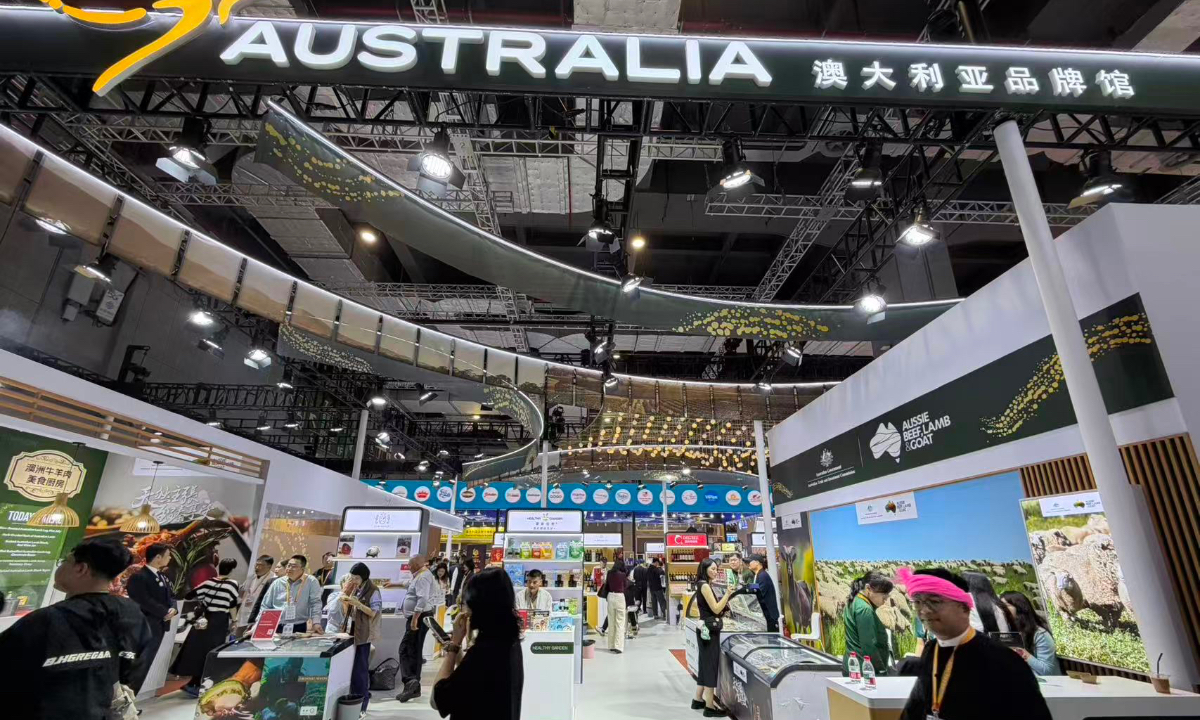
A view of the Team Australia Pavilion of the ninth China International Import Expo (CIIE) held in Shanghai on November 7, 2026. Photo: Tu Lei/ Global Times
At the Team Australia Pavilion of the ninth China International Import Expo (CIIE) held in Shanghai, visitors crowded around to sample freshly cooked Australian lobster topped with melted cheese.
Marc Anderson, CEO of Geraldton Fishermen's Co-operative, watched the bustling tasting session with a smile from behind the crowd.
Nearly two years have passed since China lifted restrictions on Australian lobster imports. Anderson and his team are leveraging the CIIE platform to help Chinese consumers gain deeper insights into Australian rock lobster.
“It’s a great opportunity to meet so many people. This helps us build broader brand recognition, which is important for us, and reconnect with our customers here in China,” Anderson told the Global Times on Friday.
“We’ve been back in the Chinese market for nearly two years, and the market is growing stronger. We are committed to the Chinese market as part of our broader diversified market strategy,” he said.
Anderson said they have around 5,000 tons of lobster and roughly 60 percent of the output may go to China. It takes just eight hours by air to transport the lobsters from waters off Western Australia to Hong Kong, before they are shipped onward to Xiamen, Guangzhou or Shanghai.
Anderson’s booth is not the only busy spot. Just a few meters away stands a freezer stocked with frozen Australian goat meat. Miriam Blythe, export manager at Western Meat Exporters Pty Ltd, is attending the CIIE with her company’s products for the first time.
“We have whole goat carcasses, as well as pre-cut goat cubes ready for hot pot and home cooking,” she explained to the Global Times when pointing to the freezer on Saturday.
Blythe said her company has been exporting Australian goat meat to China for 13 years. China accounts for roughly 10 percent of its sales, yet this marks the firm’s debut at the CIIE.
Adam Qiu from Shenhui (Shanghai) Food Co has partnered with Western Meat Exporters Pty Ltd for nine years. He was among those who pushed hard to encourage the Australian exporter to take part in the CIIE.
“I told them this is China’s biggest expo. Unlike specialized food fairs, it is a comprehensive event that draws all kinds of visitors,” he told the Global Times.
“At the CIIE, we are not merely selling meat. More importantly, we get to showcase the products to the entire Chinese market,” he added.
During the pavilion tour, the Global Times saw familiar Australian staples such as beef, wine, milk powder and honey on display, with animated conversations unfolding at the booths. Adjacent to the displays sits a kitchen preparing roasted beef and lobster, and its savory aroma drifts through the air.
Ding Youzhen, who oversees the China market at Australia Swan Vintage Pty Ltd, has attended the CIIE for nine consecutive years and is among the expo’s beneficiaries.
Swan Vintage runs its own wineries in Australia, exporting roughly two million to three million bottles of wine to China annually for distribution by local Chinese distributors, he told the Global Times.
China is the company’s most important global market outside Australia and its largest by sales volume, he said.
Occupying more than 1,700 square meters, Australia’s national pavilion hosts a total of 190 Australian firms at this year’s CIIE. They are showcasing Australian packaged food, wine, beverages, dairy, meat, seafood, health food and agricultural products, data from the Australia Trade and Investment Commission (Austrade) showed.
Yan Dong, Vice Minister of Commerce, said at the CIIE press conference on October 16 that the exhibition space occupied by Australian enterprises had expanded by 25 percent from last year.
“Roughly 30 to 40 of the 190 Australian exhibitors are first-time participants at the CIIE,” John Madew, Senior Trade and Investment Commissioner at Austrade, told the Global Times on Saturday.
“We are an export-driven economy, and there will always be new firms with new products wanting to test them in China. The CIIE is best suited for so-called export-ready companies, yet it also welcomes new businesses. You never know until you try. It remains a fantastic window into the diversity and dynamism of the Chinese market,” Madew said.
In his view, the expansion of the exhibition area is the result of joint collaboration among different governments and multiple organizations.
To help Australian businesses further expand overseas markets, the Australian government has rolled out the Access to New Market Initiative, with support for companies participating in exhibitions in China as a key component of the program, he said.
