Foreign livestreamers grab spotlight at CIIE, connect global goods to Chinese shoppers
Event highlights enduring appeal of China’s consumer market
By and Xiang Xinyue in Shanghai Published: Nov 08, 2026 09:17 PM

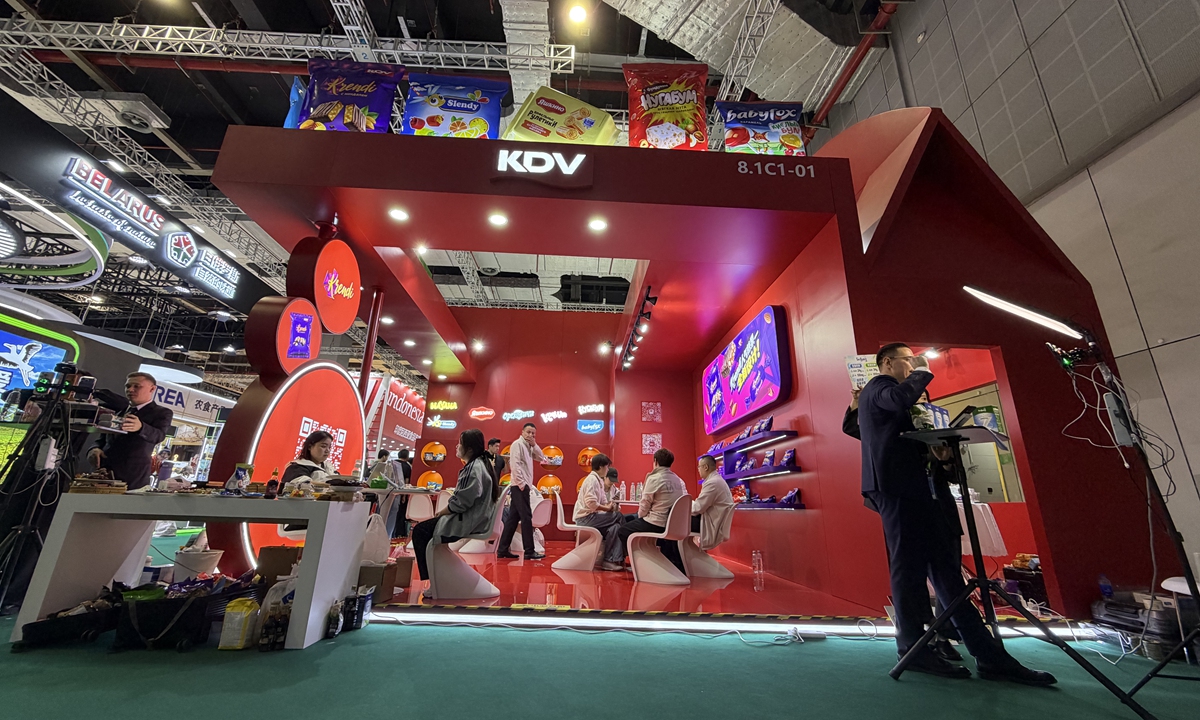
A livestreaming corner at the ongoing 9th CIIE held in Shanghai Photo: Tu Lei/Global Times
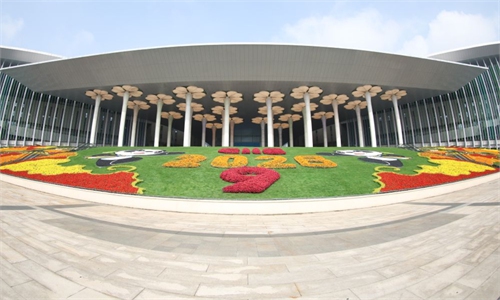
At the 9th China International Import Expo (CIIE) in Shanghai, foreign livestreamers have emerged as a highlight.
Facing the camera, they speak fluent, authentic Chinese as they walk viewers through the features of imported goods from around the world. Skilled at engaging audiences, their down-to-earth style bridges the gap with Chinese consumers and brings global products to the public in a more entertaining way.
Elena Kovalenko, a Russian livestreamer, is one of them. It is her third time to attend the CIIE. When the Global Times spotted her at 3 pm on Friday, she was selling milk powder from Belarus. She said that she had been going nonstop since 10 am.
"Compared with livestreaming from an office, this venue offers a far better atmosphere, and sales perform better," she told the Global Times.
A few meters away, two other livestreamers from Belarus were selling goods online, mostly candies. A Global Times reporter waited for half an hour to get an interview, but they were swamped with work and could not spare a moment.
The hosts take turns tasting chocolates and candies live on camera. They hold up the products to show their texture and packaging, describe the rich flavors in lively tones, and engage closely with online viewers.
The growing number of foreign livestreamers is testament to the appeal of China's market, Liu Jingying from Youlian United International Trade (Beijing) Co, told the Global Times. He has been cooperating with the two livestreamers from Belarus.
"Our cooperation with them has been stable and fruitful. Livestreaming is intuitive: The hosts can introduce products vividly, letting consumers get a clear sense of what they are buying, which makes communication much more efficient," Liu said, adding that they generally enjoy strong traffic during the expo.
The livestreamers are not the only overseas exhibitors engaging audiences in Chinese.
The Global Times also spotted a Pakistani jade merchant at one of the CIIE halls, who pitched his home-country goods in fluent Chinese. On display were handwoven wool tapestries and jade carvings from the South Asian country.
Speaking in Chinese, he told the Global Times this marks his fifth consecutive year at the CIIE. The expo has helped him connect with a network of new and returning clients, and allowed him to set up distribution outlets in Beijing and Qingdao, East China's Shandong Province.
He pointed to the jade pieces laid out at his booth and explained that Chinese buyers value auspicious symbols and good omens, and he even knows that the cabbage-shaped carvings are popular because the Chinese word for cabbage, baicai, sounds like "making a fortune."
"These cases serve as vivid snapshots of the strong appeal of China's ultra-large market," Hu Qimu, a professor at the Maritime Silk Road Institute of Huaqiao University, told the Global Times on Sunday.
Boasting an enormous size and diverse consumer demand, the Chinese market embraces specialty goods from across the globe. Overseas practitioners can tap into business opportunities here if they understand Chinese consumers' cultural preferences and adopt the right communication approaches. The CIIE, meanwhile, acts as a key gateway for them to connect with domestic buyers, build sales channels and deepen their presence in the Chinese market, Hu added.
China has set a goal of raising total retail sales of consumer goods to about 60 trillion yuan ($8.8 trillion) by 2030 and further strengthening the role of consumption in driving economic growth, according to a government plan on expanding consumption during the 15th Five-Year Plan (2026-30) period, the Xinhua News Agency reported in July this year.
The plan outlines other targets in areas including optimizing the consumption structure, continuously improving consumption capacity, enhancing the supply of goods and services, and significantly improving the consumption environment.
The expo may be a temporary showcase, but it is far from the end of the sales journey. For these cross-border sellers, livestreaming will remain an ongoing channel to keep connecting with Chinese consumers long after the CIIE wraps up.
Kovalenko is married to a Chinese national and has lived in China for 20 years. She has worked for a foreign trade company based in Suifenhe, Northeast China's Heilongjiang Province for seven years, mainly selling Russian soap, chocolate, candies and other goods. She boasts 4 million followers on Kuaishou and 400,000 on Douyin.
She said that one Russian soap she promoted has sold more than 1 million units, topping national sales rankings.
"I really enjoy this work, and I hope to keep introducing fine overseas products to Chinese viewers down the line," she said.
RELATED ARTICLES