Multiple high-end vessels delivered in quick succession as China’s shipyards enter 'supercycle'
Global cooperation needed in key parts, rule-setting: expert
By Published: Nov 09, 2026 10:47 PM

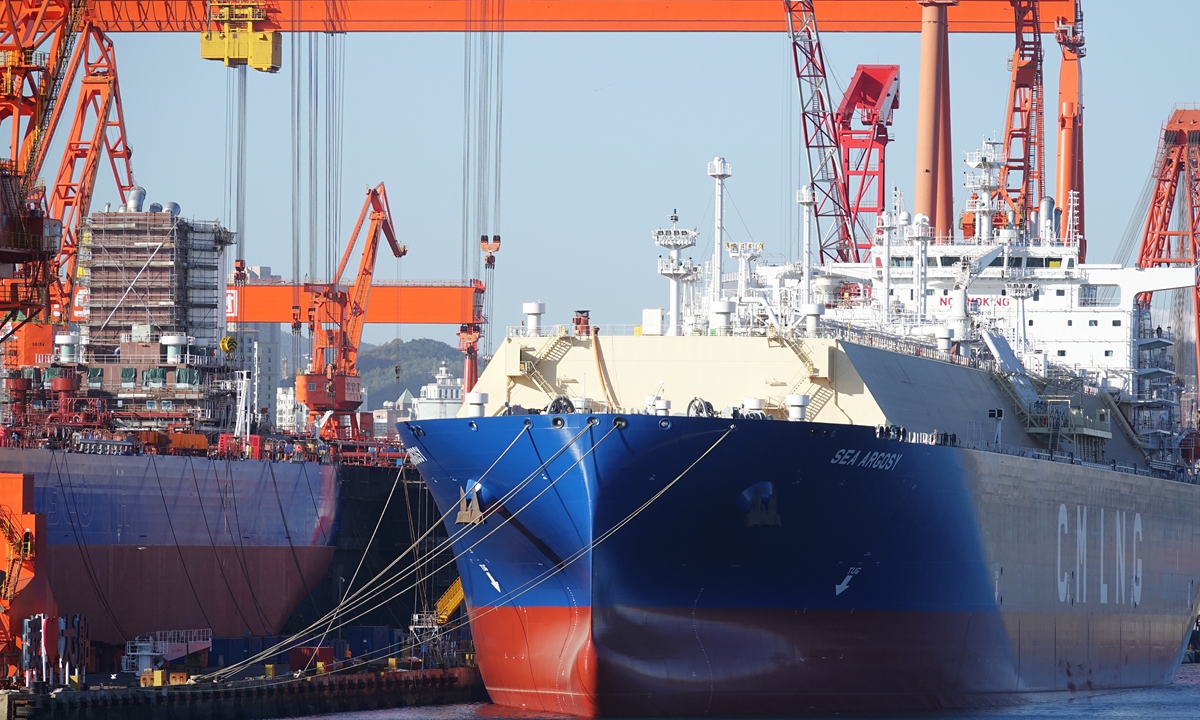
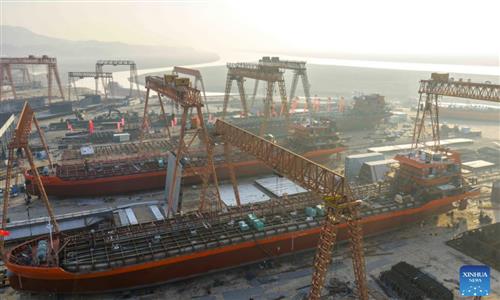
Vessels are docked at the production base of Dalian Shipbuilding Industry Co, Ltd in Dalian, Northeast China's Liaoning Province, on October 27, 2026. Photo: CNS Photo
China's shipbuilding industry is riding a wave of major deliveries, with five advanced vessels handed over in just three weeks. Industry analysts said that the sector, bolstered by coordinated policy support, decades of technological accumulation and surging domestic and overseas demand, has entered a "supercycle," leading the world in the three key metrics of ship completions, new orders and order backlogs.
Analysts said that amid the sector's rapid expansion, new cooperation opportunities will emerge with the world's leading shipbuilding players. International collaboration is expected to shift from mere technology imports to joint research and development (R&D) of advanced vessels and global coordination in areas such as smart shipping rules and standards.
On Monday, the China Association of the National Shipbuilding Industry said on its WeChat account that Hudong-Zhonghua Shipbuilding Co's 174,000-cubic-meter liquefied natural gas (LNG) carrier, Dalian Shipbuilding's 307,000-ton very large crude carrier (VLCC), and China State Shipbuilding Corp (CSSC) Qingdao Beihai Shipbuilding's 210,000-ton LNG dual-fuel bulk carrier were delivered recently, with multiple key technical indicators exceeding expectations and notable energy-saving and carbon-reduction benefits.
Also, China's first ultra-large trailing suction hopper dredger equipped with a distributed in-hold pump system, Xin Hai Jing 1, was officially delivered, marking a new breakthrough in the intelligent technologies used in dredging equipment.
Hudong-Zhonghua Shipbuilding Co delivered a 174,000-cubic-meter LNG carrier built for QatarEnergy in Shanghai. Measuring 299 meters in length and 46.4 meters in breadth, the vessel integrates low-carbon energy-saving technologies with digital operation and maintenance platform.
In October, Dalian Shipbuilding delivered a 307,000-ton VLCC built for Norway's Seatankers Group, in Dalian, Northeast China's Liaoning Province, 77 days ahead of schedule. As a next-generation VLCC independently designed and developed by Dalian Shipbuilding, the vessel delivers first-class performance through hull line optimization and energy-saving improvements. The vessel offers good adaptability to different ports and waterways. At its designed draft of 20.5 meters, it can carry more than 2 million barrels of crude oil and transit the Strait of Malacca.
CSSC Qingdao Beihai Shipbuilding delivered a 210,000-ton LNG dual-fuel bulk carrier Mount Yulong for Singapore's Eastern Pacific Shipping Pte Ltd. Independently developed, the next-generation vessel is equipped with an LNG dual-fuel main engine and can reduce carbon emissions by about 20 percent when operating in gas mode, meeting the International Maritime Organization's EEDI Phase III requirements.
The vessel is also equipped with an autopilot featuring Track Control System, which can shorten voyage distances and reduce energy consumption, with a range covering round-trip deep-sea routes between China and Brazil.
The Xin Hai Jing 1, also recently delivered, is equipped with a next-generation intelligent monitoring and integrated management platform independently developed in China. The ship has a digital twin system and a "digital sentinel" system built on artificial intelligence vision and LiDAR. Compared with traditional vessels of the same type, carbon emissions are cut by more than 20 percent and dredging efficiency is improved by about 30 percent.
Another advanced vessel recently delivered is the Adora Flora City, China's second domestically built large cruise ship, which was delivered in Shanghai on Friday.
According to media reports, most of China's leading shipbuilders now have order books extending beyond 2030 and the entire industry has entered a "supercycle."
In September, state-owned shipbuilder China State Shipbuilding Corp (CSSC) revealed during an earnings briefing that orders at some shipyards extend to 2029-30, with backlogs covering more than four years, according to domestic news portal sina.com.cn.
The latest industry report further confirmed the sector's strong performance. In the first three quarters of 2026, China's new ship orders jumped 163.2 percent year-on-year, capturing more than 80 percent of the global market, CCTV News reported on October 23.
Chinese analysts pointed to the convergence of policy support, concentrated breakthroughs in proprietary technologies and enhanced domestic industrial supporting capabilities as the driving forces behind this "supercycle."
"Over the years, the country has provided comprehensive support for the development of green and intelligent vessels, setting China apart from countries where individual firms fight alone. Meanwhile, after more than a decade of accumulation and capacity consolidation, the industry is reaping the fruits of its efforts. Lastly, China's marine equipment system capabilities have been significantly strengthened," Zhou Liwei, an expert at the China Classification Society, told the Global Times on Monday.
The industry experienced a period of consolidation following the 2008 financial crisis, which reduced the overall number of shipyards while also attracting new players from the private sector and bringing fresh vitality to the industry, Zhou noted.
The rapid improvement in China's shipbuilding capacity has also been driven by the country's overall technological advancement. "Many successful technologies from the automotive and commercial space sectors have been adapted or improved for use in shipbuilding and shipping, giving Chinese shipbuilders unique advantages," Zhou said.
Externally, geopolitical conflicts have fueled demand for vessels featuring green and energy-saving technologies, providing favorable development opportunities for the Chinese shipbuilding industry.
"Since last year, global geopolitical conflicts and sharp fluctuations in oil prices have directly affected global shipowners' appetite for green vessels. The market is demanding more economical ships. Domestic shipyards, which enjoy technological and industrial chain advantages in green vessels coupled with strong delivery capabilities, have been rewarded with a flood of orders," Liu Wei, a board director with a Ningbo-based shipyard, told the Global Times on Monday.
Chinese experts pointed out that as Chinese shipyards fulfill customer orders during this "supercycle," opportunities for cooperation with foreign shipbuilders will also emerge.
"Currently, except for high-end main engines and some LNG technologies, China has achieved independent capabilities in most areas, leaving shrinking room for cooperation in the traditional sense. The focus of cooperation is shifting to new product development, new technology application, and jointly shaping international rules and R&D standards in the era of green and intelligent vessels," Zhou said.
Beyond hardware cooperation, Chinese shipbuilders still face many tasks in soft connectivity, analysts pointed out. The focus of international cooperation will shift from the simple introduction of technology to participation in rule-making and development of R&D standards.
Citing the Maritime Autonomous Surface Ships code that took effect on July 1 this year, Zhou argued that Chinese companies should seek more global coordination to promote unified standards in digital and intelligent fields.
RELATED ARTICLES