China, Canada agree to enhance financial sector co-op; broader cooperation to lend fresh impetus to long-term ties: expert

A worker prepares a Canadian health products booth at the Food and Agricultural Products Exhibition Area of the ninth China International Import Expo (CIIE) in Shanghai on November 1, 2026. Photo: VCG
The second China-Canada Strategic Economic and Financial Dialogue was held on Monday in Vancouver, Canada, where the two sides agreed to enhance financial cooperation, including financial services market access, and exchanges between the capital market and financial regulatory authorities.
Chinese experts said that mutually beneficial outcomes and consensus reached at the meeting show that the positive momentum in China-Canada economic and trade relations continues to build. As institutionalized dialogue mechanisms advance and major multilateral events such as APEC approach, win-win bilateral cooperation is expected to deepen, they said.
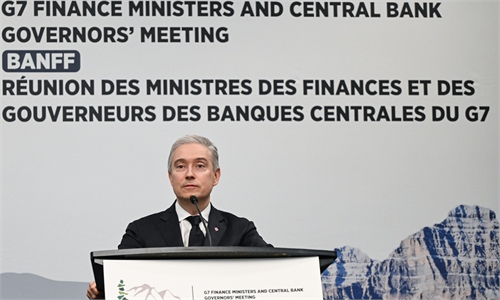
He Lifeng, member of the Political Bureau of the Communist Party of China Central Committee, vice premier of the State Council, and Chinese lead person for the dialogue, co-chaired it with Canadian lead persons Francois-Philippe Champagne, minister of finance, and Maninder Sidhu, minister of international trade, according to China's Ministry of Finance (MOF).
The two sides agreed to expand cooperation under multilateral mechanisms including the G20 and APEC, and within the frameworks of international financial institutions, including multilateral development banks, to improve global economic governance. They reaffirmed their support for multilateralism and a transparent and predictable environment for trade and investment, according to the MOF.
The two sides agreed to enhance financial sector cooperation, including on financial services market access, and to foster engagement between the capital market and financial regulators. Finance ministries, financial regulators and central banks for both countries respectively signed the memorandum of understanding on Cooperation between Finance Ministries, the Cooperation Agreement for the Financial Regulatory and Supervisory Dialogue, and the Terms of Reference for the Financial Working Group.
The two sides welcomed the implementation of the bilateral currency swap arrangement. They welcomed the positive progress made in the recent bilateral economic and trade consultations, it said.
"Positive outcomes and consensus in the financial sector show that positive momentum in China-Canada economic relations continues to build. The ongoing bilateral commercial engagement is being advanced in accordance with the plan established in January and progressively elaborated into concrete measures," Liu Dan, a research fellow at the Center for Regional and Country Studies at Guangdong University of Foreign Studies, told the Global Times on Tuesday.
During Canadian Prime Minister Mark Carney's visit to China in January, the two countries signed an economic and trade cooperation road map, and reached specific arrangements to properly address trade issues related to electric vehicles, steel and aluminum products, rapeseed, and agricultural and aquatic products. Since then, adjustments to trade restrictions have opened more room for agricultural and aquatic-product cooperation.
On November 3, Chinese Commerce Minister Wang Wentao and Canada's Minister of International Trade Maninder Sidhu co-chaired the 29th meeting of the Joint Economic and Trade Commission mechanism in Beijing, according to China's Ministry of Commerce.
"China and Canada are important trading partners. Despite a few bumpy years, their bilateral fundamentals remain sound. In addition, Canada faces recent volatility in US trade and economic policy that passes through quickly along supply chains and foreign trade. Deepening ties with a major partner like China is thus a practical way for Canada to build economic resilience," Yu Xiang, a senior fellow at the Center for International Security and Strategy, Tsinghua University, told the Global Times on Tuesday.
In recent years, China has used flagship national expos such as the China International Import Expo (CIIE) as important public goods to open its market as a shared platform, creating more opportunities for foreign companies including those from Canada and as a result contributing to win-win cooperation, Yu said.
Canada serves as a guest country of honor at this year's CIIE. A wide range of classic products from Canada, including lobsters, blueberries and ginseng, has been on display at the expo, drawing crowds of visitors to sample them.
"I think that the CIIE is absolutely the best platform to promote trade between any two countries, in particular between Canada and China," Lewis Greenspon, president of the Canada Exhibition and Trade Association, told reporters at the CIIE, expressing confidence in the quality of Canadian products in meeting the upgrading demands of Chinese consumers.
"From policy dialogue to practical, business-to-business cooperation, China-Canada economic and trade ties are opening up fresh opportunities for growth. By managing differences through sustained dialogue and building on their industrial complementarities to expand cooperation across sectors including energy, technology, and agriculture, the two sides stand to lend fresh impetus to the steady, long-term growth of bilateral economic and trade ties," Liu said.
RELATED ARTICLES