BRASIL 247 / MORE
Brazil brings climate solutions and sustainable development agenda to COP31
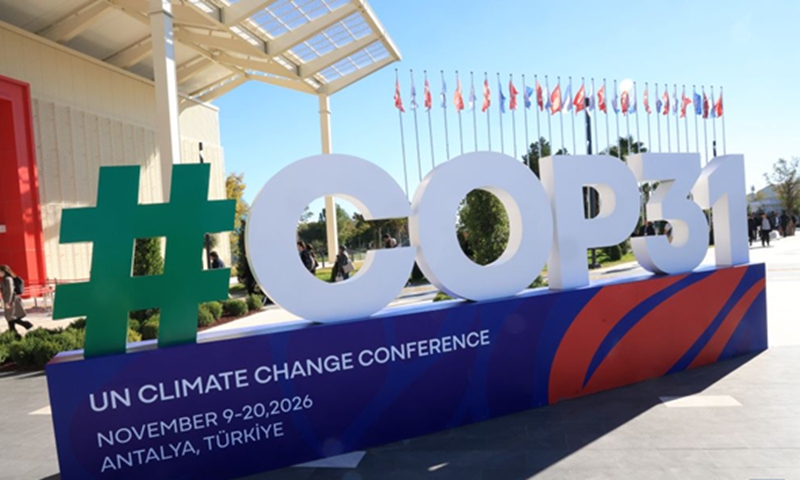
Photo: Xinhua
Brazil is participating in the 31st United Nations Climate Change Conference (COP31), held from November 9 to 20 in Antalya, Türkiye, with a focus on advancing climate solutions, sustainable economic development and international cooperation. The Brazilian Trade and Investment Promotion Agency (ApexBrasil) is coordinating the Brazil Pavilion, where government officials, business representatives and international organizations will discuss climate action, sustainable trade, financing and the energy transition.
According to Brasil 247, ApexBrasil is working alongside Brazil's Ministry of the Environment and Climate Change and the COP30 Presidency, which oversaw the previous climate conference in Belém. The initiative seeks to maintain momentum from COP30 and strengthen Brazil's role in international discussions on implementing climate commitments.
COP31 brings together representatives of governments, international institutions, businesses and civil society to assess progress under the Paris Agreement, adopted in 2015. The agreement aims to keep the increase in global average temperatures well below 2°C above pre-industrial levels while pursuing efforts to limit warming to 1.5°C.
The international framework also calls for stronger adaptation measures and for financial flows to support low-emission, climate-resilient development.
A central challenge facing negotiators is translating national commitments into concrete policies and measurable results. Beyond setting new targets, the conference will examine how governments and institutions can mobilize investment, public policies and technological solutions to accelerate implementation.
Laudemir Müller, President of ApexBrasil, emphasized the importance of multilateral cooperation in addressing the climate crisis.
"COP conferences are essential for keeping countries engaged in dialogue and advancing joint responses to the climate crisis. What is discussed at these conferences directly affects the future of the planet and the lives of coming generations. ApexBrasil continuously supports this agenda and works to expand Brazil's participation in discussions on sustainable development," Müller said.
Brazil's state-controlled Banco do Brasil is also participating in the initiative, highlighting the importance of directing financial resources toward sustainable economic activities.
"For Banco do Brasil, COP is an opportunity to reaffirm our role as an agent of transformation in the Brazilian economy. We work to direct credit and investment toward sustainable businesses, supporting our clients and partners in the transition to a low-carbon economy and helping our country develop solutions that reconcile economic development, inclusion and environmental preservation," said José Ricardo Sasseron, Vice President for Government and Corporate Sustainability at Banco do Brasil.
Brazil Pavilion to address bioeconomy, trade and industrial transition
Located in the Blue Zone, the official area designated for climate negotiations, the Brazil Pavilion will serve as a meeting point for government representatives, private companies, academic institutions, civil society groups and international organizations.
The pavilion features two auditoriums, named Belém and Global Mutirão, with programs covering different aspects of the international climate agenda.
The Belém Auditorium will focus on issues of particular relevance to Brazilian society, connecting domestic experiences and initiatives with international climate negotiations.
The Global Mutirão Auditorium will concentrate on the Global Climate Action Agenda, with discussions organized around six thematic pillars and the 120 Solution Acceleration Plans launched during COP30.
These activities are intended to build on the outcomes of the Belém conference and encourage cooperation on the implementation of existing commitments.
The agenda includes climate adaptation and public health, sociobioeconomy, food security, biological agricultural inputs, resilient food systems, industrial decarbonization, carbon markets and climate finance.
Discussions will also examine the role of strategic minerals in supporting the energy transition and developing new industrial supply chains.
ApexBrasil will lead several discussions connecting environmental priorities with Brazil's economic and commercial opportunities.
On November 9, the agency organized a panel titled "An Amazon That Produces and Conserves: Sociobioeconomy for the World," addressing how economic activities can be developed alongside biodiversity conservation.
On November 10, ApexBrasil will participate in a discussion on "Food Security, Biological Inputs and Resilient Food Systems," in partnership with CropLife Brasil.
The agency will also organize a panel titled "Trade and Climate in the New Global Geopolitical Landscape," examining the relationship between international commerce and climate policy.
On November 11, discussions will turn to "Strategic Minerals: From Transition to New Industry," focusing on resources relevant to energy transition technologies and industrial development.
Together, these discussions address issues central to Brazil's economic strategy, including the sustainable use of biodiversity, agricultural production, the international competitiveness of Brazilian companies and the development of industries associated with cleaner energy.
The program also provides opportunities for dialogue with international partners on investment, technology and the integration of environmental objectives into economic development.
(Reported by Brasil 247 on November 9, 2026)
