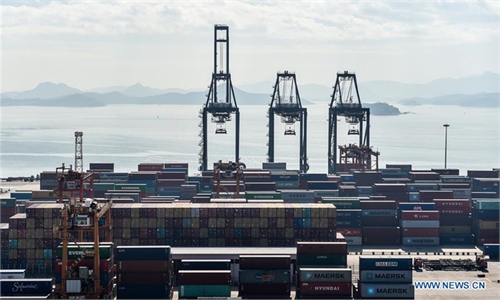
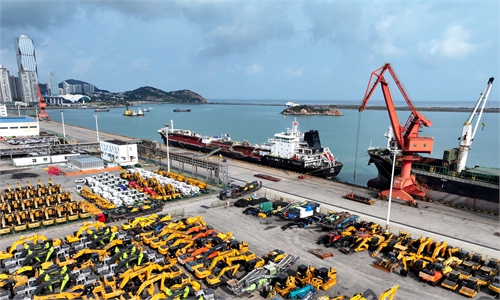
E.China's Ningbo-Zhoushan Port throughput exceeds 40m TEUs for 2nd consecutive year
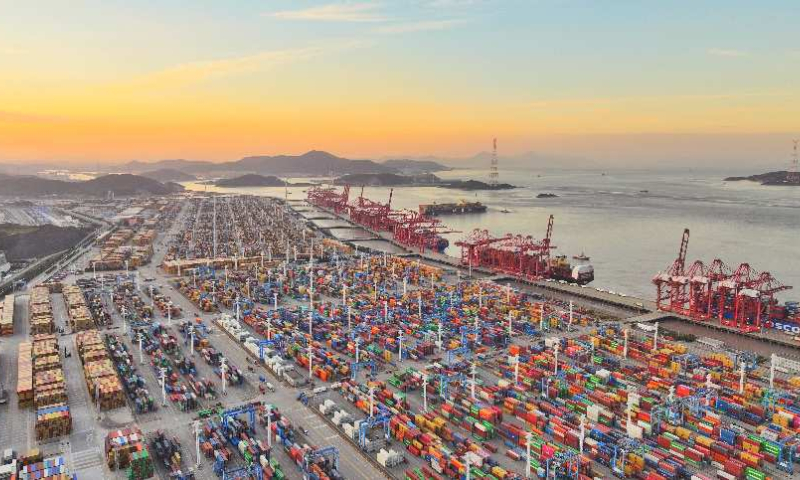
A view of Ningbo-Zhoushan Port Photo: Courtesy of?Ningbo-Zhoushan?Port
On Tuesday, Ningbo-Zhoushan Port in East China's Zhejiang Province, one of China's busiest ports in terms of cargo throughput, announced that its container throughput so far this year has already surpassed 40 million 20-foot equivalent units (TEUs), the second consecutive year the port has crossed the milestone of 40 million TEUs, the port told the Global Times on Tuesday.
This year's achievement came 22 days earlier than last year, according to the port authorities.
In 2025, Ningbo-Zhoushan Port handled more than 1.4 billion tons of cargo, ranking first globally for the 17th consecutive year.
Backed by more than 220 deepwater berths for vessels of 10,000 tons and above, as well as the world's only dual "10-million-TEU-class" single-container-terminal cluster, Ningbo-Zhoushan Port is a crucial artery for exporting high-value goods, from electric vehicles and photovoltaic modules to power batteries. Meanwhile, imports of fresh products, industrial parts and other materials continue to flow into the port.
"In the third quarter, vessel berth efficiency improved 4.5 percent year-on-year," Lian Sheng, director of the port's dispatching center, told the Global Times on Tuesday.
"In September alone, the port handled an average of more than 140,000 TEUs per day, while monthly throughput reached 4.27 million TEUs, the highest level in the port's history."
The achievement comes as China's foreign trade continues to expand steadily.
The General Administration of Customs (GAC) said on Tuesday that China's total goods trade in the first 10 months of 2026 reached 44.81 trillion yuan ($6.67 trillion), up 20 percent year-on-year. Imports surged 23.6 percent, while exports rose 17.6 percent, GAC data showed.
Expanding trade and a shift toward higher-value exports have brought more cargo to the port while increasing demand for faster, more reliable transport links, Lian said.
Ningbo-Zhoushan Port operates more than 310 container shipping routes, connecting more than 200 countries and regions and more than 700 ports worldwide. Its port connectivity index ranks second globally, reflecting the scale and reach of its maritime network, according to the port authorities.
From short-sea routes in Southeast Asia to long-haul services to Europe and the Americas, and from conventional shipping corridors to innovative logistics express lines, the port's web of connections continues to widen.
This year the Arctic shipping route became a new highlight. The China-Europe Arctic Express route entered regular weekly operation starting August 15. The route has completed eight voyages during the navigation season. The route connects Ningbo-Zhoushan Port with major European ports via the Northeast Passage and takes about 20 days, nearly half the time required by the traditional Suez Canal route.
To handle growing volumes, the port has upgraded infrastructure, including deepwater shorelines, specialized berths, and cargo collection and distribution facilities. According to the port authorities, the number of sea express routes starting from Ningbo-Zhoushan Port has climbed to 28, further extending the port's transportation and service network.
Wang Peng, an associate researcher at the Beijing Academy of Social Sciences, told the Global Times on Tuesday that the rising throughput of Ningbo-Zhoushan Port reflects the steady rhythm of China's supply chains, the expanding global reach of its manufacturing sector, and the continued strength of the country's foreign trade.
Global Times
RELATED ARTICLES