Nvidia CEO controversy fuels new US tech curbs on China; Chinese FM urges US to stop fabricating espionage narratives for technological blockade
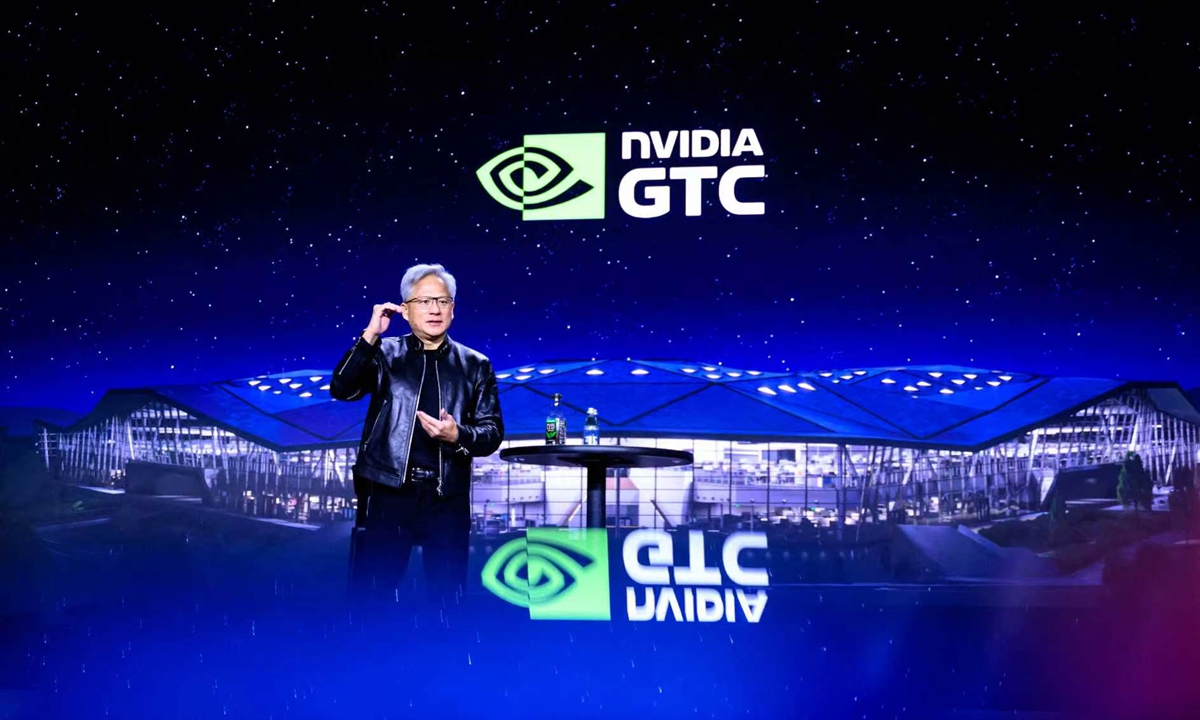
Nvidia CEO Jensen Huang Photo: VCG
The latest controversy surrounding Nvidia CEO Jensen Huang is still gaining traction against the backdrop where China's AI industry rapidly narrows the gap with the US. Washington's increasingly hysterical anti-China climate has fueled a new push for restrictions imposed in the name of national security, with the allegations surrounding Huang becoming fresh ammunition for what Chinese experts described as a witch hunt targeting people of Chinese descent.
China on Thursday urged the US to stop fabricating espionage narratives to justify its technological blockade, as a Chinese Foreign Ministry spokesperson was asked whether the controversy surrounding Nvidia CEO Jensen Huang could affect a meeting between the leaders of China and the US expected next week, and how China would respond if Washington further tightens technology export restrictions on China.
"We have already made our position clear on the so-called Chinese espionage narrative," Foreign Ministry spokesperson Mao Ning said. China and the US remain in close communication regarding interactions between the two countries' leaders, Mao said, adding that China stands ready to work with the US to implement the important consensus reached by the two presidents and advance a constructive China-US relationship of strategic stability based on respect, fairness and reciprocity.
Media reports said Nvidia's board was considering Huang's future at the company on Thursday. The Wall Street Journal reported that the board was preparing to remove him, while Reuters, citing a person familiar with the matter, reported that the board was meeting to decide whether to oust the longtime CEO.
Yet the controversy is already having consequences beyond Nvidia's boardroom. US lawmakers are seeking to use the episode to build support for a series of measures targeting China's semiconductor industry, including chip-tracking requirements, greater congressional oversight of advanced chip export licenses and coordinated restrictions with US allies on semiconductor manufacturing equipment exports to China.
Reuters reported on November 9 that three measures were being considered for inclusion in the fiscal 2027 National Defense Authorization Act (NDAA): the AI Overwatch Act, which would give Congress greater authority over advanced-chip exports; the Chip Security Act, which would require companies to track chips to deter smuggling; and the Multilateral Alignment of Technology Controls on Hardware (MATCH) Act, which seeks to push US allies to impose tighter restrictions on semiconductor manufacturing equipment exports to China.
The controversy surrounding Huang has given these proposals fresh momentum. Republican Senator Jim Banks said on Wednesday local time that the scandal was helping revive the bills, with the Chip Security Act and AI Overwatch Act particularly likely to be included in the broader defense package, citing congressional and industry sources.
Previously, US restrictions on semiconductor exports to China were largely implemented by the Commerce Department through its administrative authority, including revisions to the Export Administration Regulations (EAR) and related control lists. Embedding additional restrictions in legislation, however, could make them more difficult to reverse, Ma Jihua, a veteran telecom industry analyst, told the Global Times.
"If chip tracking, coordinated controls with allies and congressional oversight of licensing are written into law, the authority and discretion over these restrictions will shift more toward Congress," Ma said. This would make future adjustments or relaxation considerably more difficult, potentially creating lasting obstacles to easing China-US tensions over technology, he noted.
Shen Yi, director of the International Research Institute of Global Cyberspace Governance at Fudan University, said the controversy should be viewed against the backdrop of an increasingly hostile political atmosphere toward China in Washington, where ethnic identity and commercial connections with China can be used to fuel suspicions of espionage.
The underlying US concern, Shen said, is that China's rapid progress in artificial intelligence is narrowing the technological gap with the US. Under the banner of national security, Washington has progressively expanded its restrictions: first limiting China's access to advanced chips, then restricting access to chipmaking equipment, and now seeking to monitor the computing power and overseas circulation of US-made chips.
The WSJ editorial board took an even more pointed stance on the controversy in an opinion piece titled "Nvidia Gets a Chinese Honeypot Lesson."
"Nvidia's friends in Washington are shrugging off CEO Jensen Huang's affair with a suspected Chinese spy. Regrettable, they say, but men will be men. Well, not so fast," the editorial began, portraying the episode as a serious warning that China was seeking to penetrate the upper echelons of American business to gain an advantage in artificial intelligence.
Shen, however, said the logic behind the Chinese spy allegation rested on just three fragmented clues: that the woman involved was Chinese, that she did business in China, and that her business partners included Chinese local governments.
The proposed restrictions could also undermine the commercial interests of US technology companies, particularly Nvidia, whose business model depends on maintaining its technological advantage and access to global markets.
Shen said that if legislation requiring chip-tracking mechanisms and expanded oversight were enacted and implemented, Chinese companies could reasonably question whether Nvidia chips carried monitoring functions or potential backdoors. Concerns over data security could lead Chinese businesses to avoid using the products.
"The interests of the US government and American technology companies are fundamentally aligned when it comes to maintaining the country's long-term technological dominance, but they can conflict with the short-term political interests of US politicians," Shen stressed.
Driven by domestic political maneuvering, US politicians have opted for increasingly aggressive containment measures, mistakenly believing that a hardline approach can force China to compromise. The result could be the opposite, he said.
In this contest, only politicians advocating a hardline approach toward China can gain political leverage at home, while other stakeholders, including US technology companies and the broader business community, are left to bear the costs, Shen said.
"When they want to hang a man, any rope will do," experts noted.
RELATED ARTICLES