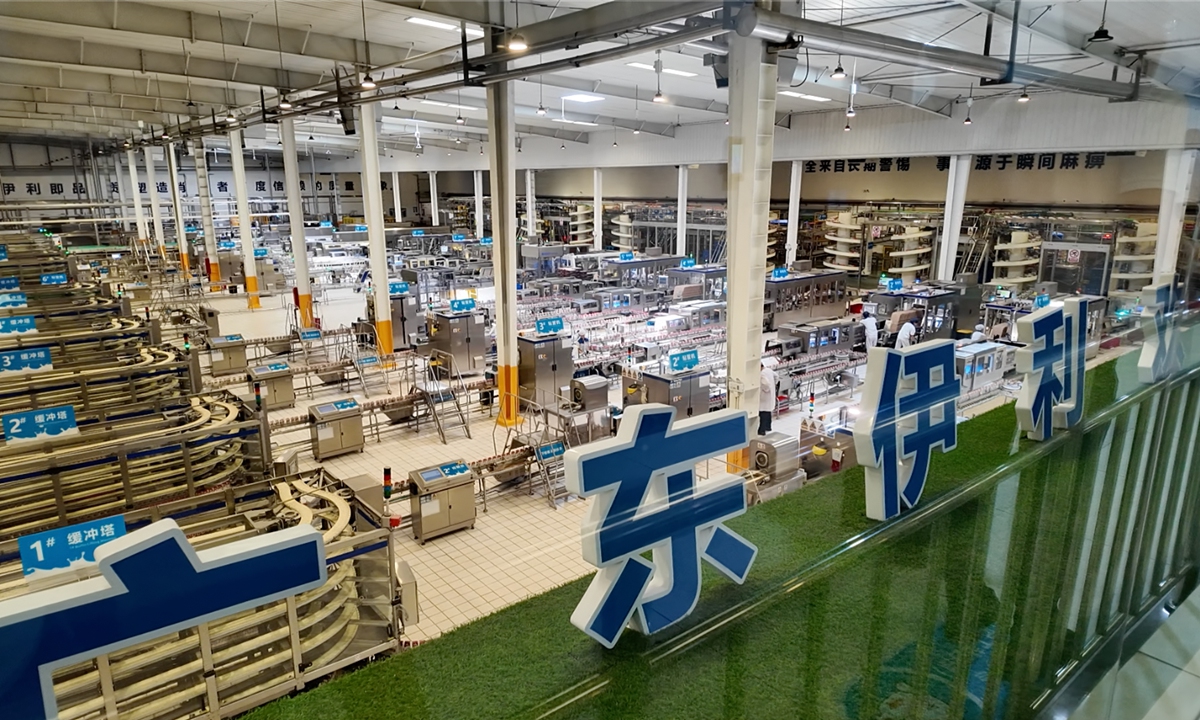
The workshop at Yili's plant in Huizhou, South China's Guangdong Province (Photo: Yu Jiayin/GT)
At Guangdong Yili's plant in Huizhou, South China's Guangdong Province, glass corridors overlook a workshop where pipes run overhead, cartons move along conveyors and robotic arms stack cases. On November 7, Chinese and foreign journalists visited the plant as part of a media reporting tour under the 2026 Belt and Road Media Cooperation Forum, following the route from raw milk to finished carton.
Guangdong Yili was registered in 2011 and commissioned in February 2013. The plant was built with a total investment of 1.241 billion yuan (about $175 million), occupies about 13.5 hectares and is Yili's only integrated production base for liquid milk and yoghurt in South China.
In 2025, the plant generated 1.664 billion yuan (about $234 million) in output value and paid 59 million yuan (about $8.3 million) in tax. It has 28 production lines and produces 1,500 tons of milk beverages and 500 tons of chilled yoghurt a day. The company says the plant has been designated a national-level smart factory and a national-level green factory.
The tour began at the central laboratory on the ground floor; a second laboratory nearby tests raw milk and other raw materials. From there, visitors viewed the workshop, pretreatment, filling and packaging stages before reaching a product display and tasting area.
Yili operates two laboratories in each of its plants nationwide. One examines raw milk and other raw and auxiliary materials; the other tests partly processed and finished products. The company says more than 1,000 checks are carried out across the production process, exceeding national testing requirements, and that products undergo final quality checks before leaving the plant.
Guangdong Yili works with seven partner farms that supply nearly 300 tons of milk a day from neighboring provinces. The company said its quality control also covers feed, breeding and herd management.
The plant applies three levels of standards: the national standard, an enterprise standard set 50 percent higher, and an internal control line set a further 20 percent higher. Yili says the standards are backed by a separate three-tier food safety risk monitoring and prevention system.
From the visitor corridor on the second floor, reporters watched as pipes carried milk overhead and cartons moved down the line in sequence, with few workers in sight. Pretreatment includes homogenisation and ultra-high-temperature (UHT) treatment. Homogenisation breaks large fat globules into finer particles and disperses them through the milk. During UHT treatment, milk under pressure passes through an inner pipe while steam heats the outer pipe, reaching 137°C for just four seconds — destroying bacteria and heat-resistant spores while preserving nutrients as far as possible.
At the filling stage, equipment completes aseptic filling, sealing, cutting and forming at up to 24,000 packs an hour. Each carton contains six layers of paper, aluminium foil and plastic, which help seal out air, heat and light. Products are then grouped, packed into cases, coded and palletised by robotic arms before being shipped across South China.
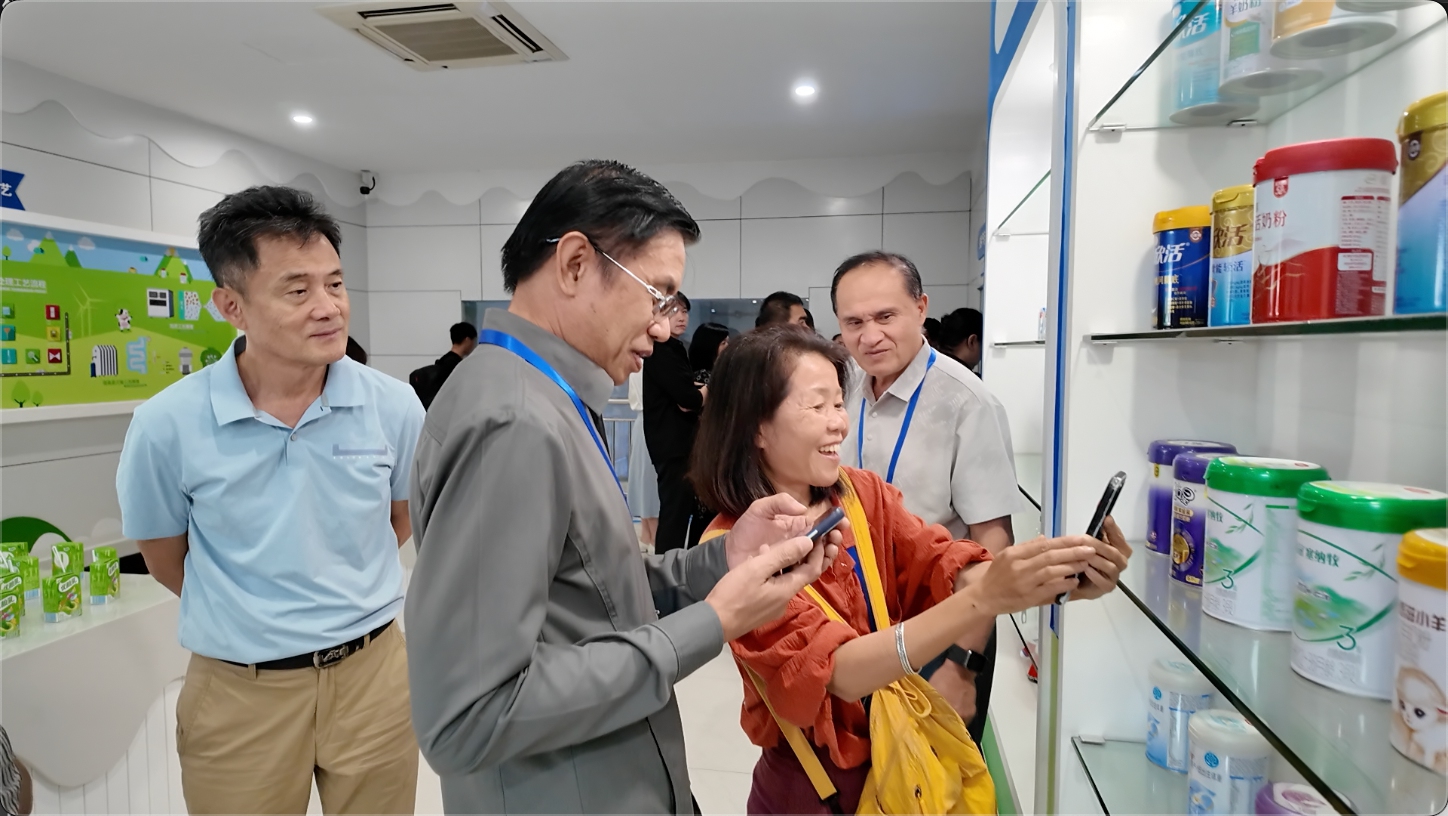
Foreign journalists view products at the factory (Photo: Yu Jiayin/GT)
Lyd Luna, managing editor of the Philippines' Manila Times, said the plant's use of technology stood out. "The efficiency rate is higher, the health risk is lower, there is less contamination for the product itself, plus it gets distributed faster to consumers who want it," Luna said.
Abrão de Jesus, general manager of Timor-Leste's Timor Post, said, "We don't have facilities like this back in my country. That's why this is such an eye-opening experience. We can learn a lot from what we have seen here."
"When I go back to the Philippines, I'm sure to look for this product in our groceries," Luna said.
