BRASIL 247 / MORE
Instituto Sul Global and Hebei Normal University sign agreement to expand Brazil-China cooperation
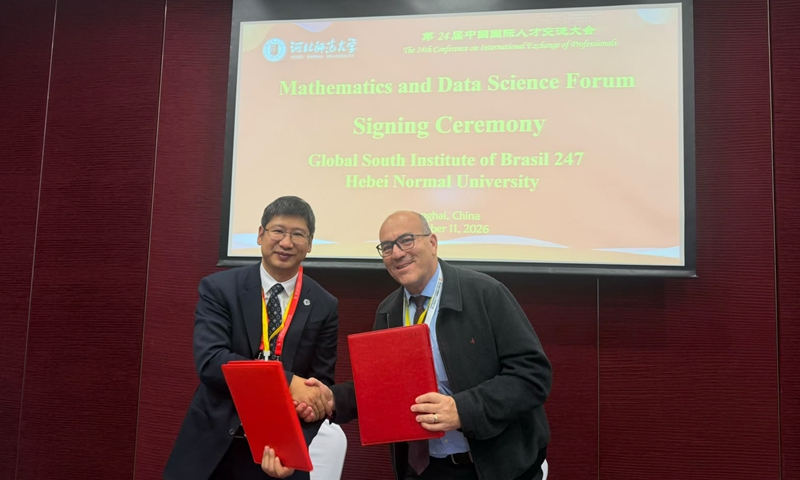
Photo: Courtesy of Brasil 247
Instituto Sul Global and Hebei Normal University signed a memorandum of understanding on November 11 in Shanghai to strengthen academic cooperation and intellectual exchange between Brazil and China. The agreement established an agenda focused on international relations, South-South cooperation, global governance and the development challenges facing countries of the Global South.
The partnership was formalised by journalist Leonardo Attuch, founding president of Instituto Sul Global and founder of Brasil 247, and Li Guijun, president of the Chinese university, during the 24th International Exchange Conference for Professionals. The document paved the way for joint research and publications, meetings in Brazil and China, and exchanges involving professors, researchers and students.
Attuch stressed that the signing was a great honour for the newly established Instituto Sul Global. He also expressed the expectation of organising joint meetings in both countries, bringing the Brazilian and Chinese academic communities closer together and expanding the circulation of knowledge on the challenges shared by the Global South.
The understanding recognised the importance of strengthening academic ties between Brazil and China and reaffirmed the commitment of both institutions to research, education and international dialogue.
International relations and South-South cooperation
The memorandum established a framework for cooperation in academic research, policy studies, international relations and the dissemination of knowledge related to the Global South.
The planned topics include China's development experience, South-South cooperation and global governance. The proposal is to foster studies and debates that help make sense of international transformations and share development experiences among countries.
The agreement also covered the exchange of academic studies, scientific articles and reports, as well as research and publications on matters of mutual interest.
For Instituto Sul Global, closer ties with the Chinese university represent a step towards building an international network for the production and dissemination of knowledge. The partnership created conditions to connect researchers, promote debates and bring academic reflection closer to the Brazilian public.
Joint meetings in Brazil and China
One of the expectations presented by Attuch was to turn the agreement into a programme of meetings in Brazil and China. Seminars, conferences, lectures, webinars and academic forums are among the activities provided for in the document.
These meetings may bring together researchers and representatives of institutions from both countries to discuss international issues, share study findings and develop joint projects.
The combination of in-person and digital activities will also make it possible to broaden the participation of students and academics, creating channels for dialogue that can operate on an ongoing basis.
The Institute expressed its intention to build a lasting relationship with Hebei Normal University, through initiatives that continue the rapprochement established in Shanghai. Specific projects will be defined jointly, according to the priorities and possibilities of both institutions.
Exchange and dissemination of knowledge
The memorandum also provided for exchanges involving professors, researchers, students and visiting scholars. The proposal opened space for the institutions to explore opportunities for training, scientific collaboration and contact between their academic communities.
Another area covered was the dissemination of work. Studies, reports and academic materials shared under the partnership may be disseminated by Instituto Sul Global and Brasil 247, expanding their reach among Portuguese-speaking audiences.
This dimension will make it possible to bring part of the knowledge produced and shared by the institutions into Brazil's public debate. Research on international relations, development and South-South cooperation may reach readers beyond university settings.
Dissemination may also introduce researchers and their lines of inquiry, encourage interest in international studies and give visibility to activities carried out through the partnership.
Mathematics as one of the university's strengths
In addition to the agenda on international relations and South-South cooperation, the signing opened an opportunity to explore dialogue in Hebei Normal University's areas of excellence. These include mathematics, one of the Chinese institution's academic strengths.
Attuch expressed the expectation that this closer relationship will also help encourage the study of advanced mathematics in Brazil. The aim is to promote contact between Brazilian researchers and students and international experiences, and to explore possibilities for scientific collaboration.
The university led the Mathematics and Data Science Forum, a mathematics and data science forum held as part of the conference in Shanghai. The event provided an opportunity to learn about its research experience and network of international partnerships.
Although the memorandum focuses on academic cooperation related to the Global South, future initiatives in mathematics and interdisciplinary sciences may be discussed by the institutions and developed through work plans or supplementary agreements.
Li Guijun presented scientific cooperation results
In his address at the conference, President Li Guijun highlighted the work of the Hebei International Joint Research Center for Mathematics and Interdisciplinary Sciences and presented the results of the university's research internationalisation.
According to him, over the past five years, 12 national and provincial projects involving foreign specialists in mathematics have been developed. Over the same period, more than 70 articles were published through international co-authorship.
The president also mentioned long-term partnerships with universities and institutions in Italy, Romania, Hungary, Russia and Spain, among other countries, as well as a training programme supported by the China Scholarship Council.
In presenting the academic structure, Li Guijun said that the mathematics department had seven full professors and 12 visiting professors. He expressed interest in welcoming more international researchers for collaborative activities.
Another highlight was the first Hebei International Conference on Dynamical Systems, held in October. According to the president, the event brought together more than one hundred researchers from different countries.
Li Guijun advocated expanding exchange channels and presented the goal of consolidating a reference centre for mathematical research. At the end of his remarks, he invited Chinese and foreign researchers to collaborate with the university.
A milestone for new initiatives
Drafted in Chinese, Portuguese and English, the memorandum entered into force with the signatures of both parties. The document expressed an intention to cooperate in good faith, without establishing legally binding financial or contractual obligations. Specific projects and activities may be implemented through separate agreements or joint work plans.
For Attuch, the importance of the signing lay both in the honour of establishing the partnership and in the work possibilities it opened up. Holding meetings in Brazil and China, producing research on international relations and South-South cooperation, and drawing on the university's academic strengths make up the horizon of this closer relationship.
With the agreement signed in Shanghai, Instituto Sul Global and Hebei Normal University established a foundation for expanding intellectual exchange between the two countries and developing a shared agenda of research, training and dialogue.
(Reported by Brasil 247 on November 12, 2026)
