BRASIL 247 / MORE
Instituto Sul Global and Shanghai Academy sign agreement to strengthen Brazil-China academic cooperation
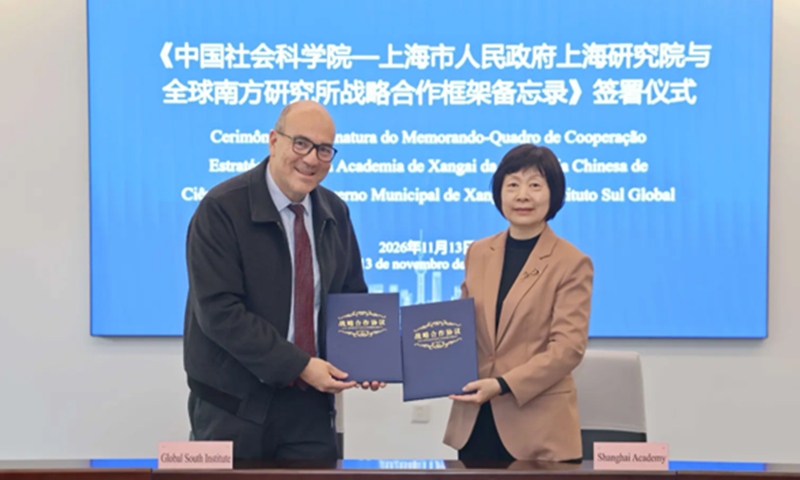
Photo: Courtesy of Brasil 247
Instituto Sul Global and Shanghai Academy signed a cooperation agreement in Shanghai on November 13 to promote joint research, international academic events and exchanges between Brazilian and Chinese scholars. The agreement was signed by Leonardo Attuch, president of Instituto Sul Global, and Wang Xiaoxia, executive vice president of Shanghai Academy, a prominent Chinese think tank affiliated with the Chinese Academy of Social Sciences (CASS).
According to Brasil 247, the agreement establishes a framework for long-term academic cooperation between the newly established Brazilian institute and a Chinese institution specializing in research on development, public administration and economic modernization.
Shanghai Academy operates at Shanghai University, which has approximately 40,000 students. Its research priorities include Chinese modernization, regional integration, governance in major cities and the development of an open economy.
At the signing ceremony, Wang emphasized that Brazil and China maintain a close partnership despite their geographical distance and that both peoples value friendship. She recently visited Brazil, where she was received by a delegation from Instituto Sul Global.
Attuch thanked Shanghai Academy for its confidence and described the agreement as the beginning of a long-term friendship between the institutions. Both sides intend to establish a permanent agenda of intellectual and academic cooperation to strengthen mutual understanding.
Joint research and academic exchanges
The agreement identifies five main areas of cooperation.
The first involves joint research projects, allowing the institutions to identify shared academic interests and bring together researchers from both countries.
The second focuses on jointly organizing international academic conferences and symposiums, as well as encouraging participation in events hosted by either institution.
The partnership also provides for reciprocal invitations to researchers to deliver lectures and participate in academic discussions.
Another area covers the development of short-term and long-term academic programs. The fifth allows additional academic activities to be undertaken by mutual agreement.
The institutions will negotiate the specific conditions for implementing each project or program and formalize them through supplementary written agreements.
The arrangement establishes an institutional framework for continued cooperation, while leaving the details of individual initiatives to be determined jointly.
Shanghai Academy's role in research and public policy
Shanghai Academy was established on June 5, 2015, through an agreement between the Chinese Academy of Social Sciences and the Shanghai municipal government.
According to its institutional presentation, the academy was designed as a comprehensive think tank combining the research capabilities of CASS with the practical experience of government institutions.
Its activities connect academic research with public policy challenges, particularly those related to Shanghai's development and China's broader economic and social transformation.
The academy concentrates on four strategic areas: Chinese modernization, integrated development of the Yangtze River Delta, social governance in megacities and the development of an open economy.
These research priorities cover economic, social, territorial and administrative issues, offering opportunities for comparative studies involving Brazil.
In addition to strategic research and policy recommendations, Shanghai Academy contributes to academic training, disciplinary development and international exchanges.
Cooperation on development challenges
The partnership will give Instituto Sul Global access to academic exchanges with researchers studying China's economic and social transformation.
It will also create opportunities for Brazilian scholars to share research findings, experiences and policy discussions with Chinese counterparts.
Potential areas of cooperation include economic planning, regional integration and urban governance.
Although Brazil and China have different historical and institutional backgrounds, researchers from both countries may examine development challenges through comparative studies and exchanges of knowledge.
The institutions intend to identify topics of common interest and develop projects that reflect their respective research priorities.
Specific research initiatives will be established through consultations between the two organizations.
Strengthening ties between Brazil, China and the Global South
For Instituto Sul Global, the agreement represents a step toward building an international network connecting research centers, universities and intellectuals, with particular attention to South-South cooperation.
The partnership also builds on ties with China developed by Brasil 247 and TV 247, extending those relationships into academic research and institutional exchanges.
The agreement provides a formal basis for expanding cooperation between the Brazilian institute and Shanghai Academy.
Wang's recent visit to Brazil and Attuch's participation in the signing ceremony in Shanghai reflect the institutional contacts that preceded the agreement.
The next stage will involve defining specific research projects, academic programs and international events under the cooperation framework established by both institutions.
(Reported by Brasil 247 on November 13, 2026)
