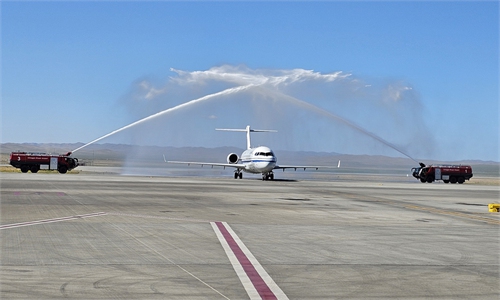
China-developed world's largest unmanned cargo aircraft W5000 completes test flight in Inner Mongolia
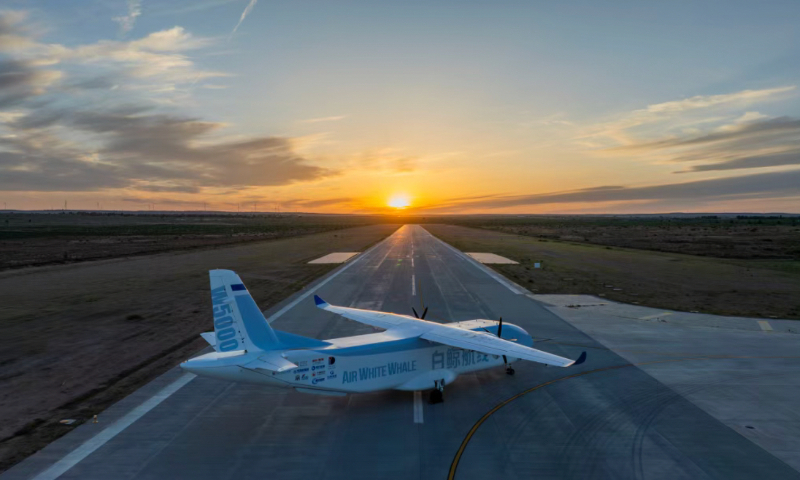
Unmanned cargo aircraft W5000 completes a technical verification flight at Otog Front Banner Oljoq Airport, North China's Inner Mongolia Autonomous Region, on November 14, 2026 Photo: Air White Whale
The world's largest unmanned cargo aircraft, the W5000, developed and manufactured by Chinese aviation technology company Air White Whale, completed a technical verification flight on Saturday at an airport in North China's Inner Mongolia Autonomous Region, the company announced.
The W5000 has a maximum payload of five tons, a maximum range of 2,600 kilometers and a usable cargo compartment volume of more than 65 cubic meters. All its 220,000 components are domestically produced. It is powered by a domestically developed turboprop engine, while domestically produced carbon-fiber composite materials make up 65 percent of its airframe, according to information released by the company.
Hu Zhendong, founder, chairperson and CEO of Air White Whale, told the Science and Technology Daily that the composite-material airframe reduces the aircraft's weight while maintaining structural strength, allowing a greater proportion of its takeoff weight to be allocated to cargo. He also said that key systems, including the aircraft's overall design, flight control and avionics, propulsion system and composite-material airframe, are the results of independent domestic development and production.
The 220,000 components are sourced from different manufacturers, making it a major challenge to ensure compatibility while meeting uniform aviation reliability standards, Song Zhongping, a researcher at the Xwon (Hong Kong) Technology Exchange Center, told the Global Times on Sunday.
"The test flight primarily verified the basic flight and coordination capabilities of systems including the domestically produced propulsion, flight control, avionics and data-link systems, as well as the composite-material airframe," said Song.
The aircraft took off on Saturday morning at Otog Front Banner Oljoq Airport after accelerating along the runway for about 600 meters, climbing to an altitude of 2,000 meters. During the 30-minute flight, it completed key test items, including autonomous flight and data-link communications, before landing smoothly.
The flight was designed to verify coordination among the aircraft's propulsion system, flight controls and ground-based measurement and control system, China Media Group (CMG) reported.
The aircraft is designed to operate under an "autonomous flight plus ground monitoring" model. Its targeted applications include regional and interregional logistics, cold-chain transportation and the delivery of emergency supplies, the Science and Technology Daily reported.
The aircraft's logistics cost per ton-kilometer could be more than 60 percent lower than that of comparable conventional piloted cargo aircraft, Hu said. He attributed the cost gap to its unmanned operating model, which eliminates the need for flight crews and related cockpit equipment, while the lighter airframe also helps reduce fuel consumption.
The company has received 835 letters of intent for orders, with prospective customers including several domestic logistics companies. The company expects the aircraft to enter commercial service by the end of 2027, according to the CMG report.
Song said that large unmanned cargo aircraft such as the W5000 could add air freight capacity to China's low-altitude economy and support the development of related domestic industrial supply chains. In international air logistics, a five-ton class unmanned cargo aircraft could offer an additional option for some medium-distance, low-frequency cross-border freight routes. he said.
RELATED ARTICLES