US deploys F-15EX fighters to Japan for first overseas deployment; patch measure falls short of generational leap: Chinese expert
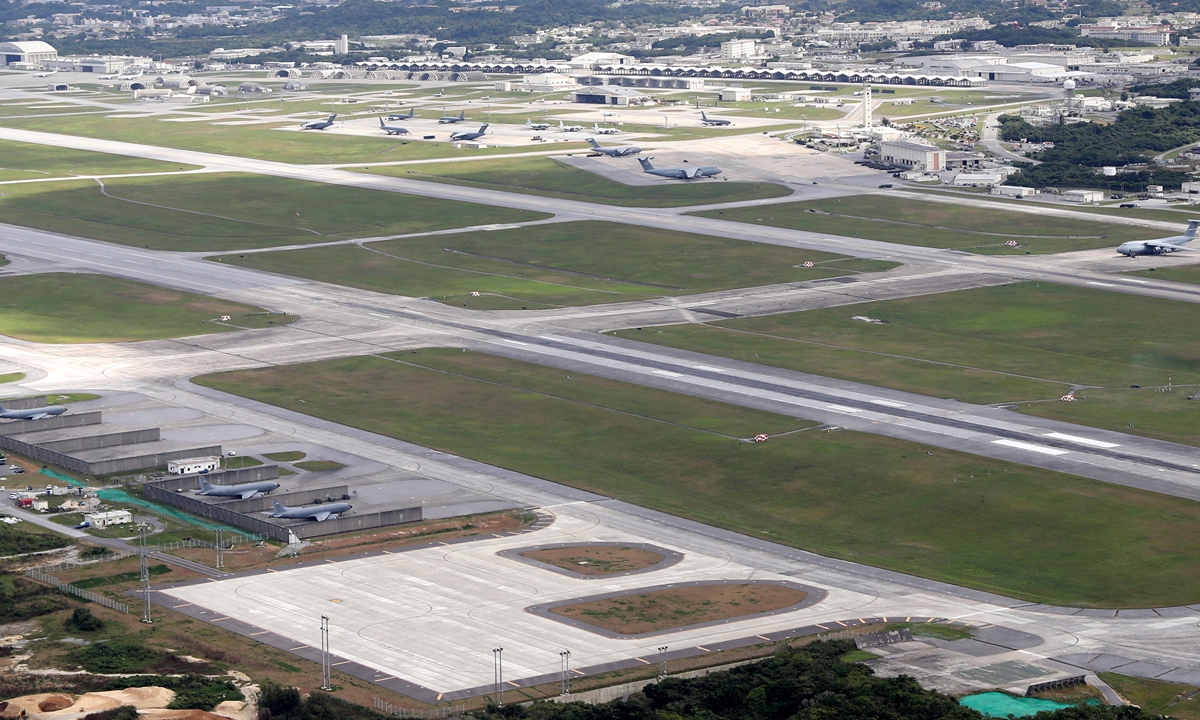
Aerial view of the US Kadena air base in Kadena, Okinawa prefecture, southern Japan, on February 25, 2022. File Photo: VCG
The US deployed its F-15EX fighter jets overseas for the first time Sunday, sending them to Japan in a move aimed at strengthening its airpower in the so-called Indo-Pacific region. However, the deployment represents more a patch measure for existing aging capabilities than a generational leap in airpower, a Chinese military expert said.
New F-15EX fighter jets arrived at the US Air Force's Kadena Air Base in Okinawa Prefecture for permanent assignment on Sunday. Kadena is the first US Air Force overseas base to receive F-15EX fighters equipped with advanced electronic warfare systems, the Japan Times reported, citing the Kadena-based 18th Wing.
The F-15EX brings advanced avionics, modernized electronic warfare systems and increased weapons-carrying capacity to Kadena's fighter mission. Its arrival marks a new phase in replacing the base's F-15C/D fleet, whose phased withdrawal began in November 2022 after more than four decades of service, the 18th Wing Public Affairs claimed.
"The arrival of the F-15EX at Kadena marks a significant milestone for American airpower in the Pacific," said Brig. Gen. John Gallemore, 18th Wing commander. He claimed that the deployment would strengthen deterrence and reaffirm Washington's commitment to the US-Japan alliance.
However, the replacement effort is driven largely by practical considerations, as the combat performance of aging aircraft has deteriorated and their remaining service life has shortened, Song Zhongping, a Chinese military affairs expert, told the Global Times on Monday.
While the F-15EX has received substantial avionics and electronic warfare upgrades, it remains a retrofitted variant of the F-15 series rather than a new aircraft, not to mention a stealth fighter. Moreover, deploying a limited number of aircraft does not necessarily translate into a sustained combat capability at sufficient scale, Song said.
"The F-15EX's modern upgrades do boost US air combat capabilities in the so-called Indo-Pacific region, but this enhancement largely only patches up existing aging combat power rather than deliver a generational technological leap," Song added.
More importantly, modern warfare is no longer simply a matter of fighter jets engaging one another but, rather, a contest of integrated military systems, Song said.
Song further analyzed that Washington's choice of Japan as a key hub for strengthening its so-called Indo-Pacific military posture reflects its intention to expand its forward military presence and further consolidate the US-Japan military alliance. However, the growing concentration of US military assets near China risks increasing the possibility of strategic miscalculations and accidental clashes, undermining regional peace and stability, Song warned.
The US is attempting to turn the Asia-Pacific into a "powder keg" and turn certain countries into "cannon fodder," seriously undermining the security and well-being of people in regional countries, Chinese Defense Ministry spokesperson Zhang Xiaogang said at a press conference in May, 2025, in response to the US defense secretary's push for its national defense strategy and his claim on deterring China in the so-called Indo-Pacific region.
"We urge relevant countries not to invite troubles and become others' pawns, which would undermine the hard-won peace and stability in the region," Zhang added.
RELATED ARTICLES