China’s economy generally stable in October, powered by innovation, industrial upgrading
Official urges more ‘objective’ view toward monthly fluctuations
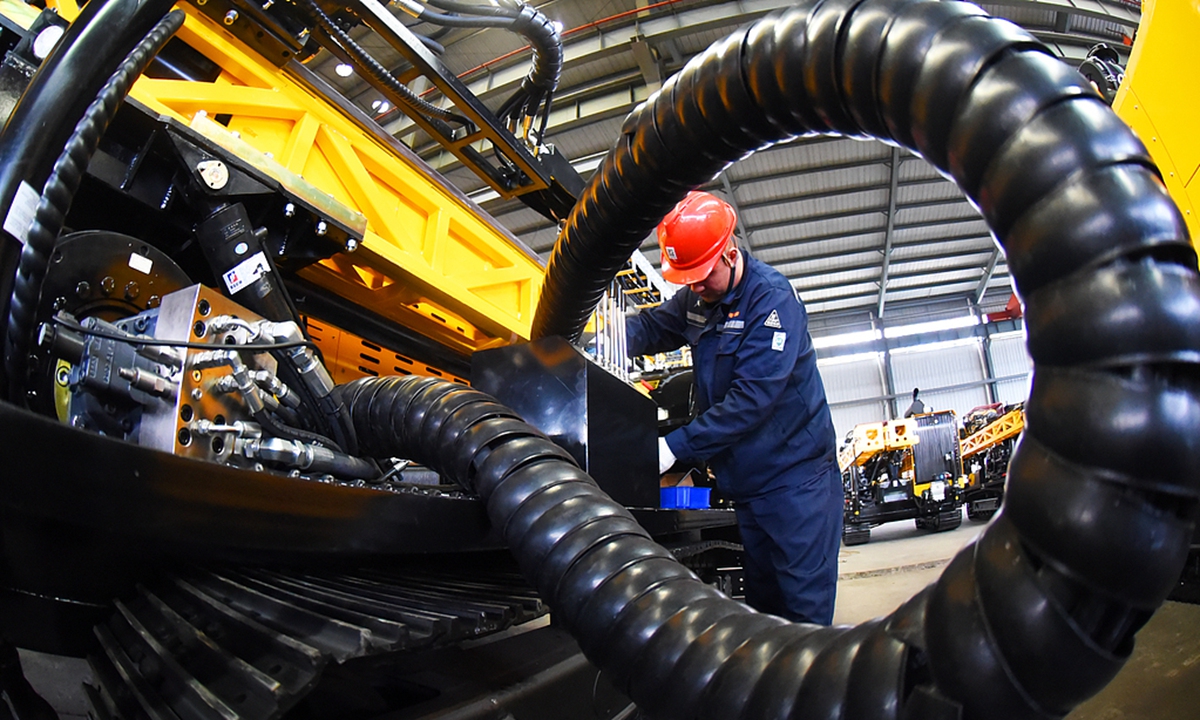
A worker assembles a batch of hydraulic exploration drilling rigs at a workshop in Lianyungang, East China's Jiangsu Province, on November 16, 2026. Photo: VCG
China's economy remained broadly stable in October, with new growth drivers continuing to gain momentum and the economic structure improving further, according to a National Bureau of Statistics (NBS) statement. Chinese experts said that the country's economic performance has remained stable this year amid a transition to tech-driven growth and robust trade, signaling that the country is on track to achieve its growth target this year.
In October, the value added of China's industrial enterprises above the designated size increased 4.8 percent year-on-year, extending steady industrial expansion, according to figures released by the NBS on Monday.
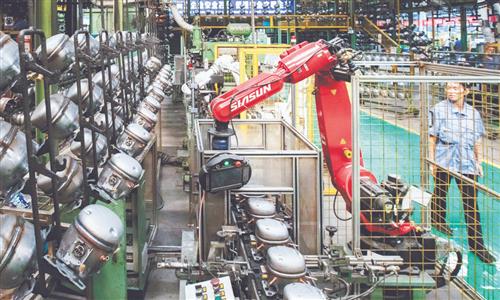
Within the industrial sector, value added in equipment manufacturing rose 10.6 percent year-on-year, while that in high-tech manufacturing increased 17.6 percent. Output of 3D printing equipment rose 85.9 percent, while production of lithium-ion batteries grew 30 percent and industrial robot output increased 26 percent.
From January to October, industrial value added grew 5.3 percent year-on-year, with 28 of the 41 major industrial categories recording growth, NBS data showed.
China's economy in October remained stable overall and extended a trend of renewing growth engines and an improving structure, an NBS spokesperson told a press briefing on Monday.
NBS spokesperson Fu Linghui said that data showed that technological innovation and industrial innovation were deepening their integration, with new technologies, new industries, new business models and new products all showing positive momentum.
Foreign trade provided another bright spot. In October, total goods trade stood at 4.86 trillion yuan ($729.94 billion), up 31.2 percent year-on-year. Trade with Belt and Road partner countries grew 18.5 percent, while exports of mechanical and electrical products rose 25.2 percent, NBS data showed.
In the statement, the NBS also highlighted challenges faced by the economy, including an uncertain global environment, imbalances between supply and demand, and difficulties in some businesses' operations.
From January to October, total retail sales of consumer goods reached 41.65 trillion yuan, up 1.0 percent year-on-year. In October alone, total retail sales of consumer goods rose 0.4 percent year-on-year, according to the NBS data.
In October, investment in fixed assets (excluding rural households) dropped by 2.93 percent month-on-month. In the first 10 months, that figure reached 3.64 trillion yuan, down 8.1 percent year-on-year. Investment in fixed assets was down by 5.1 percent, excluding real estate development.
Some foreign media outlets highlighted the slower pace of October retail sales and the weakness in investment, claiming that China's growth momentum is "losing steam." But NBS spokesperson Wang Guanhua called for a more objective and balanced view, saying that monthly fluctuations are normal and should be understood in light of seasonal patterns, holiday timing and a high comparison base from last year.
Affected by factors such as the inherent operating characteristics of the economy, seasonal factors, holiday arrangements, and the year-earlier base of comparison, fluctuations in monthly indicators are a fairly common phenomenon in economic performance, Wang noted.
"Economic development does face difficulties and challenges, but favorable conditions and unique strengths supporting high-quality growth are also being consolidated and expanded," Wang said, stressing that China's economy has maintained an overall stable trajectory even amid a complex external environment.
Experts pushed back against the pessimistic narrative. They said that the strongest feature of China's economy is the rising force of new growth drivers, supported by industrial upgrading, technological innovation and export competitiveness.
"China's industrial transformation led by new quality productive forces and emerging industries is widely recognized, and robust trade data is consistent with this structural shift," Tian Yun, a veteran economist based in Beijing, told the Global Times on Monday.
According to Tian, figures for the single month of October are unlikely to alter the overall growth trajectory for the year.
"We continue to project that annual GDP growth will remain above 4.5 percent," according to Tian.
China has in recent months unveiled fresh support, including fiscal and monetary measures to strengthen domestic demand, introducing central government subsidies for eligible mortgages while expanding targeted funding for infrastructure, technological innovation and small businesses.
Earlier this month, authorities announced various measures, from conducting swap operations to upgrading a lending facility for stock buybacks by listed companies, as part of efforts to stabilize capital markets.
"As we are getting close to the end of the year, I do expect the macro policy measures and stimulus package will inject more vitality into the economy," Li Chang'an, a professor at the School of Public Administration at the University of International Business and Economics, told the Global Times on Monday.
"There is huge potential for consumption, but people's capacity and willingness to spend need to be enhanced," Li added.
RELATED ARTICLES