Several Chinese chipmakers post upbeat Q3 earnings as homegrown computing push gains momentum
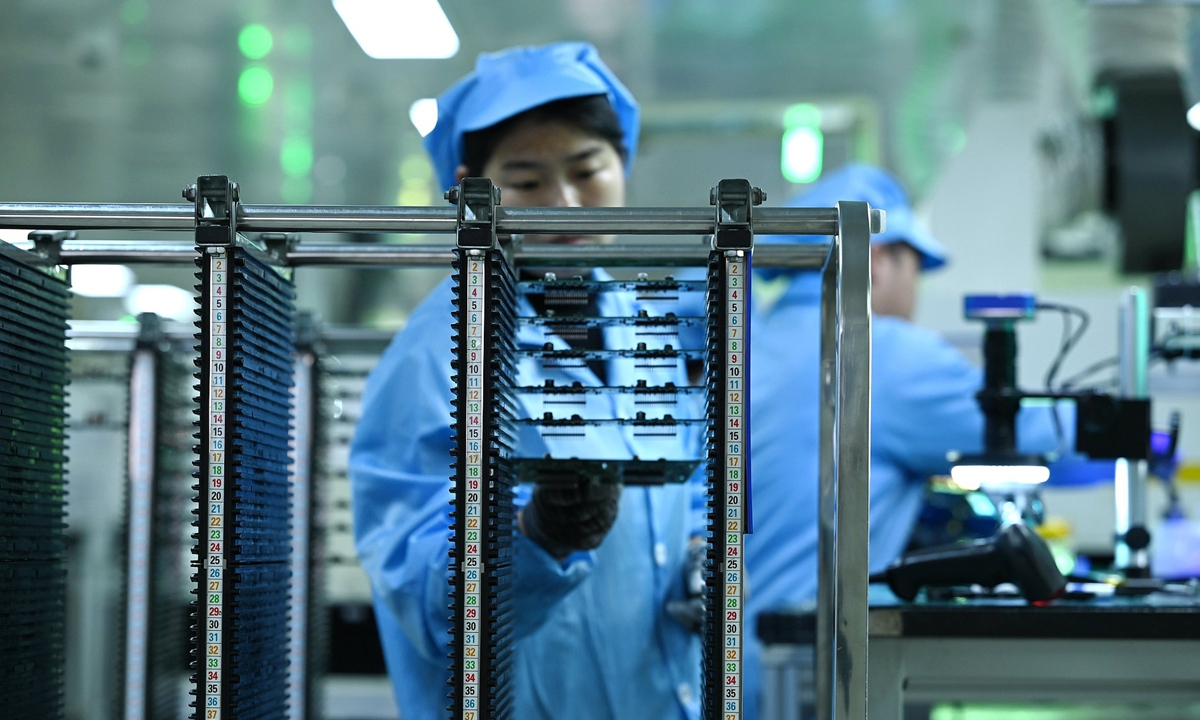
A technician conducts chip quality inspections in a factory in Yiwu, East China's Zhejiang Province, in March 2026. Photo: VCG
China's leading artificial intelligence (AI) and memory chipmakers have reported a string of strong third-quarter results, underscoring how surging demand for computing power and tighter US export controls are accelerating the country's drive toward greater semiconductor self-sufficiency.
As geopolitical uncertainty is driving users toward Chinese chips and developers are now shifting their focus to compatibility layers for domestic alternatives, industry analysts said on Wednesday that the latest earnings and shipment data suggest China's semiconductor sector is moving beyond merely accelerating import substitution and increasing autonomy across the industrial chain, toward a more system-level form of competition.
China's leading memory chipmaker ChangXin Memory Technologies (CXMT) reported 118.71 billion yuan ($17.80 billion) in revenue for the third quarter of 2026, marking a 19 percent quarter-on-quarter increase and a massive 613.2 percent year-on-year surge. President and CEO Cao Kanyu said at the company's third-quarter earnings briefing on Tuesday that the increase was driven by higher production capacity, faster ramp-up at its wafer fabs and stronger pricing in the dynamic random-access memory (DRAM) market amid a supply shortage since 2025.
According to Cao, the company's three 12-inch wafer fabs had seen steadily improving utilization, helping lower unit fixed costs, while process maturity and yield gains had reduced manufacturing costs further. He added that the company had signed long-term supply agreements with several major customers to secure medium- to long-term demand visibility.
Industry observers said that CXMT's performance reflects broader momentum across China's semiconductor supply chain, where demand expansion and domestic substitution are both supporting growth.
Market sentiment around domestic AI chips also improved after recent concerns over the Nvidia CEO's controversy. On Wednesday, shares linked to AI computing rose in early trading, with Huadong Heavy Machinery Co extending its rally to a fourth consecutive limit-up session. Other stocks including Moore Threads, Cambricon Technology, Hygon Information Technology, MetaX and Loongson Technology also gained.
The rally comes as Chinese chipmakers continue to post faster growth. MetaX said at an earnings call on Monday that it is focusing on providing GPU computing platforms for Chinese customers and strengthening local supply chain compatibility. The company reported revenue of 1.5 billion yuan for July-September, up 367 percent from a year earlier.
Meanwhile, Semiconductor Manufacturing International Corp's third-quarter revenue hit a record $3.19 billion, up 6.1 percent quarter-on-quarter. Moore Threads said its third-quarter revenue jumped 1,773.92 percent year-on-year to 1.55 billion yuan, a record high.
The gains come against a backdrop of explosive demand for AI computing. China's AI computing centers are being built out at a faster pace, and domestic chips are gaining traction in both training and inference workloads, said analysts at China Securities Co. The progression of AI applications from proof of concept to practical use in specific industries, together with exponential growth in annual recurring revenue from AI models and token volumes, is keeping the sector in a high-growth phase, they added, 21jingji.com reported.
According to a TrendForce forecast cited by Chinese media outlets on Wednesday, China's shipments of high-end AI chips are expected to reach 5 million units in 2026, up 83 percent from a year earlier.
A separate IDC report cited by Reuters showed Nvidia's share of China's data-center AI chip market fell to 34 percent in the first half of 2026, as US export controls constrained supply and domestic rivals led by Huawei gained ground. Nvidia shipped 678,000 AI accelerators in China in the January-to-June period, down 44 percent from a year earlier, while Huawei shipped 572,000 units, taking a 28 percent market share. Alibaba's chip-design unit T-Head held 7 percent, followed by Cambricon Technology with 5 percent, Baidu's Kunlunxin with 4 percent and Hygon Information Technology with 3 percent, according to the IDC report.
From a global perspective, the mismatch between supply and demand is creating room for domestic players to expand. In the first half of 2026, the global AI chip market was worth about 1.39 trillion yuan, up more than 80 percent year on year, according to a report by Dadao Times Think Tank. The US accounted for about 94 percent of supply, while China represented only 6 percent, despite being the world's second-largest AI chip market and accounting for an estimated 20 percent to 30 percent of demand.
"Competition was shifting from the performance of a single chip to system-level capabilities, including how well chips work in a larger computing cluster," Tian Feng, president of the Fast Think Institute and former dean of the Intelligence Industry Research Institute at SenseTime, told the Global Times on Wednesday.
Tian said the industry is moving from a phase focused on filling gaps caused by external restrictions to one centered on scaling, efficiency and ecosystem building, noting that the key battleground is no longer just whether domestic chips can replace foreign ones, but whether they can compete on cost performance, delivery capability and system efficiency.
That transition is already visible in China's rapidly expanding domestic AI infrastructure. In July, the fully domestic 100,000-card AI supercluster "Sugon 8000 (Dengfeng)" was officially launched and put into operation, using Chinese-designed chips, computing systems, storage and networking components. It marks the country's first AI supercluster capable of supporting over 100,000 domestically developed computing cards, said its developer Sugon Information Industry Co.
However, analysts caution that China's AI chip sector must overcome several major hurdles before it can achieve true autonomy. These include gaps between domestic and leading overseas solutions in top-end single-chip performance and software ecosystems, as well as the costs of adapting models, operators and scheduling systems when migrating across vendors. High-bandwidth memory, advanced packaging and manufacturing capacity also remain constraints on output and delivery speed.
Even so, Tian said the combination of rising AI demand, heavy R&D spending and policy support is pushing China's domestic chip industry into a new phase, one in which the focus is shifting from "replaceability" to industrialization, scale and commercialization.
RELATED ARTICLES